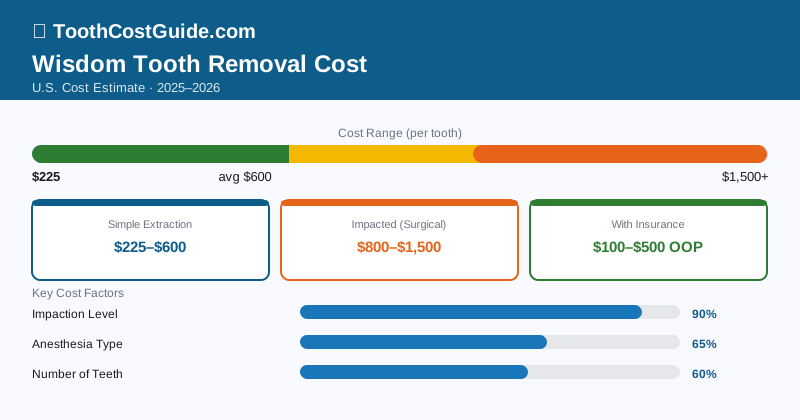
Wisdom tooth removal costs $225–$600 per tooth for a simple erupted extraction and $800–$1,500 per impacted tooth. Most people remove all four wisdom teeth at once, which brings the total to $1,000–$3,000 for all four depending on the complexity of each tooth’s position. With dental insurance that covers oral surgery, you’ll typically pay 20–50% of those costs.
The four third molars (wisdom teeth) are the last to emerge, usually between ages 17 and 25. Many don’t have room to erupt properly and become impacted — trapped below or partially through the gumline — increasing the complexity and cost of removal.
| Extraction Type | Cost Per Tooth (No Insurance) |
|---|---|
| Simple erupted extraction (office, local anesthesia) | $225–$400 |
| Soft tissue impaction | $300–$550 |
| Partial bony impaction | $400–$750 |
| Full bony impaction (most complex) | $600–$1,100 |
| All 4 wisdom teeth removed (mix of complexity) | $1,000–$3,000 |
| IV sedation (general anesthesia, add-on) | $400–$800 |
| Nitrous oxide sedation (add-on) | $50–$150 |
What Affects the Cost of Wisdom Tooth Removal
Impaction type and difficulty. The position of the tooth in the jawbone is the primary cost driver. A fully erupted wisdom tooth that needs simple extraction costs far less than a horizontally impacted tooth deep in bone. Oral surgeons classify impactions as soft tissue (tooth has erupted through bone but not gum), partial bony (tooth partially emerged from bone), or full bony (tooth completely encased in bone). Full bony removal requires cutting gum tissue, removing bone, and sectioning the tooth — a much longer procedure.
General dentist vs. oral surgeon. Many general dentists remove simple, erupted wisdom teeth. Impacted wisdom teeth — particularly full bony impactions — are typically referred to an oral and maxillofacial surgeon (OMFS). Oral surgeons charge more for their specialized training and equipment, but the complexity usually warrants the referral.
Anesthesia choice. Local anesthesia (numbing shots) is included in the base extraction fee. Nitrous oxide (laughing gas) adds $50–$150. IV sedation (going fully under) adds $400–$800 for the procedure, which is typically performed by the oral surgeon. Many patients opt for IV sedation when removing multiple impacted wisdom teeth at once.
Number of teeth removed. Removing all four at once is typically more cost-effective per tooth than removing them separately across multiple appointments. One office visit, one anesthesia fee, one recovery.
If you’re removing multiple wisdom teeth, do them all at once. The anesthesia setup fee, surgical preparation, and recovery are the same whether you remove one tooth or four. Doing them separately means paying that overhead multiple times.
Cost by Impaction Type
Soft tissue impaction ($300–$550): The tooth has broken through the bone but remains partially covered by gum tissue. The surgeon cuts and reflects the gum flap to expose the tooth, then extracts it. Moderate complexity.
Partial bony impaction ($400–$750): The tooth is partially encased in jawbone, requiring the surgeon to remove some bone to free the tooth. May also require sectioning the tooth into pieces to extract it safely.
Full bony impaction ($600–$1,100): The most complex and most common scenario for wisdom teeth. The tooth is completely below bone and gum, often horizontally oriented or angled toward the adjacent molar. The surgeon must cut through gum, remove significant bone, section the tooth, and carefully extract each piece to avoid damaging the adjacent second molar or inferior alveolar nerve.
Simple erupted wisdom tooth ($225–$400): The tooth has fully emerged and has a visible crown above the gumline. Extracted similarly to any other molar — forceps, controlled rocking motion, out. Takes 10–20 minutes per tooth.
With vs. Without Dental Insurance
Dental insurance typically covers wisdom tooth extraction under surgical benefits at 50–80% after deductible, depending on the complexity.
Typical coverage breakdown:
- Simple erupted extraction: Covered at 50–80% under basic surgical benefits
- Impacted extractions: Usually covered at 50–80% under major oral surgery
- IV sedation: Many plans cover anesthesia for impacted wisdom teeth; check your specific plan
- Annual maximum: Most plans cap at $1,000–$2,000, which may cover only 1–3 of 4 teeth in a complex case
Example for 4 moderately impacted wisdom teeth:
- Total fee without insurance: ~$2,400
- Insurance pays 50% after $100 deductible = $1,150
- Patient out-of-pocket: ~$1,250
- If plan has $1,000 annual max and patient has used none: Insurance pays $1,000 max, patient pays $1,400
Important: Some insurers have age limits. If you’re over 25, certain plans may classify routine (non-urgent) wisdom tooth removal differently. Check your plan documents.
How to Save Money on Wisdom Tooth Removal
Dental school oral surgery clinics. Accredited dental schools with oral surgery residency programs perform wisdom tooth extractions — including complex impactions — at 40–65% less than private oral surgery offices. Residents handle the procedures under attending oral surgeon supervision. Quality is well-monitored; these are licensed dentists doing graduate training.
Timing with insurance year. If you’re removing all four teeth and your annual maximum is $1,500, consider whether the total will exceed it. If so, remove two in December and two in January of the following year to access two years’ worth of benefits.
Opt for local anesthesia for simple cases. If one or two of your wisdom teeth are simple erupted extractions, local anesthesia alone works perfectly well and saves $400–$800 in IV sedation fees. Reserve IV sedation for when multiple complex impactions are being done simultaneously.
Compare oral surgery practice prices. Oral surgery fees vary by 20–35% even within the same metro area. Call two or three offices and give them the impaction classification from your dentist’s X-ray to get comparable quotes.
Before scheduling wisdom tooth surgery, ask your dentist for a copy of your panoramic X-ray to share with any oral surgery practice you contact for a second quote. This saves the cost of duplicate imaging and gives every provider the same information to quote from.
Financing Options
Wisdom tooth removal — especially all four at once with IV sedation — can run $2,000–$3,500 out of pocket. Financing is commonly offered and reasonable to use.
CareCredit: Most oral surgery offices accept CareCredit. For amounts over $1,000, 0% promotional periods of 12–18 months are typically available. Pay the full balance before the promo period expires to avoid retroactive interest charges.
In-office payment plans: Some oral surgery practices offer their own payment arrangements, particularly for procedures over $1,500. Ask explicitly before your appointment.
HSA/FSA: Wisdom tooth extraction is fully covered as an eligible healthcare expense. If you have HSA or FSA funds available, this is the best-value payment method due to the pre-tax savings.
Dental school payment options: Dental school clinics often have lower upfront costs that may not require financing at all. Combined with their 40–65% price reduction, even a complex four-tooth extraction may cost $600–$1,200 total.
Bottom Line
Wisdom tooth removal costs $225–$600 per tooth for simple extractions and $800–$1,500 for complex full bony impactions. Removing all four at once typically runs $1,000–$3,000 depending on complexity and whether you choose IV sedation. With insurance, expect to pay 20–50% of the total bill.
Don’t delay necessary wisdom tooth removal due to cost. Impacted wisdom teeth can cause infections, damage adjacent molars, and develop cysts — each of which creates far more expensive problems. If cost is a barrier, a dental school oral surgery clinic is the best path to quality care at a dramatically reduced price.
Always get a written treatment plan before agreeing to any dental work. Before wisdom tooth surgery, ask your oral surgeon to specify the impaction classification for each tooth, what anesthesia is included in the quoted fee, and whether any potential complications (like proximity to the inferior alveolar nerve) could affect the procedure or cost.