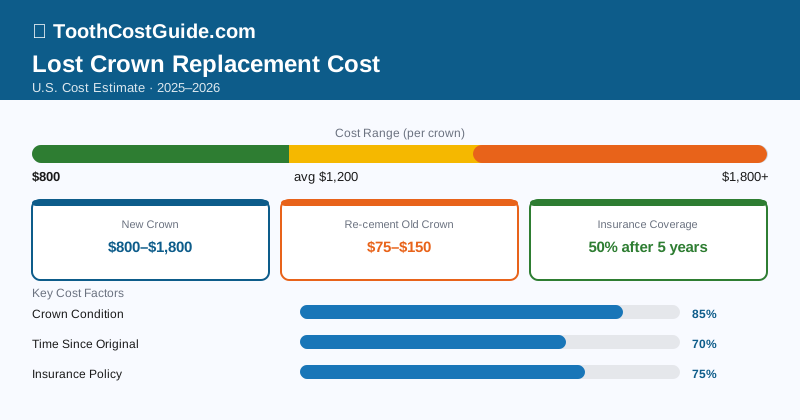
A lost dental crown can often be re-cemented for $75–$200 if the crown and tooth are undamaged. If the crown is cracked, the tooth has decayed, or a new crown is needed, costs jump to $800–$1,800 for fabrication. The good news: losing a crown is rarely a true emergency — the tooth is already prepared (shaped) and the crown is protective, not structural. But you shouldn’t leave the prepared tooth exposed for more than a few days.
| Situation | Treatment | Cost (No Insurance) |
|---|---|---|
| Crown intact, tooth undamaged | Re-cementation | $75–$200 |
| Crown damaged/cracked | New crown fabricated | $800–$1,800 |
| Decay found under crown | Remove decay + new crown | $1,200–$2,500 |
| Tooth needs buildup before crown | Core buildup + crown | $1,500–$2,500 |
| Root canal needed (decay reached pulp) | Root canal + crown | $1,700–$3,300 |
| Emergency exam + X-ray | Diagnosis | $75–$200 |
| Temporary crown (while waiting) | Chairside temporary | $100–$300 |
What Affects the Cost
Whether the crown can be re-used. If you find the crown intact, bring it to your appointment. If the internal surfaces are clean and the tooth has no new decay, re-cementation is quick and inexpensive ($75–$200). If the crown is broken, corroded, or doesn’t fit well anymore, a new one must be made ($800–$1,800).
Why the crown came off. Crowns fall off due to cement failure (most common — cheap fix), tooth fracture beneath the crown (requires more work), new decay at the crown margin (requires removing decay and possibly a new crown), or an ill-fitting crown. The dentist’s exam determines which scenario applies.
Decay under the old crown. Crowns can mask decay developing along the gumline at the crown margin. If decay is present, it must be completely removed before re-cementation or new crown fabrication. Depending on severity, the dentist may need to perform a core buildup to reconstruct the tooth structure, adding $200–$400 to the cost.
Material of the new crown. All-ceramic (zirconia, lithium disilicate) crowns are most common today and cost $1,200–$1,800. Porcelain-fused-to-metal crowns cost $1,000–$1,500. All-metal gold crowns cost $1,300–$2,500 but are extremely durable, especially for back teeth.
Same-day (CEREC) vs. lab-fabricated crown. Many dentists now use CAD/CAM technology (CEREC or similar) to mill a crown in-office in one appointment. Same-day crowns cost $1,200–$1,800 — comparable to lab crowns — but eliminate the need for a second visit and a temporary crown.
Treatment Options & Costs
Re-cementation ($75–$200): The ideal scenario. The dentist cleans the inside of the crown and the prepared tooth, checks for any decay or damage, and cements the crown back in place. Takes 20–30 minutes. If you still have the crown, store it safely in a small container or zip-lock bag.
New crown — traditional two-appointment process ($800–$1,800): The dentist prepares the tooth (or re-prepares if structure has changed), takes an impression or digital scan, places a temporary crown, and orders the permanent crown from a dental lab. You return in 2–3 weeks to have the permanent crown cemented. Temporary crown cost ($100–$300) is sometimes included in the fee.
Same-day CEREC crown ($1,200–$1,800): Design and mill the crown in one visit — no temporaries, no second appointment. Comparable cost to lab crowns, preferred for convenience. Available at practices that have invested in the milling equipment.
Core buildup ($200–$400, often added to crown cost): When the tooth has lost significant structure due to decay or fracture, a composite buildup reconstructs the core before the crown is placed. Most dental plans cover buildups at 50–80% when done alongside a crown.
With vs. Without Insurance
Crowns are typically classified as “major restorative” on dental plans:
- Coverage level: 40–60% after deductible and annual maximum
- Waiting period: Many plans require 6–12 months of enrollment before covering crowns — check if this applies to your plan
- Frequency limitation: Most plans only cover a replacement crown on the same tooth every 5–7 years
- Annual maximum: $1,000–$2,000 per year; a single crown often consumes most or all of the annual benefit
Out-of-pocket with insurance example:
- New crown: $1,400
- Insurance pays 50% after $100 deductible = $650
- Patient pays: ~$750
Re-cementation with insurance:
- Re-cementation: $150
- Covered at 80–100% as a basic procedure
- Patient pays: $0–$30
What To Do With a Lost Crown
- Find and save the crown — check what you ate, look carefully. Keep it in a small container.
- Don’t try to re-glue it yourself with Super Glue. Super Glue is toxic in the mouth and can damage the crown and tooth, making professional re-cementation impossible.
- Use a temporary fix if needed. OTC dental cement kits (Dentemp, Re-cap) cost $10–$15 at pharmacies. They can temporarily re-seat the crown for a few days while you arrange an appointment. Denture adhesive can also hold a crown temporarily.
- Call your dentist within 24 hours. An exposed prepared tooth is vulnerable to decay, sensitivity, and fracture — especially since the underlying tooth structure has already been shaped down.
- Eat soft foods on the other side until the crown is replaced.
- Watch for pain or sensitivity. Mild sensitivity is normal. Sharp pain, swelling, or pain that wakes you at night could mean the underlying tooth is infected.
How to Save Money
Re-use the crown if possible. Always bring the old crown to your appointment — re-cementation at $75–$200 beats a new crown at $1,200–$1,800.
Check your plan’s frequency limitation. If your insurance covered the original crown less than 5–7 years ago, a replacement may not be covered. Know this before assuming insurance will pay.
Dental schools for new crowns. Dental school crown fees run $400–$700 — substantially less than private practices. The trade-off is multiple longer appointments and a waiting list.
Negotiate a cash discount. Some dentists offer 5–15% discounts for upfront cash or check payment. Worth asking, especially for a $1,400+ crown.
Time the crown with your benefits calendar. If you’ve already used your annual maximum, ask whether you can do the temporary crown now and the final crown after January 1 when benefits reset. Many dentists accommodate this split-year planning.
Never use Super Glue or craft adhesives to re-attach a dental crown. These products contain chemicals that are toxic in the mouth and can permanently damage the crown’s internal surface, preventing proper professional re-cementation. Use only dental cement products from a pharmacy as a temporary measure.
Bottom Line
A lost crown costs $75–$200 to re-cement if the crown is intact and undamaged — or $800–$1,800 for a new crown if fabrication is needed. Always save your crown. Use temporary dental cement from a pharmacy for a day or two if needed, but see a dentist within 24–48 hours to protect the prepared tooth underneath. With insurance, a new crown typically runs $600–$900 out of pocket after coverage.