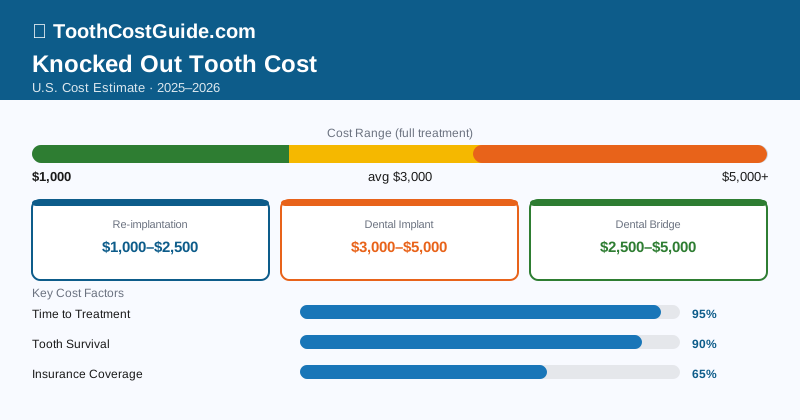
A knocked-out (avulsed) tooth is one of the true dental emergencies where minutes matter. Re-implantation costs $500–$2,000 for the procedure itself, but only works if the tooth is returned to the socket within 30–60 minutes. If re-implantation fails or isn’t possible, permanent replacement via dental implant runs $3,500–$6,000 per tooth. Acting fast can save you thousands of dollars and preserve your natural tooth.
| Treatment Path | Cost (No Insurance) |
|---|---|
| Emergency exam + X-rays | $100–$250 |
| Tooth re-implantation (procedure) | $500–$1,500 |
| Splinting (stabilizing re-implanted tooth) | $200–$500 |
| Root canal (usually needed post-implant) | $800–$1,500 |
| Follow-up care and monitoring | $200–$500 |
| Dental implant (if re-implant fails) | $3,500–$6,000 |
| Fixed bridge (3-unit, alternative to implant) | $3,000–$5,000 |
| Partial denture (removable, lowest cost) | $1,000–$2,500 |
What Affects the Cost
Time elapsed since injury. This is the single biggest factor in whether re-implantation is even attempted. Teeth re-implanted within 30 minutes have survival rates of 80–90%. After 60 minutes out of the mouth, survival drops sharply. A tooth kept properly moist (in milk, saliva, or saline) survives longer than one left dry. If the tooth has been out too long or the socket is damaged, you’re looking at replacement — not re-implantation — which costs far more.
Which tooth was knocked out. Permanent front teeth (central and lateral incisors) are the most commonly avulsed and the ones most often re-implanted. Baby teeth are generally not re-implanted because forcing them back can damage the developing permanent tooth underneath. Back teeth rarely qualify for re-implantation due to root anatomy.
Patient age. Children and younger adults have higher success rates with re-implantation because their periodontal ligament cells are more resilient. Older adults may see higher rates of eventual tooth loss even after successful initial re-implantation.
Complexity of the socket. If the socket itself is fractured, bone grafting or socket repair adds $300–$1,500 to the total. Soft tissue lacerations requiring sutures add $100–$300.
Replacement option chosen. If re-implantation isn’t possible or fails over time, you’ll choose between a dental implant ($3,500–$6,000, the gold standard), a fixed bridge ($3,000–$5,000, requires grinding down adjacent teeth), or a removable partial denture ($1,000–$2,500, less permanent). The gap option — leaving the space empty — is free but causes bone loss and tooth shifting over time.
Treatment Options & Costs
Immediate re-implantation ($500–$2,000 total): The best outcome. The dentist cleans the tooth gently, replaces it in the socket, and splints it to neighboring teeth for 2–4 weeks while the periodontal ligament reattaches. Most re-implanted teeth will eventually need root canal therapy ($800–$1,500) because the pulp is damaged during the trauma. Total first-year cost including splinting, root canal, and follow-up: $1,500–$3,500.
Dental implant ($3,500–$6,000): A titanium post surgically placed in the jawbone with a ceramic crown on top. Takes 3–6 months from placement to final crown because the implant must osseointegrate (fuse with the bone). Most durable long-term solution — implants last 20+ years with good care. Bone grafting may add $300–$1,500 if the socket has deteriorated.
Fixed dental bridge ($3,000–$5,000): Three crowns fused together: two crowns anchor to teeth on either side of the gap, with a false tooth (pontic) in the middle. Requires permanently altering two healthy teeth. Lasts 10–15 years on average. Less expensive than an implant but not as long-lasting.
Removable partial denture ($1,000–$2,500): A removable appliance with a false tooth. Least expensive permanent option. Not as comfortable or functional as implant or bridge, but an option when cost is a barrier.
With vs. Without Insurance
Dental insurance coverage for knocked-out tooth treatment is complicated because it spans multiple codes:
- Emergency exam: Usually covered at 80–100%
- Re-implantation procedure: Covered under “oral surgery” at 50–80% on most PPO plans; check your plan’s specific language on “tooth re-implantation” (ADA code D7270)
- Root canal after re-implantation: Covered at 40–60% as major restorative
- Dental implant: Many plans exclude implants entirely or have a $1,000–$1,500 lifetime implant benefit that barely dents the cost
- Bridge: Covered at 40–60% on most plans
Medical insurance may help. If the injury resulted from an accident, your medical insurance (or auto insurance, or the at-fault party’s liability coverage) may cover trauma-related dental expenses. Always file with both medical and dental insurance.
Out-of-pocket with insurance example:
- Re-implantation + splinting + root canal: $3,000 total
- Dental insurance pays 50% after deductible = ~$1,400 paid
- Patient pays: ~$1,600
What To Do — The 30-Minute Window
- Find the tooth immediately. Pick it up by the crown (the white part), never the root.
- Do not scrub or dry the tooth. Rinse gently with water if dirty. Leave any tissue fragments attached.
- Try to re-insert it yourself. If the socket is clean and you can position the tooth correctly, push it back in and bite down gently on gauze or a cloth. This is the single best thing you can do.
- If you can’t re-insert it, store it in milk. Milk is the best transport medium. Saline solution or the space between your gum and cheek (keeping it moist in saliva) also work. Do NOT store in plain water — it destroys the root cells.
- Get to a dentist within 30 minutes. Call ahead so they can prepare. If your dentist isn’t available, go to a hospital emergency room.
- Don’t take ibuprofen before the dentist sees you if you can avoid it — some practitioners prefer no NSAIDs in the first hour.
How to Save Money
Act fast to save your natural tooth. The best money-saving strategy is getting to the dentist quickly enough that re-implantation is viable — a $1,500 re-implantation is far cheaper than a $5,000 implant.
Check auto and health insurance. Accidents involving a vehicle may have dental coverage through auto insurance. Medical insurance may cover the emergency room visit and surgical aspects of treatment.
Dental schools for the implant phase. If you ultimately need an implant, dental school implant programs charge $1,500–$2,500 for the full implant — half to one-third of private practice costs.
Ask about phased treatment. An implant can be placed months after the injury, giving you time to save or arrange financing. A temporary “flipper” (removable false tooth) costing $300–$500 fills the gap cosmetically while you plan longer-term treatment.
A knocked-out permanent tooth is a true dental emergency. You have 30–60 minutes before re-implantation becomes unlikely to succeed. If you cannot reach a dentist, go to a hospital emergency room. Do not attempt to clean the root with soap or hydrogen peroxide — this destroys the cells needed for reattachment.
Bottom Line
A knocked-out tooth costs $1,500–$3,500 total if re-implanted successfully within the golden window, or $3,500–$6,000 for an implant if re-implantation fails or isn’t possible. Speed is everything — every minute counts. Keep the tooth moist, get to a dentist within 30 minutes, and explore dental school options for the implant phase if cost is a barrier.