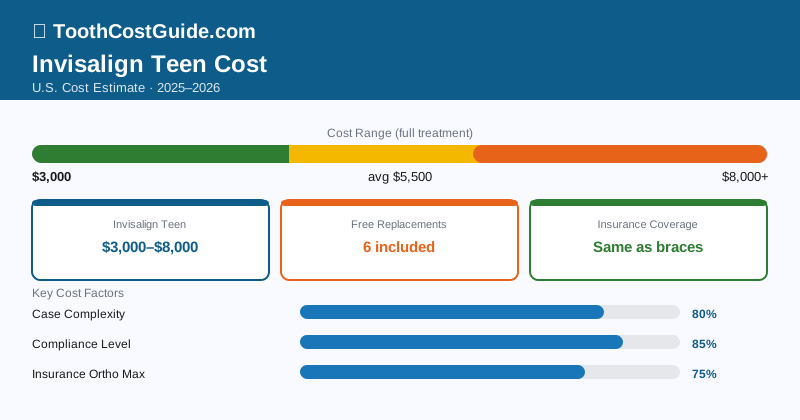
Invisalign Teen costs $3,000–$8,000, comparable to traditional metal braces ($3,000–$5,500) and ceramic braces ($4,000–$7,000) for teenagers. It uses the same clear aligner technology as standard Invisalign but includes several teen-specific features: blue compliance indicators that fade with wear, up to 6 free replacement aligners for lost or damaged trays, and mandibular advancement technology for teens with jaw development concerns. Insurance covers Invisalign Teen on the same terms as braces.
| Teen Orthodontic Option | Cost Without Insurance |
|---|---|
| Invisalign Teen | $3,000–$8,000 |
| Invisalign Teen (Lite program, mild cases) | $2,500–$4,500 |
| Metal braces (teen) | $3,000–$5,500 |
| Ceramic braces (teen) | $4,000–$7,000 |
| Damon self-ligating braces | $3,500–$7,000 |
| Lingual braces (rarely for teens) | $8,000–$13,000 |
What Makes Invisalign Teen Different from Standard Invisalign
1. Compliance indicators: Each Invisalign Teen aligner has a small blue dot on the back that fades with wear — losing about 1/3 of its color per 2-week period when worn the recommended 22 hours/day. Parents and orthodontists can check the dot to assess whether the teen is wearing aligners as directed without needing to ask. This is the primary monitoring tool for teen compliance.
2. Free replacement aligners: Invisalign Teen includes up to 6 free replacement aligner sets per treatment. Teens inevitably lose or damage aligners — leaving them in a pocket that goes through the wash, setting them on a lunch tray, or accidentally throwing them away. Six free replacements are included in the standard Invisalign Teen fee.
3. Eruption tabs: Spaces in the aligner are designed to accommodate erupting teeth (wisdom teeth emerging or second molars that haven’t fully grown in). This allows treatment to proceed without waiting for all permanent teeth to fully erupt.
4. Mandibular advancement (MA) feature: For teens with overjet (protruding upper front teeth) or Class II bite relationships, certain Invisalign Teen trays can incorporate precision wings that hold the lower jaw in a slightly forward position — similar in concept to a Herbst or Forsus functional appliance. This allows simultaneous bite correction and tooth alignment with clear aligners.
5. Vivera retainers: Upon completion, Invisalign-compatible retainers designed specifically for teenage patients are available.
Cost Comparison: Invisalign Teen vs. Braces
For most comparable cases, Invisalign Teen and braces are priced within 10–20% of each other:
- Mild teen case: Metal braces $3,000–$4,000 vs. Invisalign Teen $3,000–$4,500 (comparable)
- Moderate teen case: Metal braces $4,000–$5,500 vs. Invisalign Teen $4,500–$6,500 (Invisalign slightly more)
- Complex teen case with bite correction: Metal braces $5,000–$7,000 vs. Invisalign Teen with MA $5,500–$8,000 (Invisalign slightly more)
The price difference narrows at experienced orthodontic practices — Invisalign Platinum and Diamond providers who treat high aligner volumes may price Invisalign Teen at or below the braces fee for comparable cases.
Invisalign Teen costs similar to braces for most teen cases. The decision should be based on lifestyle fit (removable vs. fixed), case complexity, and compliance honesty — not price. The compliance indicator (fading blue dot) is the most important practical tool: if your teen isn’t wearing aligners 22 hours/day, treatment won’t progress and braces would have been the better choice.
Is Your Teen a Good Candidate for Invisalign?
Good candidates for Invisalign Teen:
- Teens with mild-to-moderate crowding, spacing, or overbite
- Teens who play wind instruments (clarinet, saxophone, trumpet) — removing aligners for practice is a huge advantage
- Teens who play contact sports — aligners are removed, eliminating bracket injury risk
- Teens with high motivation and demonstrated responsibility (wear their retainers, don’t lose things)
- Teens who are very appearance-conscious about braces
- Teens who can commit to 22 hours/day wear without constant reminders
Braces may be better for:
- Teens with complex bite correction needs (severe overbite, underbite, crossbite)
- Teens with demonstrated difficulty remembering things or low compliance motivation
- Teens who tend to lose items frequently
- Younger teens (11–12) with multiple teeth still erupting
- Cases requiring significant molar movement or vertical corrections
Having an honest conversation with your teen about compliance is the most important step. Invisalign only works if worn 22 hours per day. An expensive Invisalign Teen case left in a drawer for 6 months produces no tooth movement and wastes thousands of dollars.
The Compliance Question
Unlike braces (which are fixed and work whether the patient cooperates or not), Invisalign requires the patient to consistently wear the aligners. Studies show that aligner compliance in teens varies widely — some research shows average wear times of 15–18 hours/day versus the prescribed 22 hours.
Practical compliance strategies:
- Set phone alarms as reminders to put aligners back in after meals
- Keep a case in every bag, pocket, and on the nightstand — never wrap in a napkin at restaurants
- Track wear time with apps like DrTray Traytime
- Agree on a monitoring system with parents (compliance dot checks, weekly photos)
- Establish consequences and rewards for compliance vs. non-compliance
If compliance is a genuine concern: Have an honest conversation with the orthodontist. Some will suggest braces for teens who they assess as compliance risks, even when the case is clinically appropriate for aligners. This is good clinical judgment, not a sales strategy.
Insurance Coverage
Invisalign Teen is covered by dental insurance orthodontic benefits on exactly the same terms as traditional braces:
- Lifetime maximum: $1,000–$3,000
- Coverage: 50% up to the lifetime maximum
- Age limits: Under 18–19 (most plans)
Insurance does not pay extra for replacement aligners — those 6 free replacements are included in the Invisalign Teen fee, not claimed separately.
Example calculation:
- Invisalign Teen: $5,500
- Insurance lifetime maximum: $1,500
- Insurance pays: $1,500 (50% of the first $3,000 = $1,500, which equals the maximum)
- Family out-of-pocket: $4,000
Some insurers have a fee schedule for orthodontic coverage that caps the “allowable” at the cost of metal braces. If your Invisalign Teen case costs $5,500 but the insurer’s metal braces allowable is $4,500, they may base the 50% payment on $4,500 rather than $5,500. Ask your orthodontist’s billing team to verify before starting.
Financing Options
In-house orthodontic plans: Payment spread over the treatment period (typically 18–24 months). A $6,000 Invisalign Teen case over 24 months = $250/month after the insurance benefit is applied.
CareCredit: Promotional 0% periods of 12–24 months for qualified applicants. Useful for families who prefer separating the payment from the orthodontist’s billing schedule.
FSA: Invisalign Teen is fully FSA/HSA eligible. Contributing the expected patient portion during the prior year’s open enrollment saves 22–37% in federal taxes on that amount.
Sibling discounts: Many practices offer discounts for families with multiple children in treatment simultaneously. Ask about family discount policies at your consultation.
How to Save on Invisalign Teen
Compare with Invisalign-experienced orthodontists. Platinum and Diamond Invisalign providers sometimes offer lower fees for equivalent cases due to higher volume pricing. Use Invisalign’s provider locator to find high-tier providers in your area.
Ask whether Invisalign Lite (Teen) is appropriate. For mild teen cases (mild crowding or spacing), the limited-aligner Lite program costs $2,500–$4,500 — significantly less than a full Comprehensive program. Ask if your teen’s case qualifies.
Dental schools. Many orthodontic residency programs offer Invisalign under faculty supervision at 30–50% discounts. Cases must be appropriate for resident clinical training.
Use insurance + FSA together. Apply the insurance lifetime maximum first, then pay the remaining balance with pre-tax FSA dollars.
Bottom Line
Invisalign Teen costs $3,000–$8,000 — comparable to traditional braces for equivalent cases. The teen-specific features (compliance dots, 6 free replacements, eruption tabs, mandibular advancement) address the real challenges of teen aligner treatment. Insurance covers Invisalign Teen on the same terms as braces. The decision between Invisalign Teen and braces should center on compliance honesty, case complexity, and lifestyle factors — not on price, since costs are similar.
Invisalign Teen is a legitimate alternative to braces for appropriate teen cases at comparable cost. The compliance requirement (22 hours/day) is the central variable — teens who wear aligners consistently get equivalent results to braces; teens who don’t wear them get no results. An honest assessment of your teen’s responsibility level is the most important factor in this decision.