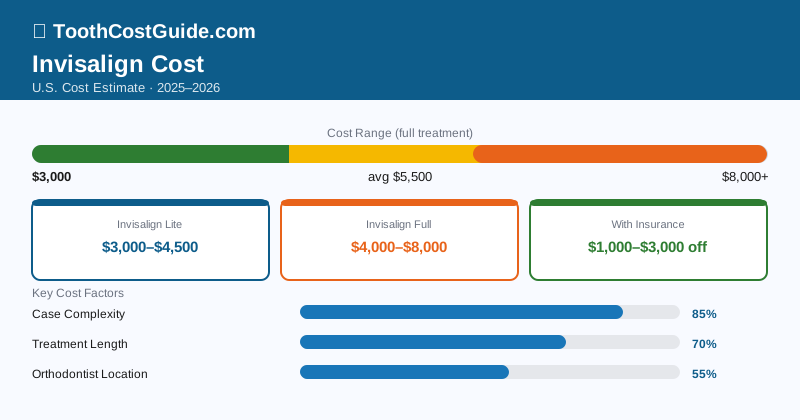
Invisalign full treatment costs $3,000–$8,000 without insurance, depending on case complexity. Invisalign Lite (for mild corrections) runs $1,500–$3,500. Invisalign First (for children) costs $2,000–$4,500. At-home aligner brands like Byte or Smile Direct (limited cases) run $1,500–$2,800. Most orthodontic insurance plans cover Invisalign at the same rate as traditional braces — up to the lifetime orthodontic maximum.
| Invisalign Product | Typical Cost |
|---|---|
| Invisalign Lite (mild crowding, 14 aligners) | $1,500–$3,500 |
| Invisalign Moderate (up to 26 aligners) | $2,500–$5,000 |
| Invisalign Full (comprehensive, unlimited refinements) | $3,500–$8,000 |
| Invisalign First (mixed dentition, children) | $2,000–$4,500 |
| At-home aligners (Byte, SmileDirectClub alternatives) | $1,500–$2,800 |
| Invisalign retainers (Vivera, set of 4) | $400–$900 |
| Whitening included with Invisalign | Often included |
What Affects the Cost of Invisalign
Case complexity. The primary cost driver. Mild crowding or small spacing corrections may qualify for Invisalign Lite — a limited number of aligners (typically 14) at a significantly lower cost. Moderate to complex cases requiring tooth rotation, vertical movement (intrusion/extrusion), or significant bite correction require Invisalign Full with unlimited aligner refinements. Complex cases cost more because they require more planning, more aligner sets, and more clinical oversight.
Provider type: general dentist vs. orthodontist. Both general dentists and orthodontists can prescribe Invisalign. Invisalign has a provider tier system — Platinum and Diamond providers who treat high volumes of cases often charge more, but their experience with complex aligner movements is genuinely better. A less experienced general dentist may offer a lower price but produce a result that requires more refinements or doesn’t achieve full correction.
Geographic location. As with all dental fees, metro areas charge 25–40% more than smaller markets. Invisalign provider fees are set by each practice, not by Align Technology (the manufacturer).
Whether refinements are included. Invisalign Full includes unlimited refinements (additional aligner sets to fine-tune the result) in the base fee. Some providers using Invisalign Lite offer fewer included refinements; additional trays may cost $500–$800 per round. Confirm what’s included in your quoted price.
The Invisalign lab fee paid by your provider to Align Technology is the same regardless of provider. The fee you pay reflects the provider’s clinical time, expertise, and practice overhead — not a markup on the physical aligners. A highly experienced orthodontist at $6,000 and a general dentist at $3,500 are both marking up from a similar lab cost.
Invisalign vs. Traditional Braces: Cost Comparison
For equivalent cases, Invisalign typically costs $500–$1,500 more than traditional metal braces because of the higher lab fees to Align Technology. However, pricing has become more competitive as more providers offer both.
When Invisalign is a better financial choice:
- When the price difference is small ($0–$500) compared to braces
- When the cosmetic benefit during treatment (nearly invisible) is important to you
- When you’re an adult treating professional and social visibility matters
When braces are the better financial choice:
- When the case complexity is high (severe rotations, bite correction) and braces will produce a faster, more reliable result — potentially avoiding $500–$800 in extra Invisalign refinements
- When cost difference is $1,000+
- For children with inconsistent compliance (braces can’t be removed)
With vs. Without Dental Insurance
Most dental insurance plans with orthodontic benefits cover Invisalign at the same rate as traditional braces — typically 50% up to the lifetime orthodontic maximum of $1,000–$3,000.
Example for Invisalign Full at $5,500:
- Lifetime orthodontic insurance maximum: $1,500
- Insurance pays: $1,500
- Patient out-of-pocket: $4,000
Key insurance facts:
- Adult orthodontic coverage is excluded from many plans; check the age limit
- Some plans state coverage only for “braces” — ask your insurer whether Invisalign specifically qualifies
- Waiting periods for orthodontic benefits vary by plan
Confirming insurance coverage: Contact your insurance company directly with code D8080 (comprehensive orthodontic treatment, adolescent) or D8090 (comprehensive orthodontic, adult) and ask what your lifetime maximum is and how much has been used.
How to Save Money on Invisalign
Get multiple consultations. Unlike dental procedures, Invisalign consultations are uniformly free and providers set their own prices. Getting quotes from 2–3 orthodontists and dentists is straightforward and can reveal price differences of $500–$2,000 for identical cases.
Compare orthodontist vs. general dentist pricing. For simple to moderate cases, a general dentist with significant Invisalign experience may charge $500–$1,000 less than an orthodontist. View their completed case portfolios before deciding.
Invisalign through a dental school: Some dental schools with orthodontic programs use Invisalign for appropriate cases. Treatment costs may be 30–50% lower than private practice. Availability varies.
Negotiate the total fee. Some Invisalign providers will match a lower competitor quote, include whitening, or add Vivera retainers at reduced cost. Ask what can be included to make the deal more competitive.
Consider Invisalign Lite for minor corrections. If your crowding or spacing is genuinely mild, Lite cases are appropriately treated at significantly lower cost. Be honest with multiple providers about the severity of your concern and ask explicitly if a Lite case would be appropriate.
Ask whether the Vivera retainers (post-treatment) are included in the treatment fee or billed separately. A set of 4 Vivera retainers costs $400–$900 out of pocket. Many providers include one round of retainers; some charge extra. This is a legitimate negotiating point.
At-Home Aligner Alternatives
Companies like Byte, ALIGNERCO, and others (Smile Direct Club ceased operations in 2023) offer mail-order clear aligners for $1,500–$2,800, with no in-person orthodontist involvement.
Important limitations:
- Suitable only for very mild crowding or spacing in otherwise healthy mouths
- No in-person clinical assessment means medical problems (gum disease, bite issues, root anomalies) can go undetected and worsen
- Many cases treated by mail-order companies result in incomplete correction, relapse, or bite problems requiring orthodontic treatment to correct
- The American Association of Orthodontists strongly advises against unsupervised tooth movement
For cases that genuinely qualify (verified by a dentist), at-home aligners can be a legitimate cost-saving option. For anything beyond minor corrections, in-person orthodontic treatment is the appropriate choice.
Financing Options
Invisalign treatment is almost universally offered on a payment plan basis at orthodontic practices.
In-office payment plans: Most practices allow you to split the total Invisalign fee across monthly payments for 12–30 months, often interest-free during treatment. A $5,000 case over 24 months = ~$208/month.
CareCredit: Widely accepted. 0% promotional periods of 18–24 months are standard for Invisalign financing amounts. Pay in full before the promotional period ends.
HSA/FSA: Orthodontic treatment, including Invisalign, is HSA and FSA eligible. Annual FSA elections can be front-loaded (you can claim the full annual election on January 1) and used to pay orthodontic installments.
Bottom Line
Invisalign full treatment costs $3,500–$8,000 without insurance, with insurance contributing $1,000–$3,000 in orthodontic benefits for qualifying patients. For mild cases, Invisalign Lite at $1,500–$3,500 is a genuine option. The best way to find the right price is multiple free consultations — prices vary significantly between providers for equivalent work.
Invisalign produces excellent results for appropriate cases when prescribed and monitored by an experienced provider. It’s not a universal replacement for braces in complex cases, but for moderate crowding, spacing, and certain bite corrections, it’s clinically equivalent with the advantage of near-invisibility.
Always get a written treatment plan before agreeing to any dental work. For Invisalign, ask for the specific case tier (Lite, Moderate, Full), how many aligners are planned, how many refinements are included in the fee, what the retainer situation is post-treatment, and whether all in-treatment monitoring appointments are included.