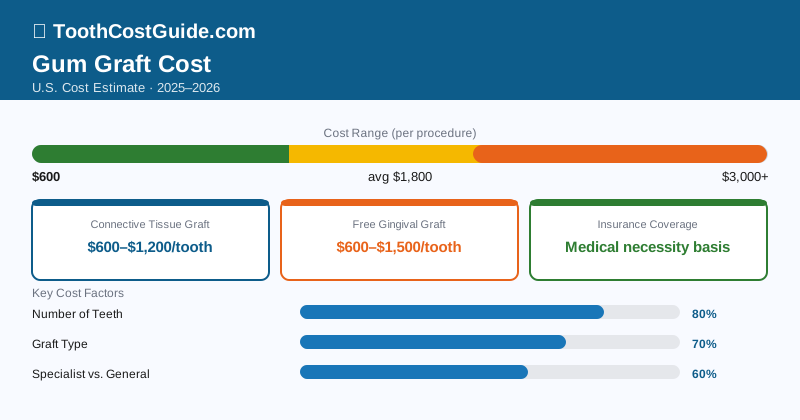
Gum graft surgery costs $600–$3,000 in the United States, with most patients paying $900–$1,500 when treating a small number of teeth in a single surgical session. The variation is driven by the type of graft used, how many teeth need coverage, and whether you see a periodontist or a general dentist. Dental insurance that includes periodontal benefits often covers 50–80% of medically necessary gum grafts, but patients still face significant out-of-pocket costs due to annual maximums.
Gum Graft Types and Their Costs
| Graft Type | Cost Per Tooth / Per Procedure |
|---|---|
| Connective tissue graft (CTG, 1–3 teeth) | $600–$1,200 |
| Free gingival graft (FGG, 1–3 teeth) | $600–$1,100 |
| Pedicle graft (adjacent tissue, 1 tooth) | $500–$900 |
| Alloderm / donated tissue graft (1–3 teeth) | $800–$1,500 |
| Multiple teeth / full quadrant (4+ teeth) | $1,200–$3,000 |
| Pinhole Surgical Technique (PST) | $1,000–$3,000 total |
What Affects the Cost of a Gum Graft
Number of teeth being treated. Gum grafts are generally priced per tooth or per surgical area, not as a flat per-visit fee. Treating a single isolated recession site costs $600–$1,000. Covering recession across an entire quadrant (multiple adjacent teeth treated simultaneously) costs $1,200–$3,000 but is far more cost-efficient per tooth than individual treatments scheduled separately.
Type of graft material. A connective tissue graft (CTG) — the most common type — harvests a thin layer of tissue from the palate and sutures it over the recession site. A free gingival graft (FGG) takes a slightly larger palatal tissue sample and is used when thick, keratinized tissue is needed rather than coverage alone. Both require a donor site on the palate, which requires its own healing period. Alloderm (processed donor tissue from a tissue bank) eliminates the palatal donor site, making recovery easier and faster, but the material is more expensive and some insurance plans reimburse it at a lower rate.
Specialist vs. general dentist. Gum grafts are almost universally performed by periodontists — dental specialists in gum tissue and supporting structures. Periodontist fees are higher than general dentist fees. In major metropolitan areas, expect $800–$1,200 per tooth site; in smaller markets, $600–$900. The specialist premium is generally worth it for a procedure requiring precision tissue handling and suturing.
Whether preparatory treatment is needed. Insurance and clinical protocols typically require that active gum disease be treated before gum grafting is performed. This means patients often face deep cleaning (scaling and root planing) costs of $200–$400 per quadrant before graft surgery is even scheduled. Factor these into your total cost estimate.
Periodontists routinely treat multiple recession sites in a single appointment to reduce total surgical visits and cost. If you have recession on several teeth, ask your periodontist to evaluate treating all affected areas at once — the per-tooth cost is lower than multiple separate sessions, and you heal once rather than repeatedly.
Cost by Graft Type and Complexity
Connective tissue graft (CTG). The gold standard for root coverage. A small flap is made at the palate, a thin connective tissue sample is removed, and it’s sutured under a flap at the recession site. Provides excellent aesthetic results and durable coverage. Cost: $600–$1,200 for 1–3 teeth treated simultaneously.
Free gingival graft (FGG). Used primarily to increase the zone of attached (keratinized) gum tissue rather than for cosmetic root coverage. Common at sites where recession is mild but the gum tissue is thin and mobile. Less aesthetically refined than CTG but effective. Cost: $600–$1,100.
Pedicle graft (lateral or coronally advanced flap). When there is adequate gum tissue adjacent to the recession site, the periodontist can slide or rotate that tissue over the exposed root without harvesting from the palate. No donor site means faster recovery, but it’s only possible when adjacent tissue is sufficient. Cost: $500–$900 per tooth.
Alloderm (acellular dermal matrix). Processed human donor tissue used instead of palatal harvest. Results are comparable to CTG for root coverage, and patients avoid a second surgical site in the palate. Particularly useful when treating many recession sites simultaneously, since palatal tissue availability is limited. Cost: $800–$1,500 for 1–3 teeth, or $1,500–$3,000 for larger cases.
Pinhole Surgical Technique (PST). A minimally invasive approach using a small needle-sized hole to loosen and advance gum tissue over recession sites without incisions or sutures. Faster recovery, less postoperative discomfort, but not appropriate for all recession types. Performed by periodontists trained specifically in the technique. Cost: $1,000–$3,000 total depending on how many teeth are addressed.
With vs. Without Dental Insurance
Gum grafts occupy a gray zone in dental insurance — they may be covered as a periodontal surgical procedure, but benefits vary widely and annual maximums often limit what you actually receive.
With insurance: Most PPO plans that include periodontal benefits cover gum grafts at 50–80% of the “allowed amount” after deductible. A $1,200 graft claim might result in $500–$700 paid by insurance, leaving you with $500–$700 out of pocket — before considering that you may have already used some of your annual maximum on cleanings, X-rays, or previous treatments.
Annual maximum problem: Dental insurance annual maximums of $1,000–$2,000 are a significant obstacle. A $1,200 graft may consume your entire annual benefit in one visit. If you need multiple grafting sessions, it may make sense to spread them across calendar years to maximize insurance contributions.
Medical necessity documentation. Insurance coverage requires that the graft be medically necessary — not purely cosmetic. Your periodontist needs to document recession measurements (in millimeters), document that the gum tissue is thin or that there is sensitivity or risk of further recession without treatment. Purely cosmetic recession improvements on teeth with adequate tissue thickness are typically not covered.
Cosmetic vs. therapeutic. If recession is causing root sensitivity, difficulty brushing, or risk of tooth loss, coverage is more likely. If you want recession coverage on healthy teeth solely to improve appearance, most insurers won’t cover it. Your periodontist should help clarify how your specific case will be coded.
Periodontal graft procedures should always be pre-authorized before scheduling surgery. Submit X-rays, periodontal charting, and recession measurements to your insurer for a written predetermination. This tells you exactly what the insurer will pay before you commit to surgery — critical for a $1,000–$3,000 procedure.
How to Save Money on a Gum Graft
Treat multiple sites in one session. The surgical setup fee, anesthesia, and time in the chair are fixed costs regardless of how many teeth you treat. Getting four teeth grafted at once costs far less per tooth than four separate single-tooth procedures. Ask your periodontist to evaluate treating all recession sites in a single surgical session.
Consider Alloderm if you have many sites. When treating more than 3–4 teeth, palatal donor tissue is limited. Alloderm eliminates donor site restrictions and often speeds recovery when many sites are treated. While the material costs slightly more, you avoid extended recovery from a large palatal wound.
Ask about periodontal residency programs. University periodontal programs perform gum graft procedures at 40–60% below private practice rates. The procedures are performed by periodontal residents under faculty supervision. For patients with significant recession who lack insurance coverage, this can save $600–$1,500 per session.
Compare periodontists. Unlike emergency procedures, gum grafts are elective-timing procedures that allow you to get 2–3 consultations before committing. Consultation fees are typically $50–$150 and provide an exam, X-rays, and a treatment plan. Fees for the same procedure can vary $200–$500 between practices in the same city.
Address the cause. Gum recession often has underlying causes: aggressive brushing, bruxism (grinding), or occlusal (bite) problems. Treating these causes before or alongside grafting protects your investment. A soft-bristle brush and proper technique prevent new recession from forming after grafting.
Financing Options
Gum grafts are significant expenses — typically $600–$3,000 — that most patients need financing options to manage, especially when insurance covers less than expected.
CareCredit. Widely accepted at periodontal offices. Offers 0% promotional financing for 6–24 months. The most popular option for dental specialty procedures. Read the fine print: deferred interest applies if the balance isn’t paid in full before the promotional period ends.
Sunbit and LendingClub Patient Solutions. Newer dental financing alternatives with less aggressive retroactive interest policies than CareCredit. Some periodontal practices offer these as alternatives. Compare total cost of financing before choosing.
HSA/FSA. Gum graft surgery qualifies as a medical expense eligible for HSA and FSA funds. Pre-tax payment provides a 22–37% effective discount depending on your federal and state tax bracket — better than any dental discount or payment plan.
Spread treatment across calendar years. For patients with a $1,500 annual dental insurance maximum and three quadrants needing grafting, spreading treatment over 2–3 calendar years lets you collect $1,500 from insurance each year rather than hitting the cap in one year. This is a slower but lower-cost approach for patients with moderate recession who aren’t at immediate risk.
Bottom Line
Gum graft surgery is a $600–$3,000 investment that addresses a real clinical problem: gum recession exposes tooth roots to decay, causes sensitivity, and — if untreated — can progress until teeth are lost. The procedure has a high success rate and long-term durability when performed by a skilled periodontist and when the underlying causes of recession are also addressed.
Insurance helps if you have periodontal benefits, but annual maximums mean you’ll still pay a significant portion out of pocket. Get a pre-authorization before scheduling surgery, treat multiple sites per session when possible, and ask your periodontist about university training program referrals if cost is a significant barrier.
Dental cost estimates in this guide reflect U.S. national averages for 2024–2025 and may vary significantly by geographic region, provider type, and individual treatment needs. Always request a written treatment plan with itemized costs before agreeing to any dental work. Confirm coverage details directly with your insurance provider before treatment begins.