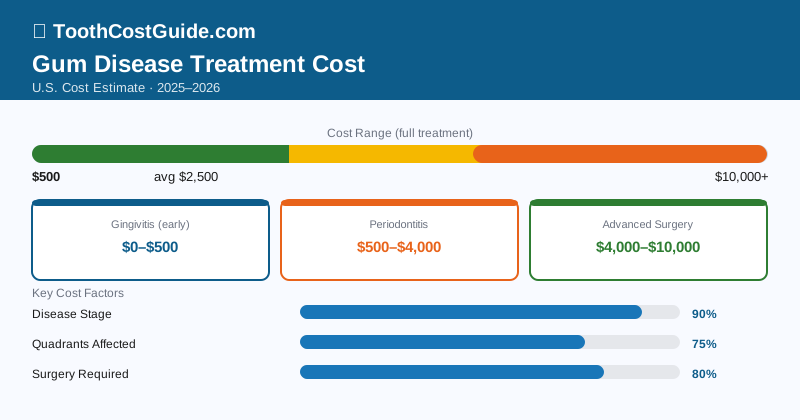
Gum disease treatment costs range from $500 for early gingivitis treated with a deep cleaning to $10,000 or more for advanced periodontitis requiring multiple quadrants of surgical treatment. Where you fall on that spectrum depends entirely on how far the disease has progressed before you seek treatment. Most dental insurance plans cover periodontal treatment partially — typically at 50–80% — but annual maximums often limit total benefits, leaving patients with significant out-of-pocket costs for advanced-stage treatment.
Gum Disease Treatment Costs by Stage
| Treatment Type | Cost (No Insurance) |
|---|---|
| Gingivitis: prophylaxis (deep-ish cleaning) | $75–$200 |
| Scaling and root planing (SRP) – per quadrant | $200–$400 |
| SRP – full mouth (4 quadrants) | $800–$1,600 |
| Periodontal maintenance (3–4x/year) | $100–$250 per visit |
| Localized antibiotic therapy (Arestin, per site) | $35–$75 per site |
| Osseous surgery – per quadrant | $1,000–$2,000 |
| Osseous surgery – full mouth | $3,000–$8,000 |
| Gum graft (recession repair) | $600–$3,000 |
| Bone graft (periodontal regeneration) | $600–$1,200 per site |
| Laser periodontal therapy (LANAP) | $2,000–$4,000 per arch |
What Affects the Cost of Gum Disease Treatment
Severity and stage of gum disease. The American Academy of Periodontology classifies gum disease in stages I–IV and grades A–C. Stage I–II disease (mild to moderate bone loss, pockets 4–6mm) is typically treated non-surgically with scaling and root planing. Stage III–IV disease (severe bone loss, pockets over 6mm, possible tooth mobility) often requires surgical intervention after SRP fails to adequately resolve the condition. The more advanced the disease, the more treatment is required and the higher the cost.
Number of quadrants requiring treatment. Both SRP and surgical procedures are priced per quadrant (the mouth is divided into four quadrants). A patient with localized disease in one quadrant might pay $200–$400 for SRP of that area. A patient with generalized advanced periodontitis affecting all four quadrants faces $800–$1,600 for SRP plus potentially $3,000–$8,000 if surgery is needed. Every additional quadrant multiplies costs proportionally.
Surgical vs. non-surgical approach. Scaling and root planing is the non-surgical backbone of periodontal treatment — performed by a dentist or periodontist with ultrasonic scalers and hand instruments under local anesthesia. If re-evaluation after SRP (typically 4–8 weeks later) shows persistent pockets, osseous surgery may be recommended to reshape bone and gain direct access to root surfaces. Surgical treatment significantly increases costs.
General dentist vs. periodontist. General dentists with periodontal training perform SRP; periodontists (dental specialists with 3 years of post-doctoral training in gum disease) handle both SRP and surgery. Periodontist fees are 20–40% higher than general dentist fees for comparable procedures, but complex cases benefit from specialist expertise. For Stage III–IV disease or any surgical treatment, a periodontist is strongly recommended.
The single most important cost-reduction strategy for gum disease is early treatment. Gingivitis (the reversible early stage) costs $75–$200 to treat with a thorough cleaning. If untreated, gingivitis progresses to periodontitis requiring $800–$1,600 in deep cleaning, and potentially $3,000–$8,000 in surgery. Annual dental checkups catch gum disease in its least expensive stage.
Cost by Stage and Treatment Type
Gingivitis. Reversible inflammation limited to the gum tissue, with no bone loss. Treatment is a thorough prophylaxis (cleaning) and improved home care. Some gingivitis cases benefit from antimicrobial rinses ($10–$20) or a slightly more thorough “full-mouth debridement” if buildup is heavy. Cost: $75–$200. With insurance, often covered at 100% as a preventive service.
Early to moderate periodontitis (Stage I–II). Scaling and root planing removes bacterial deposits from below the gumline and smooths root surfaces. Performed under local anesthesia, typically one or two quadrants per appointment. Full mouth SRP often requires 2 appointments. Cost: $200–$400 per quadrant, $800–$1,600 for full mouth. Most plans cover SRP at 50–80% after deductible.
Localized antibiotic therapy. After SRP, antibiotic microspheres (Arestin) may be placed directly into stubborn deep pockets to help resolve remaining infection. Priced per site: $35–$75 per application. Insurance coverage for adjunctive antibiotics is inconsistent — check your plan. Some periodontists include Arestin in the SRP fee; others bill it separately for 5–20 sites.
Advanced periodontitis — osseous surgery (Stage III–IV). When SRP doesn’t adequately resolve deep pockets, periodontal osseous surgery provides direct access to root and bone surfaces. The periodontist reshapes bone defects and eliminates pockets surgically. Performed per quadrant under local anesthesia, with IV sedation available ($300–$600 additional). Cost: $1,000–$2,000 per quadrant. Full mouth: $3,000–$8,000.
LANAP (Laser-Assisted New Attachment Procedure). A laser-based alternative to traditional osseous surgery. Uses a specific wavelength laser to remove diseased tissue and sterilize pockets without cutting. Less discomfort and faster recovery than traditional surgery. Requires a periodontist with LANAP certification. Cost: $2,000–$4,000 per arch (typically done in two arch-based sessions rather than quadrant-by-quadrant). Insurance coverage varies — some plans cover it as an equivalent to osseous surgery; others have specific exclusions.
Periodontal maintenance. After active treatment, patients transition to a lifelong periodontal maintenance program — typically every 3–4 months rather than the standard 6-month hygiene cycle. These maintenance visits are more thorough than routine cleanings and cost $100–$250 each. Most insurance plans cover 2–4 periodontal maintenance visits per year for patients with a documented history of periodontal treatment.
With vs. Without Dental Insurance
Periodontal disease falls under basic or major services in most dental plans, with coverage ranging from 50–80% after deductible.
SRP coverage: Most plans cover scaling and root planing at 50–80% after the deductible. Some plans require that the patient not have had a prophylaxis (routine cleaning) within a certain number of months before SRP, as they cannot be billed in the same period. Your periodontist’s billing team handles this coding — just make sure they’re aware of your insurance.
Surgical coverage: Osseous surgery and other periodontal surgeries are covered at 50% by most plans, making the patient’s share on a $6,000 surgical case $3,000 — still significant. With a $1,500 annual maximum, insurance may cover only $750 of a multi-quadrant surgical case, and you’d pay $5,250 out of pocket.
Annual maximum problem: The $1,000–$2,000 annual maximum of most dental plans is hopelessly inadequate for advanced periodontal treatment. A realistic treatment plan for Stage III–IV disease might generate $8,000–$12,000 in dental fees over 12–18 months. Even at 50% coverage with a $2,000 annual maximum, insurance contributes $2,000 per year while you pay $6,000–$10,000 over the treatment period.
Spreading treatment across calendar years. Periodontal treatment inherently lends itself to staggered delivery — upper right quadrant one month, upper left the next. With strategic timing, you can spread surgical quadrants across two or three calendar years, collecting your annual maximum benefit each year.
Always submit a pre-authorization before periodontal surgery. Submit full-mouth X-rays, periodontal charting with probing depths, and your periodontist’s clinical notes. The insurer will tell you exactly what they’ll pay before you commit to surgery. Never undergo periodontal surgery without knowing what your insurance will cover.
How to Save Money on Gum Disease Treatment
Seek treatment early. The most effective cost-reduction strategy is not letting gingivitis progress to periodontitis. Biannual cleanings and checkups catch the disease before expensive intervention is required.
Ask about full-mouth disinfection vs. quadrant SRP. Some periodontists offer full-mouth SRP in a single visit (one long appointment or two appointments in the same week) rather than spreading over months. This “full-mouth disinfection” approach may reduce your total number of appointments and copays.
Compare periodontist fees. Periodontal fees vary $200–$500 between practices in the same market for the same procedures. Initial consultations ($75–$150) are worth having at 2–3 offices before choosing, especially for high-cost surgical cases.
University periodontal clinics. Dental school periodontal residency programs provide SRP and surgical treatment at 40–60% below private practice rates. These are licensed periodontists in advanced training. Cost for SRP: $75–$150 per quadrant. Cost for osseous surgery: $400–$800 per quadrant. For a patient facing a $6,000–$8,000 treatment plan without adequate insurance, the university program can cut costs by $3,000–$5,000.
Negotiate multisession discounts. If you’re paying largely out of pocket for multiple quadrants, ask whether the periodontist offers any reduction for a commitment to full-mouth treatment. Some practices discount 5–10% for self-pay patients completing a comprehensive treatment plan.
Financing Options
Periodontal treatment costs accumulate quickly — $1,600–$10,000+ for patients with advanced disease. Most patients need to finance at least part of their treatment.
CareCredit. The most widely accepted dental financing product. Promotional 0% periods of 12–24 months make large treatment plans manageable. Deferred interest applies if not paid in full — understand this before signing.
In-house payment plans. Periodontal practices frequently offer their own payment plans, particularly for treatment spanning multiple visits. These are often 0% for 3–6 months with flexible structures for longer-term cases.
HSA/FSA. All periodontal treatment is a qualified medical expense. If you have an HSA or FSA, use these funds first. Pre-tax payment at a 22–37% effective discount is better than any financing product.
Dental discount plans. Membership plans that provide 20–40% discounts at participating dentists and periodontists. Plans like Careington or Cigna Dental Savings offer meaningful discounts for uninsured patients. A $900/year membership that discounts $6,000 in periodontal treatment by 30% saves $1,800 — a strong return.
Bottom Line
Gum disease treatment costs range from $75 for early gingivitis to $10,000 or more for advanced periodontal disease requiring full-mouth surgery. The most important message is that early treatment is dramatically less expensive and more effective than letting the disease advance. Annual dental checkups with periodontal probing assessments are the best investment you can make to stay on the low-cost end of this spectrum.
If you’ve been diagnosed with periodontal disease, get a full periodontal chart (probing depths at six points per tooth), understand the stage of your disease, and ask specifically about treatment staging that maximizes your insurance benefit across calendar years.
Dental cost estimates in this guide reflect U.S. national averages for 2024–2025 and may vary significantly by geographic region, provider type, and individual treatment needs. Periodontal disease is a progressive condition — delayed treatment results in both greater disease severity and higher treatment costs. Always seek evaluation and treatment promptly. Confirm coverage details directly with your insurance provider before treatment begins.