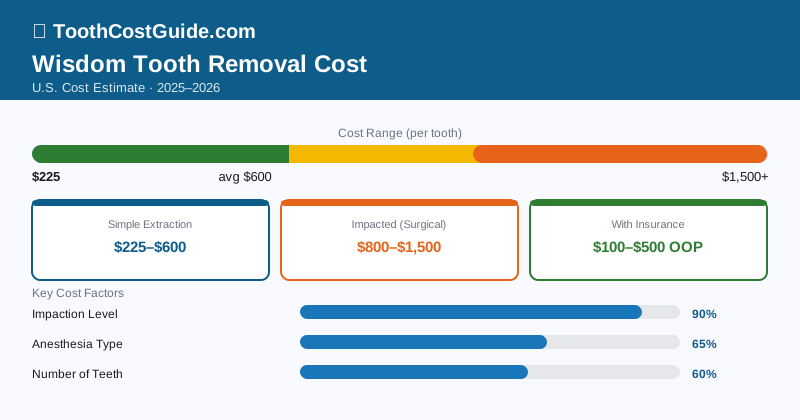
Two people sit in the same oral surgery office getting the same “wisdom tooth removal.” One pays $400. The other pays $1,100. Same procedure name, completely different scenario — because the position of the tooth in your jaw determines everything about complexity, time, and cost.
The Numbers, Broken Down
| Situation | Cost Per Tooth (No Insurance) |
|---|---|
| Simple erupted extraction | $225–$400 |
| Soft tissue impaction | $300–$550 |
| Partial bony impaction | $400–$750 |
| Full bony impaction (most complex) | $600–$1,100 |
| All 4 wisdom teeth (mixed complexity) | $1,000–$3,000 |
| IV sedation add-on | $400–$800 |
| Nitrous oxide add-on | $50–$150 |
With dental insurance covering oral surgery at 50–80%, most people pay $500–$1,500 out of pocket for a full four-tooth removal with insurance. Without insurance, dental school oral surgery clinics reduce that to $600–$1,500 for equivalent care.
Understanding Impaction Levels
Your dentist or oral surgeon classifies each wisdom tooth before quoting. The classification comes directly from your panoramic X-ray.
Simple erupted ($225–$400): The tooth has fully come through the gum. Extraction uses forceps — similar to pulling any molar. Takes 10–20 minutes. Local anesthesia is fully adequate. If all four of your wisdom teeth are erupted, you’re in the best-case scenario.
Soft tissue impaction ($300–$550): The tooth has pushed through the bone but gum tissue still covers it. The surgeon reflects the gum flap to expose the tooth, extracts it, and closes with sutures. More involved than simple, but still manageable.
Partial bony impaction ($400–$750): Part of the tooth is still encased in jawbone. The surgeon removes bone around the tooth with a drill, then sections the tooth into pieces for safe removal. Significantly more work than soft tissue.
Full bony impaction ($600–$1,100): The tooth is entirely below bone and gum. Often oriented horizontally or at an angle pushing against the second molar. The surgeon cuts through gum tissue, removes bone around the tooth, sections it carefully, and extracts each piece — taking care not to damage the adjacent molar root or the inferior alveolar nerve running through the lower jaw. This is a legitimate surgical procedure, not a basic extraction.
One important fact most patients don’t know: A horizontally impacted wisdom tooth that’s sitting directly against your second molar can resorb (damage) the second molar’s root if left in place for years. What starts as a $800 wisdom tooth removal can become a $4,000 problem involving the neighboring tooth. This is one of the stronger arguments for not indefinitely postponing impacted wisdom tooth removal.
Do All Four at Once?
Almost always yes, if they all need to come out.
The reasoning is straightforward: you pay one anesthesia setup fee, you recover once, and you clear the problem entirely. Removing two now and two later means two recovery periods and two sets of office visit costs.
The only situation that changes this is if some teeth are genuinely fine — no impaction, healthy eruption, no crowding concerns — while others need removal. An oral surgeon who recommends removing healthy, fully erupted, problem-free wisdom teeth “just to prevent future problems” deserves a second opinion.
Anesthesia: What Makes Sense
Local anesthesia only (included in base fee): Fully adequate for most single extractions. You feel significant pressure but no pain. Patients who’ve had a wisdom tooth out under local anesthesia often report it was less bad than anticipated.
Nitrous oxide ($50–$150): Mild sedation, takes effect in 2–3 minutes, wears off before you leave the office, you can drive home. Good for patients with anxiety about dental procedures who are having 1–2 teeth removed.
IV sedation ($400–$800): You’re not unconscious but deeply relaxed — most patients don’t remember the procedure. Standard choice for all four impacted wisdom teeth being removed simultaneously. The oral surgeon administers and monitors it. You need a driver.
For simple erupted extractions under local anesthesia, skipping sedation saves you real money. For full bony impactions on multiple teeth, IV sedation is genuinely worth considering — both for comfort and because it allows the surgeon to work more efficiently.
Before lower wisdom tooth removal, ask: “Is this tooth near the inferior alveolar nerve on the panoramic X-ray?” A tooth with roots wrapping around or very close to this nerve has a small risk of temporary or (rarely) permanent numbness of the lower lip and chin. Your surgeon should discuss this before you sign consent — not as something to prevent the surgery, but so you understand the risk profile for your specific anatomy.
With Insurance
Dental insurance covers wisdom tooth extractions under surgical benefits — typically 50–80% after deductible.
Example: Four wisdom teeth, mixed complexity, total fee $2,400. Insurance covers 50%.
- Insurance pays: $1,200 (assuming annual max not yet used)
- Patient pays: $1,200 + any deductible
The annual maximum problem: If your plan has a $1,000 annual max, you can’t use $1,200 of insurance benefit regardless of the stated 50%. If the total benefit needed exceeds your remaining annual max, consider splitting the procedure across two calendar years — two in December, two in January of the following year, two separate annual maximums.
IV sedation coverage: Many dental insurance plans cover anesthesia for impacted wisdom teeth when medically justified. The key phrase: “impacted.” Simple erupted wisdom tooth removal may not qualify for anesthesia coverage. Confirm with your plan before assuming sedation is covered.
Where to Pay Significantly Less
Oral surgery residency clinics at dental schools. This is the most reliable cost reduction for wisdom tooth removal, including complex impacted cases. Oral surgery residents are licensed dentists completing post-doctoral training — their extractions are performed under attending oral surgeon supervision. The procedure takes longer (more thorough documentation and supervision), but the surgical quality is closely monitored.
Cost at dental school: $600–$1,500 for all four teeth with IV sedation, compared to $1,500–$3,500 at private oral surgery offices. The savings are real.
Compare oral surgery offices before booking. Wisdom tooth extraction fees vary 20–35% between oral surgery practices in the same city. Call two offices, give them your impaction classification from the dentist’s x-ray (soft tissue, partial bony, or full bony, and which teeth), and compare the itemized quotes.
Consider whether your general dentist can handle some. If your dentist is confident extracting erupted wisdom teeth, having the simple ones done there at lower cost — and only going to the oral surgeon for the impacted ones — can save $200–$400.
Bottom Line
Wisdom tooth removal runs $1,000–$3,000 for most four-tooth procedures, with insurance reducing out-of-pocket costs to $500–$1,500. Simple erupted wisdom teeth cost $225–$400 each. Complex full bony impactions cost $600–$1,100 each, plus optional IV sedation at $400–$800 per procedure.
Don’t procrastinate on wisdom teeth that are actively symptomatic or impacted against neighboring teeth — the complications from delay (infection, cyst formation, damage to adjacent molars) create far more expensive problems. If cost is the barrier, a dental school oral surgery clinic is the most reliable path to quality care at dramatically lower cost.
Before wisdom tooth surgery: ask for the impaction classification for each tooth from your panoramic x-ray, confirm what the quoted fee includes (local anesthesia, IV sedation, post-op visits), and ask specifically whether the inferior alveolar nerve is at risk for the lower teeth. Get the total itemized fee in writing before you schedule. And bring a driver if you’re having IV sedation — you cannot legally drive after it.
Frequently Asked Questions
Simple erupted wisdom teeth cost $225–$400 per tooth, while impacted teeth range from $300–$550 for soft tissue impaction to $400–$1,500 for full bony impaction. Total costs for removing all four wisdom teeth typically fall between $900–$4,000 depending on impaction severity.
Most dental insurance plans cover 50–80% of surgical extraction costs after you meet your deductible, though coverage varies by plan. Many plans classify wisdom tooth removal as a major procedure with an annual maximum benefit of $1,000–$2,000, which may not fully cover multiple extractions.
Most patients experience 7–10 days of significant discomfort and swelling, with complete healing taking 3–6 months for the jaw bone to fill in. You should avoid hard foods, smoking, and strenuous activity for at least one week to prevent complications like dry socket.