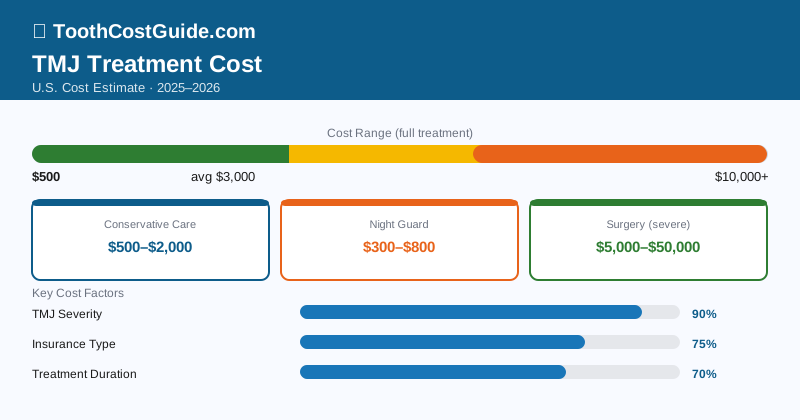
$50,000 is the worst-case number for total TMJ jaw reconstruction. Most people with TMJ disorder spend under $600 — and 90% of cases resolve with conservative treatment.
That gap is enormous, and it’s exactly what makes TMJ a confusing condition to navigate. You’ll find practices offering $8,000 custom orthotic systems and clinics insisting you need MRI-guided arthroscopy. You’ll also find dentists who hand you a $300 night guard and tell you to eat soft foods for a month. Knowing where your case actually falls on that spectrum saves you money — and prevents unnecessary, potentially irreversible procedures.
The Full TMJ Cost Ladder
| Treatment Option | Cost Range | Notes |
|---|---|---|
| Self-care (heat, soft diet, OTC NSAIDs) | $0–$30 | First-line; effective for most mild cases |
| OTC bite guard / boil-and-bite | $20–$80 | Short-term; less precise than custom |
| Custom occlusal splint / night guard | $300–$800 | Custom-fitted; 3–6 month typical use |
| Physical therapy (per session) | $75–$150 | 6–12 sessions typical |
| Botox injections for TMJ | $300–$800 | Per treatment; lasts 3–6 months |
| Arthrocentesis (joint lavage) | $300–$500 | Minor in-office procedure |
| Arthroscopy | $1,500–$5,000 | Outpatient; scope-assisted |
| Open joint surgery / total replacement | $5,000–$50,000+ | Last resort; major reconstruction |
What Is TMJ Disorder?
TMJ stands for temporomandibular joint — the hinge connecting your jaw to your skull, just in front of each ear. Temporomandibular disorders (TMDs) are a cluster of conditions affecting these joints and the surrounding muscles.
The National Institute of Dental and Craniofacial Research (NIDCR) estimates that more than 10 million Americans are affected by TMJ disorders at any given time, with women of childbearing age affected more frequently than men. Symptoms range from jaw pain and clicking to headaches, ear pain, and difficulty opening the mouth fully.
The cause matters for treatment selection. Three main categories:
- Myofascial pain — muscle tension and soreness, often related to bruxism (grinding/clenching). Most common. Most responsive to conservative care.
- Disc displacement — the cartilage disc inside the joint shifts out of position. Causes clicking, locking, or limited opening.
- Degenerative joint disease — arthritis of the joint itself. Less common; more likely to need interventional treatment.
Conservative Treatment: Start Here
The American Academy of Orofacial Pain and NIDCR both recommend that treatment follow a reversible-to-irreversible hierarchy — meaning you exhaust conservative options before committing to anything that permanently changes your teeth, jaw, or joint structure.
Self-care is genuinely effective for most mild TMJ flares. Apply moist heat or ice packs to the jaw, eat soft foods, avoid wide opening (skip the oversized sandwich), and take ibuprofen or naproxen as directed. If your TMJ symptoms started during a stressful period, this approach alone resolves most cases within 2–4 weeks at essentially no cost.
Custom occlusal splint ($300–$800) — also called a night guard, bite guard, or stabilization splint — is the workhorse of conservative TMJ treatment. A dentist takes impressions or digital scans of your teeth and fabricates a hard acrylic device you wear over your upper or lower teeth, usually at night. It doesn’t “fix” your bite — it reduces muscle hyperactivity and protects teeth from grinding damage. Most patients notice improvement within 4–8 weeks.
Physical therapy ($75–$150/session) is underutilized in TMJ treatment. A physical therapist trained in craniofacial PT addresses postural issues, tight neck and jaw muscles, and joint mechanics that a splint alone doesn’t touch. Six to twelve sessions paired with a night guard produces better outcomes than either alone for myofascial TMJ pain. Some insurance plans cover PT for TMJ — it’s worth checking before assuming it’s out-of-pocket.
OTC bite guards work adequately for simple teeth-grinding protection. For TMJ disorder, the fit and occlusal relationship matter more — a poorly fitted OTC guard can actually worsen muscle tension in some patients. If you’re treating diagnosed TMJ disorder, invest in the custom appliance.
Botox Injections for TMJ ($300–$800 per treatment)
Botulinum toxin injected into the masseter and temporalis muscles temporarily reduces their ability to generate forceful contractions — which is exactly what’s causing much of the pain in bruxism-related TMJ disorder. Effects last 3–6 months, then the muscles recover and the clenching can return.
It’s not a permanent solution. But it’s less invasive than surgery, has solid peer-reviewed evidence behind it, and can provide meaningful relief for patients whose muscle hyperactivity hasn’t responded to splints alone. Annual maintenance runs $600–$1,600. Insurance rarely covers it — it’s almost always out-of-pocket.
Minimally Invasive Procedures
Arthrocentesis ($300–$500) is the simplest surgical option — done under local anesthesia, with two small needles placed into the joint space to flush it with sterile fluid and remove inflammatory mediators. Think of it as a joint lavage. It’s particularly effective for acute closed-lock cases where the disc is stuck and mouth opening is severely limited. Takes about 30 minutes. Recovery is minimal.
Arthroscopy ($1,500–$5,000) uses a small camera inserted into the joint through a tiny incision, allowing the surgeon to visualize, irrigate, and address adhesions or disc displacement under direct vision. More targeted than arthrocentesis, less invasive than open surgery. Usually done as outpatient under sedation.
Open Joint Surgery and Reconstruction ($5,000–$50,000+)
Open joint surgery — including disc repositioning, disc removal, or total joint replacement — is reserved for cases that have failed conservative treatment and minimally invasive procedures, where the joint anatomy is significantly compromised.
Total joint replacement uses prosthetic components (similar to a hip replacement) and is appropriate for end-stage degenerative joint disease or severe deformity. Costs run $20,000–$50,000+ when you factor in surgeon fees, hospital facility fees, anesthesia, and follow-up care.
This is not a first-line treatment for newly diagnosed patients. Established clinical guidelines place surgery at the end of a documented conservative treatment failure pathway — not as a starting option.
Be cautious of any TMJ provider who recommends expensive irreversible treatments — extensive bite adjustments, orthodontics to “fix your bite,” or surgery — at the first consultation. The NIDCR explicitly states that irreversible treatments should not be first-line therapy for TMJ disorders. Get a second opinion before committing to anything that permanently alters your teeth or jaw.
Insurance Coverage for TMJ Treatment
This gets complicated — and it’s worth understanding before you schedule anything.
Dental insurance typically covers custom splints/night guards at 50% as a basic service (after deductible), but many plans specifically exclude TMJ-related treatment. Read your plan’s exclusion language carefully.
Medical insurance may cover TMJ treatment when it’s diagnosed and billed as a medical (musculoskeletal) condition. Physical therapy, arthroscopy, and open joint surgery are more likely to be covered through medical than dental. TMJ disorder legitimately carries medical diagnosis codes, and some oral surgeons bill both insurance types when appropriate.
Botox for TMJ is rarely covered by either. Ask your insurer before assuming — exceptions exist.
When navigating TMJ costs, submit claims through both dental and medical insurers when applicable. The coverage gap between the two can be significant.
Frequently Asked Questions
Often, yes. The NIDCR notes that most TMJ symptoms are temporary and resolve without aggressive treatment, especially when triggered by stress, acute injury, or teeth clenching during periods of anxiety. Conservative measures — heat, soft diet, anti-inflammatories, and a simple bite guard — resolve symptoms in the majority of cases within weeks to months. If your symptoms are chronic (lasting more than 3 months) or progressively worsening, that's when a specialist evaluation is warranted.
Evidence suggests yes — for muscle-related TMJ pain specifically. Multiple peer-reviewed studies have found that botulinum toxin injections into the masseter and temporalis muscles significantly reduce jaw pain and grinding-related symptoms for 3–6 months. It's most effective for bruxism-driven TMJ disorder. It's less effective (and not indicated) for pain caused by disc displacement or joint degeneration. The effects are temporary, so you'd need repeat injections every 3–6 months — ongoing cost of $600–$1,600 per year.
Start with your general dentist, who can rule out dental causes and refer appropriately. For complex or chronic TMJ disorders, look for an oral and maxillofacial surgeon (OMFS), an orofacial pain specialist (board-certified through ABOP), or a prosthodontist with TMJ experience. Be cautious of practitioners who immediately recommend expensive irreversible treatments — splint therapy and physical therapy should always precede any surgical option, per established treatment guidelines.