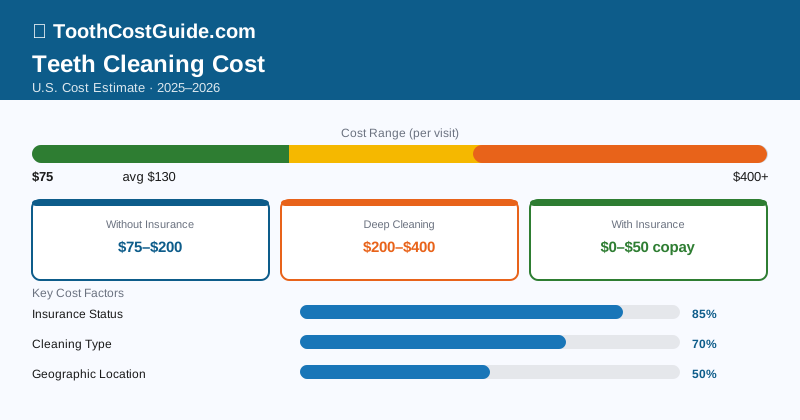
Here’s a number that might surprise you: according to the ADA Health Policy Institute, nearly 47% of American adults skipped a dental visit last year — and cost was the most commonly cited reason. The irony is that skipping a $120 cleaning often leads to a $900 deep cleaning within a year or two. The math doesn’t work in your favor.
So let’s talk about what a cleaning actually costs, how the type of cleaning affects that price dramatically, and where you can get the same quality care for half the price.
Estimates based on 2026 national averages adjusted for your state. Actual costs vary by provider, complexity, and plan details. Get a written treatment estimate before proceeding.
What You’ll Pay for a Teeth Cleaning
| Cleaning Type | Cost Without Insurance |
|---|---|
| Routine adult prophylaxis | $75–$200 |
| Child cleaning (under 14) | $50–$130 |
| Periodontal maintenance (post-gum-disease) | $115–$250 |
| Deep cleaning — scaling & root planing, per quadrant | $150–$350 |
| Deep cleaning — full mouth (all 4 quadrants) | $600–$1,400 |
| Gross debridement (heavy buildup, long gap since last visit) | $75–$150 |
That wide range on the routine prophylaxis — $75 to $200 — is mostly geography and practice type. A cleaning in a private Manhattan office runs closer to $200. The same cleaning at a community health center in rural Ohio might be $75. Dental school clinics typically land at $35–$80 regardless of city.
The Difference Between a Routine Cleaning and a Deep Cleaning
This is where patients often get confused — or feel upsold.
Routine prophylaxis (D1110): Removes plaque and calculus above the gumline. Takes 45–60 minutes. For patients with healthy gums and pocket depths under 3mm. This is the twice-a-year cleaning most people think of.
Scaling and root planing, or SRP (D4341/D4342): Removes buildup below the gumline, under local anesthesia. For patients with active gum disease — specifically, pocket depths of 4mm or more around multiple teeth. This is therapeutic treatment, not maintenance. It costs 4–6x more per session and is done in two appointments (right side, then left).
The key question to ask if your dentist recommends an upgrade: “Can you show me the periodontal charting with pocket depths that indicate I need SRP?” A legitimate gum disease diagnosis comes with documented measurements. If your dentist can’t show you that, get a second opinion.
Skipping cleanings for 2+ years often means your routine visit gets reclassified as a deep cleaning — not as an upsell, but because tartar buildup below the gumline is genuinely present. The most expensive cleaning is the one you’ve been postponing.
What Drives the Price Up (or Down)
Where you live matters more than most people expect. FAIR Health Consumer data shows the 50th percentile fee for an adult prophylaxis (CDT code D1110) ranges from about $90 in lower-cost markets to $175+ in major metro areas. You can look up the exact rate for your zip code at fairhealthconsumer.org — and use that as a reference point when your dentist quotes you a fee.
Who performs it. Private practices charge the most. Dental chains (Aspen Dental, Heartland, Bright Now!) may have lower listed prices but tend to find additional billable services. Dental school clinics charge 50–70% less than private offices, with the work performed by supervised students.
How long it’s been since your last visit. If it’s been 3+ years, expect either a gross debridement first ($75–$150 as a separate line item) or an extended appointment billed at a higher rate. Some offices charge an additional fee for appointments requiring extra time.
With Insurance vs. Without
This is one of the few areas in dentistry where insurance genuinely shines. Nearly every dental plan — HMO, PPO, and indemnity — covers routine preventive cleanings at 100%, twice per year, when you see an in-network provider.
That means a $150 cleaning costs you $0. The same exam and bitewing x-rays that normally run $280–$350 combined? Also $0 at many in-network offices.
Where insurance gets complicated: Deep cleanings. SRP is typically classified under “basic” coverage (80% plans) or “major” coverage (50% plans), not preventive. For a full-mouth SRP at $1,000 total, a plan covering 80% would pay $800 — leaving you $200 plus your deductible. A 50% plan pays $500, leaving you $500+. Check your plan documents before assuming SRP is heavily covered.
Without insurance, your best options:
- In-house membership plans — many dental offices offer $99–$299/year plans that include two free cleanings, annual x-rays, and 10–20% off other treatment. Often better value than buying individual dental insurance.
- Dental school clinics — same quality, supervised care, at roughly half the cost.
- Community health centers (FQHCs) — federally funded clinics that offer sliding-scale fees based on income. Find one at findahealthcenter.hrsa.gov.
At one private practice we looked at, an in-house membership plan cost $199/year and covered two cleanings, one set of x-rays, and one exam — totaling about $380 in services at that office’s normal rates. Net savings: $181. Plus 20% off anything else you need. Compare that to standalone dental insurance at $300+/year with waiting periods and annual maximums.
If a Deep Cleaning Is Recommended
A few things worth knowing before you schedule:
First, you can request a second opinion. A gum disease diagnosis is based on clinical measurements, and different dentists can sometimes classify borderline cases differently. A second opinion at another office costs $50–$100 and is entirely reasonable.
Second, gum disease treatment doesn’t end with SRP. After deep cleaning, you’ll be placed on periodontal maintenance — a more thorough quarterly or four-month cleaning (D4910) instead of the standard twice-yearly prophylaxis. That visit costs $115–$250 per visit, and insurance typically covers it under “basic” (80%) rather than “preventive” (100%). Budget for ongoing costs.
Third, SRP can be financed. CareCredit is accepted at most dental offices and offers 0% promotional financing for 6–18 months. FSA and HSA funds are also eligible — using pre-tax dollars effectively gives you a 22–35% discount off the out-of-pocket total.
Bottom Line
A routine cleaning costs $75–$200 without insurance, and $0 with in-network dental coverage. The real risk isn’t the cleaning cost — it’s skipping cleanings until you need a $1,000+ deep cleaning, then fillings, then crowns. Preventive care is genuinely the cheapest dental strategy over a lifetime.
If you’re uninsured: check whether your dentist offers an in-house membership plan before buying standalone insurance. If you haven’t been to the dentist in years: call before assuming you’ll need expensive treatment — many offices will tell you honestly what to expect based on your history.
Before agreeing to a deep cleaning upgrade, ask your dentist to show you the periodontal pocket depth measurements that support the diagnosis. Pocket depths of 4mm+ with bleeding and bone loss on x-ray are the standard clinical indicators. If you’re shown these, the diagnosis is legitimate. If not, a second opinion costs very little.
Frequently Asked Questions
A routine professional teeth cleaning typically costs $75–$200 for a single visit at most US dental practices. If you need a deep cleaning instead due to gum disease, expect to pay $200–$400 per quadrant of your mouth, which can total $800–$1,600 for full-mouth treatment.
Most dental insurance plans cover 80–100% of preventive cleanings, including two routine cleanings per year, leaving you with little to no out-of-pocket cost. However, deep cleanings are sometimes classified as periodontal treatment and may require a separate deductible or have a 50% coverage rate instead.
The American Dental Association recommends a professional teeth cleaning every 6 months for most people with healthy gums. If you have gum disease or other risk factors, your dentist may recommend cleanings every 3–4 months to prevent progression to more expensive treatments like deep scaling and root planing.