You’ve had the same dentist for twelve years. She does great work and you trust her. Then you switch insurance and discover she’s not in the new network. You go anyway — your insurance is a PPO, you’re covered out-of-network, everything will be fine.
Three weeks later a bill arrives for $700 more than you expected. Welcome to balance billing.
This is one of the most common and most avoidable surprises in dental care. Out-of-network dental coverage exists on PPO plans, but it works through a mechanism — “allowable amounts” — that creates significant exposure most patients don’t understand until they’re looking at a bill.
| Procedure | In-Network Cost | Plan Allowable | OON Dentist Fee | Your OON Bill |
|---|---|---|---|---|
| Cleaning (prophylaxis) | $0 | $100 | $150 | $50–$75 |
| Filling (1 surface composite) | $30–$50 | $150 | $250 | $130–$175 |
| Crown (porcelain) | $500–$700 | $900 | $1,600 | $860–$1,160 |
| Root canal (molar) | $400–$600 | $900 | $1,400 | $770–$1,040 |
| Extraction (simple) | $50–$100 | $150 | $250 | $145–$170 |
| Dental implant | $1,700–$2,500 | $1,500 | $4,000 | $2,750–$3,250 |
The Allowable Amount Problem
PPO dental plans — unlike HMOs — do cover out-of-network providers. That’s a real benefit. The catch is how they calculate what they pay.
When you see an in-network dentist, the insurer pays its percentage of a contracted rate — a fee both parties agreed to in advance. That contracted rate is typically 20–40% below the dentist’s standard rate, and the dentist cannot charge you more than it. You’re protected.
When you see an out-of-network dentist, the insurer pays its percentage of an “allowable amount” — a number the insurer sets unilaterally, often based on what’s called the UCR rate (Usual, Customary, and Reasonable). UCR is supposed to represent the prevailing fee in your area. In practice, UCR rates are often set conservatively and can lag actual market prices by years. The dentist’s actual fee and the insurance allowable may be very different numbers — and you’re responsible for the gap.
Here’s the crown example from the table above in full:
- Your dentist’s fee: $1,600
- Insurance allowable: $900
- Insurance pays 50% of $900 = $450
- You pay your coinsurance: 50% of $900 = $450
- You also pay the balance bill: $1,600 – $900 = $700
- Your total: $1,150
Compare that to the same crown in-network:
- Negotiated contracted rate: $1,200
- Insurance pays 50% = $600
- You pay 50% = $600
- No balance bill (in-network dentists can’t balance bill)
- Your total: $600
The difference: $550 more for the same procedure, same quality, same dentist skill — just an in-network vs. out-of-network designation.
The balance bill is the gap between what your dentist charges and what the insurance company decides to recognize. Out-of-network dentists are free to set their fees without restriction. They don’t have to accept the insurance allowable. You do have to pay whatever remains.
HMO plans and out-of-network: Dental HMOs typically provide zero coverage for out-of-network providers — full stop. If you see an OON dentist with a dental HMO, you pay the entire bill yourself. The only carved-out exception is true emergencies when no in-network dentist is available.
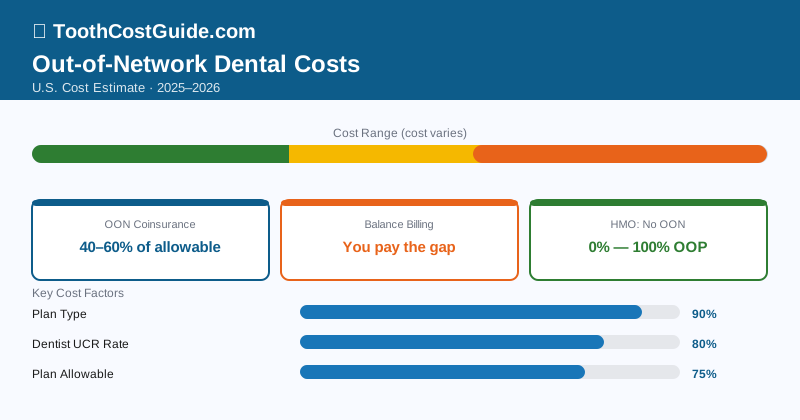
With an out-of-network PPO dentist, you face two separate costs: your coinsurance percentage AND the gap between the dentist’s fee and the plan’s allowable amount (balance billing). Always call your insurance to get the plan’s allowable amount for your procedure BEFORE seeing an out-of-network provider so you know your total exposure.
Plan Types and Their OON Exposure
Not all PPO plans treat out-of-network use the same way:
- PPO-only plans: Cover only in-network dentists, despite the PPO name. Common in employer HMO-style plans. Out-of-network = 0% coverage.
- PPO + out-of-network: Cover OON at reduced benefit, typically 40–60% of the allowable amount. This is most individual market PPOs.
- Indemnity plans: Pay a fixed percentage of whatever the dentist actually charges, not of a limited allowable. Better OON protection, higher premiums. Makes sense if you frequently see OON providers.
The UCR rate issue is worth emphasizing again. In high-cost cities — New York, San Francisco, Boston — dentists routinely charge 150–300% of the UCR rate. Balance bills in these markets can be enormous. In lower-cost regions, dentist fees track closer to UCR and OON exposure is less severe. If you live in a high-cost metropolitan area, your OON risk is substantially higher than the averages suggest.
Emergency OON care: Dental emergencies on the road or in unfamiliar cities often require OON care. Most PPO plans cover this at the standard OON rate — you still face balance billing. A $500–$1,000 emergency dental fund in an HSA or savings account is practical insurance against this scenario.
Who This Affects Most
Longtime patients whose dentist left the network. Networks change. A dentist who was in-network when you signed up may not be in-network now. If you haven’t verified in the past year, you might not know. This situation catches more patients than any other OON scenario.
Patients in areas with limited network providers. Rural communities and some underserved suburban areas have few in-network choices. Out-of-network use isn’t a choice — it’s the only option available.
Patients with specialized care needs. Periodontists, oral surgeons, prosthodontists, and endodontists may not participate in most dental networks. If you need specialty care, you’re more likely to be going out-of-network and may not even realize it.
Travelers with dental emergencies. Getting a tooth knocked out or an abscess while traveling nearly always means OON care. The bill can be significantly larger than you’d expect.
How to Keep OON Costs Under Control
Q: How do I verify my dentist is actually in-network?
Don’t rely on the insurer’s online directory — network listings are often months out of date. Call your insurance company directly with the dentist’s name and NPI (National Provider Identifier) number. Then call the dental office itself and say: “I have [Insurer] [Plan Name] — are you currently in-network for that specific plan?” A dentist can be in Delta Dental PPO but not Delta Dental Premier; in Cigna DPPO but not Cigna DHMO. Plan type matters.
Q: What is a predetermination and should I always get one?
For any procedure over $200, ask your dentist to submit a predetermination (also called a pre-authorization or pre-treatment estimate) before work begins. The insurer reviews the planned procedure and responds in writing with exactly what they’ll pay, what the allowable is, and what you’ll owe. It’s not a guarantee, but it’s a strong indicator — and it eliminates surprises before you’re committed to a $1,600 crown.
Q: Can I negotiate with an OON dentist?
Yes, and more often than you’d expect, it works. Before your appointment, ask the dental office directly: “Will you accept my insurance’s allowable amount as payment in full for this procedure?” Many dentists, especially with established patients they want to retain, will agree to this rather than risk losing you to an in-network competitor. Get the agreement in writing before treatment.
Q: What if I switch to a better plan?
Indemnity dental plans are designed for patients who see OON providers frequently. Instead of paying a limited allowable, they pay a percentage of the dentist’s actual fee — greatly reducing balance billing exposure. These plans cost more in premiums but may net out cheaper for someone who regularly sees an OON dentist for major work.
Q: Can I use tax-advantaged accounts for balance bills?
Yes. Balance bills are qualified dental expenses. Paying them with pre-tax HSA or FSA funds reduces the effective cost by your marginal tax rate — typically 22–37%. If you know you’ll be seeing OON providers, max your FSA election during open enrollment to build a buffer.
The Surprise Billing Law (No Surprises Act), which protects patients from surprise medical bills, does NOT apply to dental care in most cases. Dental is largely exempt. Always confirm costs before treatment — you have no federal protection against large surprise dental balance bills.
Out-of-network dental costs can be dramatically higher than in-network costs due to balance billing — the gap between your dentist’s fee and the insurance company’s allowable amount. For major procedures like crowns and implants, OON balance bills can exceed $500–$1,500 per procedure. Always verify in-network status before appointments, get predeterminations for major work, and ask OON dentists to accept the plan allowable before assuming the bill is unavoidable.
Bottom Line
Out-of-network dental coverage exists on PPO plans — but it comes with two separate cost layers that most patients don’t fully understand until they see a bill. Your coinsurance percentage applies only to the plan’s allowable amount, not the dentist’s actual fee. The gap between those two numbers is yours to pay, with no federal protection against the surprise. A single out-of-network crown can cost $500–$1,000 more than the same procedure in-network. Protect yourself: verify in-network status before every appointment by phone, request predeterminations for anything major, ask OON dentists to accept the plan allowable, and use HSA or FSA funds to soften the cost when balance bills do arrive.
Frequently Asked Questions
Out-of-network dental visits typically cost 2–3 times more than in-network visits due to balance billing. For example, an in-network cleaning might cost $100–150 with your copay, but an out-of-network provider could bill $300–450 for the same service, leaving you responsible for the difference your insurance won't cover.
Most PPO plans do cover out-of-network dental care, but at a much lower reimbursement rate—typically 50–70% of the allowed amount rather than 80–90% for in-network providers. You're responsible for any balance between what your insurance pays and what the dentist charges, which is why out-of-network costs spike significantly.
Before your appointment, contact your dentist's office and your insurance company to get a written estimate of what you'll owe out-of-pocket. Ask your dentist if they're willing to accept your insurance's allowed amount as payment in full, or consider switching to an in-network provider to eliminate balance billing entirely.