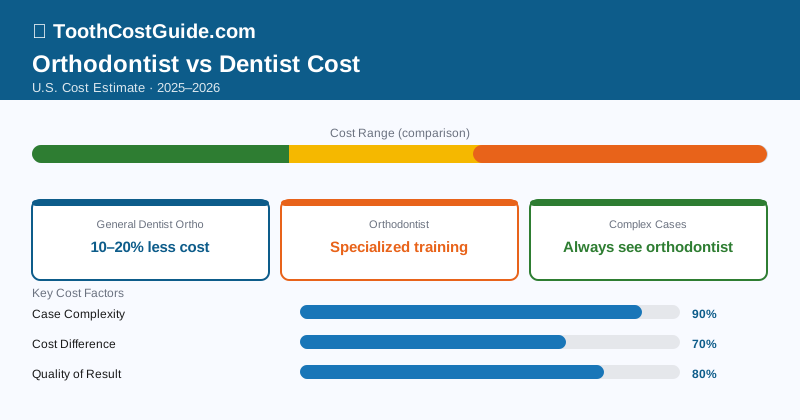
Your regular dentist can legally do Invisalign. That’s true. It’s also true that an orthodontist completed 2–3 years of additional specialty training focused almost entirely on moving teeth, developing bites, and managing jaw mechanics across thousands of supervised cases. Whether that expertise gap matters for your specific situation depends entirely on what’s actually wrong with your teeth.
Orthodontists typically charge 10–30% more than general dentists for comparable orthodontic cases. For mild adult cosmetic cases, that premium isn’t always necessary. For anything involving significant bite correction, teenagers, jaw development, or moderate-to-complex movements, it absolutely is.
| Provider Type | Invisalign (mild case) | Braces (mild-moderate) | Braces (complex) |
|---|---|---|---|
| General dentist | $2,500–$5,000 | $2,800–$5,500 | N/A (refer out) |
| Orthodontist (standard) | $3,000–$6,500 | $3,000–$7,500 | $4,500–$8,000 |
| Orthodontic residency (dental school) | $1,500–$3,500 | $1,500–$4,000 | $2,000–$4,500 |
| Board-certified orthodontist | $3,500–$8,000 | $3,500–$8,000 | $5,000–$10,000+ |
The Actual Difference in Training
General dentist: Four-year dental degree (DMD or DDS), licensed for general dental care. Many complete continuing education courses in Invisalign provision — the most popular being Align Technology’s certification program. They can appropriately treat mild crowding, spacing, and minor cosmetic concerns in motivated adults.
Orthodontist: Four-year dental degree plus a 2–3 year accredited orthodontic residency — which focuses exclusively on tooth movement, bite development, jaw mechanics, facial growth, and complex malocclusion. Orthodontists typically see 30–50 new cases per month. A general dentist providing Invisalign may see 5–10 cases per year. Volume matters.
Board-certified orthodontist: Completed the American Board of Orthodontics (ABO) written and clinical examination — a voluntary additional credential. Not required to practice as an orthodontist, but the gold standard credentialing marker.
When a General Dentist Is the Right Choice
A dentist is appropriate for:
- Very mild adult crowding or spacing (1–3mm total)
- Post-orthodontic relapse with minimal shifting
- Single-tooth cosmetic corrections
- Invisalign Go or Express cases in adults with healthy gums and no bite issues
- Patients who have been evaluated by an orthodontist and confirmed to have uncomplicated mild cases
Practical advantages: Lower cost (typically 10–20% less for equivalent mild cases), integrated care with your existing provider, convenient for patients already established with a dentist who does a meaningful volume of aligner cases.
When You Should See an Orthodontist
Orthodontic cases that belong with a specialist:
- Any significant bite correction — overbite, underbite, crossbite, open bite
- Significant crowding (more than 4–5mm per arch)
- Children and teenagers (jaw development adds complexity that requires specialty training)
- Phase 1 early interceptive treatment
- Cases needing palate expanders or functional appliances
- Adults with complex skeletal issues
- Cases involving surgical jaw coordination
- Patients with prior history of gum disease or bone loss
- Anything requiring significant 3D tooth movements
Orthodontic tooth movement involves forces applied to teeth and transmitted through roots to supporting bone. Improper force application can cause root resorption, bone loss, and permanent damage. Those 2–3 years of residency exist because managing those forces safely across varied case types requires specialized knowledge and supervised practice — not a weekend Invisalign certification course.
For mild adult cosmetic cases, a general dentist providing Invisalign can deliver appropriate treatment at a modest cost savings. For any case involving significant bite correction, teenage treatment, jaw development concerns, or moderate-to-complex tooth movements — see a specialist orthodontist. The difference in training is substantial and the cost difference is modest.
The Real Cost Difference by Scenario
Mild adult crowding (2–3mm), Invisalign:
- General dentist: $2,500–$4,000
- Orthodontist: $3,000–$5,000
- Difference: $500–$1,000 (15–25% more for orthodontist)
Teen comprehensive braces:
- General dentist: Typically refers to orthodontist — which is the appropriate call
- Orthodontist: $3,000–$6,000
Adult with overbite, moderate complexity:
- General dentist: May attempt with Invisalign, $3,000–$5,500
- Orthodontist: $4,000–$7,500
- Difference: $1,000–$2,000
The bottom line on cost is straightforward: for mild adult cases where either provider is appropriate, the dentist’s 10–20% lower fee is a real and legitimate savings. For moderate or complex cases, the orthodontist is the right provider regardless of cost comparison.
Insurance Coverage Differences
Most dental insurance plans with orthodontic benefits cover treatment from both general dentists and orthodontists at the same benefit level — 50% up to the lifetime maximum. Choosing an orthodontist doesn’t reduce your coverage.
The wrinkle: some general dentists who provide Invisalign are not credentialed as orthodontic providers in insurance networks. That means an out-of-network claim — potentially lower reimbursement or no coverage at all.
Confirm with your insurance company whether your specific dentist is in-network for orthodontic services before starting treatment. “In-network for general dentistry” and “in-network for orthodontics” are different designations. A provider can be one without being the other.
How to Make the Decision
Step 1: Get an orthodontist consultation first for any case that isn’t obviously mild. They’ll diagnose actual case complexity. If it’s genuinely simple, they’ll tell you. This gives you an informed baseline regardless of which provider you ultimately choose.
Step 2: Ask your dentist how many Invisalign cases they treat per year. A dentist handling 50+ cases annually has real experience. A dentist who has completed 5–10 cases total doesn’t have the volume for confident complex case management. Ask the question directly.
Step 3: Be honest about complexity. Bite correction, jaw issues, significant crowding, teenage treatment — pay the specialist premium. The cost difference for a 24-month treatment is typically $500–$1,500. The expertise difference for complex cases is far larger than that.
Step 4: For mild adult cosmetic cases, either provider can be appropriate. Choose based on provider case volume, insurance network status, and your comfort level with the provider.
The Bottom Line
Orthodontists charge 10–30% more than general dentists for equivalent mild cases, but bring 2–3 years of specialty training that justifies the premium for anything beyond mild adult cosmetic corrections. For children, teenagers, significant bite issues, or moderate-to-complex malocclusion, an orthodontist is the appropriate provider. Full stop. For mild adult crowding in an otherwise healthy mouth, a high-volume Invisalign-certified general dentist is a reasonable and cost-effective option.
The decision between orthodontist and dentist for braces should be driven by case complexity. Children and teens: always see an orthodontist. Adults with significant bite issues: orthodontist. Adults with very mild cosmetic crowding: either is appropriate. The $500–$1,500 specialist premium for a 2-year treatment is trivial compared to the cost of suboptimal treatment outcomes that require correction.
Frequently Asked Questions
Orthodontists typically charge 10–30% more than general dentists for braces, with total treatment costs ranging from $3,000–$7,000 at an orthodontist versus $2,500–$5,500 at a general dentist for traditional metal braces. The difference widens for Invisalign and ceramic options, where orthodontists may charge $4,000–$8,000 compared to $3,500–$6,500 at a general dentist.
Most dental insurance plans cover braces at either provider, but typically cap coverage at $1,200–$1,500 lifetime, leaving you responsible for the remainder out-of-pocket. However, some plans require you to see an in-network orthodontist or may pay a lower percentage (50%) for general dentists performing orthodontic work, so verify your specific plan's coverage before choosing a provider.
Your general dentist can legally straighten teeth and offer Invisalign, but orthodontists complete 2–3 years of additional specialty training focused on complex bite issues, jaw mechanics, and long-term tooth stability across thousands of cases. For simple alignment issues, a dentist may deliver comparable results in 12–18 months, but complex cases involving bite correction or severe crowding typically achieve better, longer-lasting outcomes with an orthodontist over 18–24 months.