Q: Is it actually possible to negotiate a dental bill?
A: Yes. At most independent dental offices, it’s not only possible — it’s expected.
Q: Doesn’t that feel awkward?
A: Less awkward than paying $400 more than you had to. And once you understand how dental fee schedules actually work, asking for a discount stops feeling like you’re doing something unusual.
Q: How much can you realistically save?
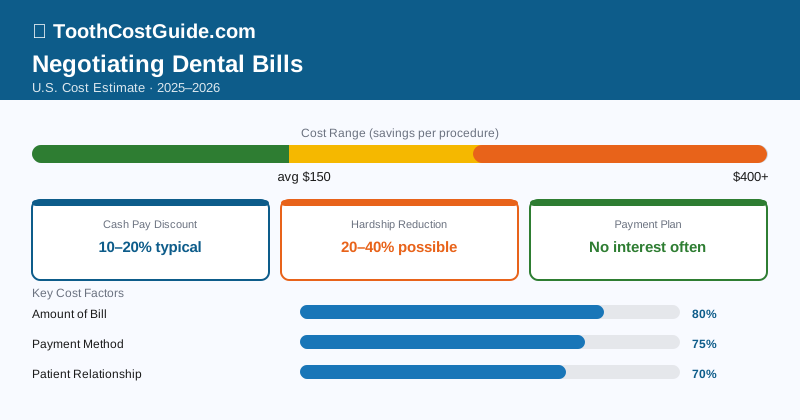
A: 10–30% on most procedures through cash-pay discounts alone. 20–50% in hardship situations. Billing error corrections can be even larger.
Here’s what the data shows and exactly how to do it.
| Negotiation Tactic | Typical Savings | Best For |
|---|---|---|
| Cash / same-day payment discount | 10–20% | Any patient paying out of pocket |
| Bundling multiple procedures | 5–15% | Patients needing several treatments |
| Hardship / financial difficulty request | 20–50% | Low-income or job-loss situations |
| Phasing treatment (delaying non-urgent work) | Avoids immediate cost | Patients managing cash flow |
| Asking for generic/lower-cost alternatives | 20–40% | Materials choices (amalgam vs. composite) |
| Requesting itemized bill review | Varies | Catching billing errors (common!) |
| Dental school referral from dentist | 40–60% | Complex or expensive procedures |
Why Dental Fees Are Negotiable in the First Place
Dental practices set their own fee schedules based on regional “usual, customary, and reasonable” (UCR) rates. Those rates are starting points — not fixed prices. The reason they’re typically set 10–30% above break-even is to leave room for insurance adjustments. Insurance companies negotiate contracted rates that pull fees downward; the fee schedule is set high enough that after the insurance discount, the practice is still collecting a viable amount.
When you pay cash, there’s no insurance company taking a haircut. There’s also no billing overhead, no claims processing, no waiting 30–90 days for reimbursement, and no risk of a denial. A dentist collecting $700 cash today is often worth more to a small practice than $1,000 billed to insurance with a six-week wait and uncertain outcome. Your immediate payment is leverage you probably don’t realize you have.
What Real-World Savings Look Like
- Crown: List price $1,200 → cash pay negotiated: $900–$1,000 (savings: $200–$300)
- Root canal: List price $1,400 → hardship discount: $700–$1,000 (savings: $400–$700)
- Full dentures: List price $2,500 per arch → bundle/cash: $1,800–$2,000 (savings: $500–$700)
- Multiple fillings: 4 fillings at $200 each = $800 → bundle: $600–$680 (savings: $120–$200)
- Extraction: List price $250 → cash pay: $175–$210 (savings: $40–$75)
Dental office manager surveys suggest 60–80% of independent dental practices will offer a cash discount of 5–20% when asked directly. The key phrase: “when asked.” The discount isn’t volunteered. You have to ask.
Important caveat: Corporate dental chains — Aspen Dental, Heartland, Western Dental, and others — typically do not negotiate individual bills. Their pricing is set at the corporate level. This strategy works at independently owned practices, which still make up the majority of US dental offices.
Who Can Negotiate What
Cash-pay discounts are available to any self-pay patient. You don’t need to demonstrate financial hardship. You’re simply a patient who’s paying immediately without insurance billing, and you’re asking for the rate that reflects that.
Bundled discounts apply when you’re committing to multiple procedures at the same practice. The more work you’re agreeing to, the more value the practice captures by retaining you — and the more room they have to negotiate.
Hardship discounts require a more personal conversation. There’s no formal qualification criteria. The conversation is honest: “I’ve had some financial setbacks this year, and I want to be upfront about what I can manage.” Dentists prefer to collect something over sending a bill to collections.
One important note: If you have dental insurance, negotiating away your copay gets complicated. Most insurance contracts prohibit dentists from waiving patient cost-sharing without insurer disclosure. This strategy is cleanest when you’re fully self-pay.
Do not attempt to negotiate after treatment is complete and the bill is already sent to collections. Negotiate before treatment begins or, at most, at checkout before leaving the office. Timing is everything.
Eight Concrete Steps With Exact Scripts
Get the treatment plan in writing first: Before any negotiation, ask for a written treatment plan with itemized procedure codes (CDT codes) and fees. Review it carefully for anything you don’t understand.
Check the itemized bill for errors: Billing errors occur in an estimated 25–40% of dental bills. Common issues: duplicate charges, wrong tooth number, wrong procedure code, charges for a procedure that was modified or cancelled. Ask to review line items.
Research fair prices: Use Fair Health Consumer (fairhealthconsumer.org) or Healthcare Bluebook to check what the procedure typically costs in your zip code. This gives you a benchmark.
Use the cash-pay script: Call or speak in person with the office manager (not the receptionist). Say: “I’d like to pay for this treatment in full with cash/check on the day of service. Can you offer a self-pay or cash discount? I’ve seen practices offer 10–15% — would something like that work?”
Bundle for a bigger discount: If you need multiple procedures, say: “I need [list procedures]. If I agree to have all of this done here, is there a bundled fee you could offer? I want to commit to your practice for all of this work.”
Request a hardship reduction if applicable: Ask to speak privately with the dentist or office manager. Be honest: “I want to be straightforward — I’ve had some financial difficulty this year and I can’t afford the full fee. I’m committed to getting this care here. Is there any flexibility on the cost, or do you have a financial assistance program?”
Offer to pay immediately in exchange for a discount: “If I write you a check right now for $X, can we call it settled?” Immediate payment has real value to a small business.
Ask about lower-cost alternatives: “Is there a less expensive option that would still address the problem? For example, could an amalgam filling work instead of composite? Could we do a less complex restoration first and see how it holds up?”
The best person to negotiate with is the office manager — not the front desk receptionist and not the dentist (who may be uncomfortable with billing conversations). Call during a slow time (Tuesday or Wednesday morning) and ask specifically for the office manager. Come prepared with your procedure list and a target price in mind.
Pros and Limitations of This Approach
What works in your favor:
- No applications or approvals needed — it’s a conversation
- Works at the majority of independent dental practices
- Can be layered with other savings strategies (dental discount plan, payment plan, FSA)
- No impact on credit score regardless of outcome
Where this doesn’t apply:
- Corporate chains generally won’t move on price
- Requires some comfort with the ask — most people don’t like requesting discounts
- Insurance subscribers have significantly less flexibility due to contract provisions
- Hardship discounts aren’t guaranteed — it depends on the practice and the dentist
Bottom Line
Negotiating dental bills is one of the most direct ways to cut costs — and it requires nothing more than a conversation. Asking for a cash-pay discount succeeds 60–80% of the time at independent practices. For larger procedures or genuine financial hardship, respectful, direct communication can reduce a bill by 20–50%. Check your itemized bill for errors first, reference published fee benchmarks if you have them, offer immediate payment, and target the office manager rather than the front desk. A $2,000 dental bill, negotiated well and paid in cash that day, can regularly become $1,200–$1,500. The worst response you’ll get is no.
Frequently Asked Questions
A single dental crown ranges from $800 to $1,500 at most US dental offices, depending on material (porcelain, ceramic, or zirconia) and your location. By negotiating a cash-pay discount, you can typically reduce this to $560-$1,050, saving 10-30% off the standard fee.
No, insurance plans do not recognize unofficial negotiated discounts—they only cover their allowed percentage of the dentist's standard fee. However, if you pay cash and negotiate directly with the office, you bypass insurance entirely and pocket the full discount without reporting it to your insurer.
Negotiating before treatment is most effective because offices have flexibility in their pricing and can lock in a discount upfront; negotiating after treatment is harder but still possible, especially if you ask at the time of billing. The key is asking before you leave the chair or before the final bill is sent, when the dentist is most willing to adjust fees.