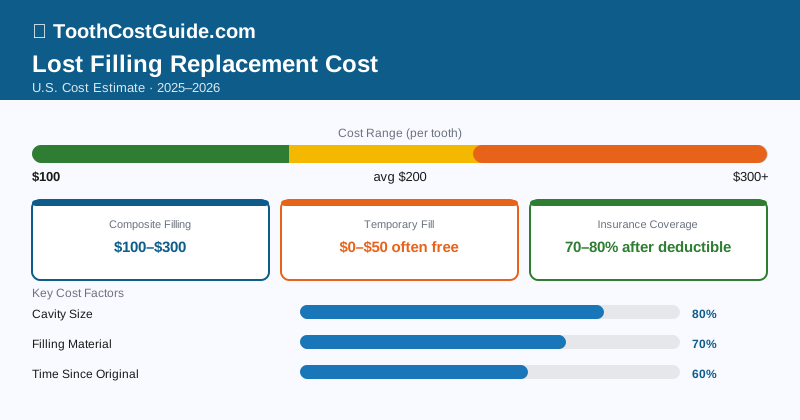
Of all the things that can go wrong with a tooth, losing a filling is probably the most manageable. You feel the gap, maybe some sensitivity to cold, a slight rough edge your tongue keeps finding. Replacing it typically costs $100–$300 — and with dental insurance covering 70–90% of basic restorative work, your out-of-pocket could be under $50. The complication? Waiting too long. An open cavity collects bacteria every day, and what starts as a simple $150 filling replacement can quietly escalate to a crown if you ignore it for months.
| Replacement Option | Cost (No Insurance) |
|---|---|
| Emergency exam + X-ray | $75–$200 |
| Composite (tooth-colored) filling | $100–$300 |
| Amalgam (silver) filling | $75–$200 |
| Large filling / buildup (extensive decay) | $250–$500 |
| Inlay or onlay (lab-made) | $600–$1,500 |
| Crown (if tooth too damaged for filling) | $1,000–$1,800 |
| Temporary filling (OTC or chairside) | $20–$100 |
Five Factors That Change What You’ll Pay
How big the original filling was. A single-surface filling — covering just one face of the tooth — replaces for $100–$150. A multi-surface filling that wrapped around two or three sides of a molar goes for $200–$300 to redo. If the original was already large, there’s a real chance the dentist finds additional decay around the edges when they clean it out, which pushes the size up further.
How long it’s been out. A filling that fell out this morning with no discomfort? Straightforward replacement. A filling that’s been missing for three weeks? New bacteria have had time to colonize the gap, possibly deepening the cavity or irritating the pulp. Every week without a protective seal increases the likelihood of a more expensive fix.
Tooth location. Front tooth fillings are quicker and slightly cheaper than molars. Molar restorations require more isolation, more material, and more chair time — all of which factor into the fee.
Whether a crown is now the right call. If the original filling was already large — covering more than roughly half the tooth — and it fell out, the remaining tooth walls may be too thin and fragile to support another filling reliably. In that case, a crown ($1,000–$1,800) becomes the appropriate treatment. It’s a bigger jump in cost, but placing another filling on a heavily compromised tooth often just delays an inevitable crown while risking a fracture in the meantime.
Geography and practice type. Dental fees vary 20–40% depending on whether you’re in a major city or a rural area. Dental school clinics charge 40–65% less than private practices.
Replacement Options: What Each One Involves
Temporary filling — $20–$100. Over-the-counter kits like Dentemp and Recapit cost $10–$20 at any pharmacy. They’re zinc oxide-based materials that set in the mouth and protect the cavity from food and bacteria for a few days to a couple of weeks. Not a long-term solution, but entirely appropriate as a bridge to your appointment. Dentists can also place a more durable chairside temporary for $50–$100 if you need a few weeks before the permanent fix.
Standard composite filling — $100–$300. Tooth-colored resin placed directly into the cavity and bonded to surrounding tooth structure. One appointment. This is the standard replacement for the vast majority of lost fillings. Insurance covers it at 70–90% under basic restorative benefits.
Amalgam filling — $75–$200. Still a legitimate option, especially for back teeth where appearance isn’t a concern. Silver amalgam costs 30–50% less than composite and is similarly durable. If budget is tight and the tooth isn’t visible when you smile, amalgam gets the job done.
Inlay or onlay — $600–$1,500. Lab-fabricated restorations for larger cavities where a direct composite won’t hold reliably. More durable than standard fillings for big preparations. Requires two appointments. Covered at 50–80% by most plans.
Crown — $1,000–$1,800. When the remaining tooth walls are too thin to hold a filling, a crown becomes necessary. Covered at 40–60% under major restorative benefits after the deductible.
What Insurance Actually Covers
Lost filling replacement falls squarely in “basic restorative” territory on most dental plans — the most favorable coverage tier:
- Coverage percentage: 70–90% after the annual deductible
- Deductible: $50–$100 per year (often already met by mid-year)
- Frequency limitations: Some plans only cover filling replacement on the same tooth every 2–5 years — worth checking if your filling was recently placed
- Annual maximum impact: Minimal; a simple filling replacement won’t come close to your $1,000–$2,000 annual cap
Out-of-pocket example with insurance: a $175 composite filling costs you $35 after your plan pays 80%.
Without insurance: use a dental discount plan ($80–$150/year) to bring that $175 down to $100–$130.
What to Do Right Now
Don’t panic — this is fixable. But there are a few things to do right away:
- Protect the tooth with an OTC temporary filling kit from a pharmacy. $10–$20 and available at CVS, Walgreens, Walmart. Seal the cavity so food and bacteria can’t pack in.
- Avoid chewing on that side. Food in an open cavity causes pain and increases bacterial exposure.
- Manage sensitivity with ibuprofen and, if the nerve is exposed and causing sharp pain, a dab of clove oil directly on the area.
- Call your dentist. Most offices can fit a lost filling appointment within 1–2 days — it’s a quick procedure for them.
- Discard the old filling material if you find it. Don’t try to put it back.
If you develop severe pain, swelling, or notice a pimple-like bump on the gum near the tooth, that’s a different situation — potentially an infected nerve requiring more than just a filling replacement.
Saving Money Without Cutting Corners
Replace it promptly. The number one money-saving move here is simply not waiting. A $150 replacement today can easily become a $1,500 crown if secondary decay progresses over months.
Consider amalgam for back teeth. If appearance isn’t a concern, amalgam fillings cost 30–50% less than composite and are just as effective. Ask your dentist if it’s an option.
Use discount plans if uninsured. A dental discount plan typically costs $80–$150/year and reduces filling fees to $70–$150 — often paying for itself with a single visit.
Use FSA or HSA funds. Filling replacements are fully eligible expenses. Paying with pre-tax dollars effectively cuts your cost by 22–37% depending on your tax bracket.
Ask if a large direct composite could substitute for a crown short-term. If your dentist recommends a crown, ask honestly whether a large composite buildup is a reasonable 1–3 year interim while you save up or wait for your insurance waiting period to clear. This doesn’t apply in every situation, but sometimes it buys meaningful time.
A lost filling left open for more than a few weeks invites new decay into the gap. Protect it temporarily with an OTC kit and see a dentist within a few days. What costs $150 today can cost $1,500 if you wait months.
If a lost filling is accompanied by severe pain, swelling, or a pimple-like bump on the gum, the underlying tooth may be infected. This requires urgent dental care — possibly a root canal — not just a replacement filling.
The Bottom Line
Replacing a lost filling costs $100–$300 — among the least expensive dental procedures there is. With dental insurance covering 70–90%, you might pay $35 or less out of pocket. The only real financial danger here is waiting: every week the cavity sits exposed is a week for decay to deepen and costs to escalate. Grab an OTC temporary kit, protect the tooth, and call your dentist in the morning.
Frequently Asked Questions
Replacing a lost filling typically costs $100–$300 without dental insurance, depending on the filling material and tooth location. Composite (tooth-colored) fillings are usually more expensive than traditional amalgam fillings, which may cost $100–$150 for a simple replacement.
Most dental insurance plans cover 70–90% of filling replacement costs as basic restorative work, potentially bringing your out-of-pocket cost under $50. However, coverage depends on your specific plan, whether you've met your deductible, and how long it's been since the original filling was placed—some insurers won't cover replacements within a certain timeframe.
You should schedule a replacement within 1–2 weeks to prevent complications, as an open cavity collects bacteria and can lead to decay, sensitivity, or infection that may require more expensive treatment like a root canal. Waiting longer risks the tooth structure deteriorating, which could increase your overall dental costs significantly.