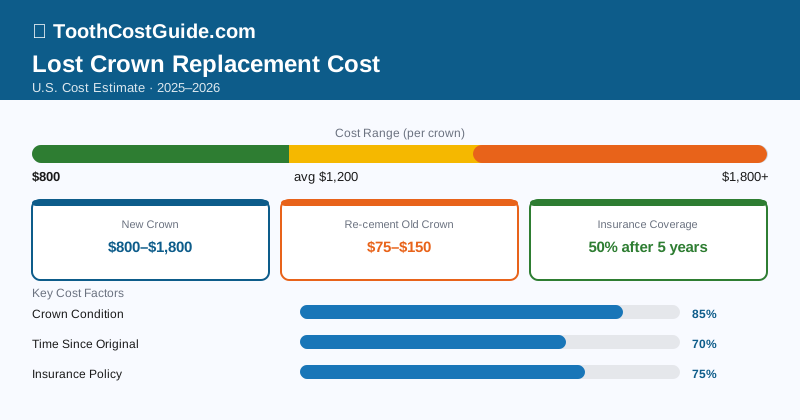
Here’s a scenario that happens more than most people realize: you’re eating something chewy and suddenly feel something hard in your mouth — your dental crown just let go. The panic is understandable, but the reality is often reassuring. If the crown itself is undamaged and the tooth underneath hasn’t decayed, re-cementing it runs just $75–$200. It’s only when the crown is broken, or decay has worked its way under the margin, that costs climb to $800–$1,800 for a new fabrication.
| Situation | Treatment | Cost (No Insurance) |
|---|---|---|
| Crown intact, tooth undamaged | Re-cementation | $75–$200 |
| Crown damaged/cracked | New crown fabricated | $800–$1,800 |
| Decay found under crown | Remove decay + new crown | $1,200–$2,500 |
| Tooth needs buildup before crown | Core buildup + crown | $1,500–$2,500 |
| Root canal needed (decay reached pulp) | Root canal + crown | $1,700–$3,300 |
| Emergency exam + X-ray | Diagnosis | $75–$200 |
| Temporary crown (while waiting) | Chairside temporary | $100–$300 |
Why Crowns Fall Off — and Why It Matters for Your Bill
The cause of crown loss largely determines what comes next.
Cement failure is the most common culprit. The crown’s retention depends on zinc phosphate or resin cement that can break down over years. If cement failure is the only issue — tooth is fine, crown is intact — re-cementation is fast and cheap.
New decay at the crown margin. Crowns don’t prevent cavities at the junction between crown and natural tooth. Bacteria creep into microleakage over time. If decay has established itself along the gumline where the crown meets the tooth, it must be completely removed. Depending on how extensive it is, you may need a new crown and possibly a core buildup.
Fractured tooth underneath. Sometimes the crown held fine, but the remaining tooth structure cracked. This is a more complex situation — the dentist must assess whether enough tooth remains to support a new crown or whether extraction is required.
Crown was never a great fit. Old crowns that were always slightly off in fit or occlusion may repeatedly fail or accumulate decay faster. A replacement crown often addresses fit issues the original missed.
Treatment Options and What They Cost
Re-cementation ($75–$200): The best outcome. The dentist cleans the crown’s interior and the prepared tooth surface, checks for any new decay or fracture, and re-cements. Takes maybe 20–30 minutes. Bring the crown in — store it in a small container or zip-lock bag.
New crown — traditional process ($800–$1,800): When the old crown can’t be reused, the dentist prepares the tooth (reshaping if needed), takes an impression or digital scan, seats a temporary crown, and orders the permanent from a dental lab. Two to three weeks later, the permanent crown gets cemented. The temporary crown cost ($100–$300) is sometimes bundled into the overall fee.
Same-day CEREC crown ($1,200–$1,800): If the practice has in-office milling equipment, the crown can be designed and milled digitally in a single visit. No temporary crown, no return appointment. Pricing is comparable to lab-fabricated crowns, so the main benefit is convenience.
Core buildup ($200–$400, usually added to crown cost): When significant tooth structure has been lost to decay or fracture beneath the crown, a composite buildup reconstructs the core before the new crown is placed. Most dental plans cover buildups alongside crowns at 50–80%.
Q&A: Common Questions About Lost Crowns
Can I put the crown back myself? Temporarily, yes — but not with Super Glue. Pharmacy dental cement kits (Dentemp, Re-cap) cost $10–$15 and are specifically designed for this purpose. They can hold the crown in place for a few days while you arrange an appointment. Denture adhesive also works in a pinch. Never use Super Glue — it damages the crown’s internal surface permanently.
How urgent is this really? More urgent than it feels. The prepared tooth underneath a crown has been ground down significantly — it’s thinner and more vulnerable than a natural tooth. Exposed for more than a few days, it’s susceptible to decay, temperature sensitivity, and fracture. See a dentist within 24–48 hours.
What if I can’t find the crown? A new one gets made. This is the $800–$1,800 path. No workarounds on this one.
Does insurance cover a replacement crown if they just covered the original? Only if enough time has passed. Most dental plans have a frequency limitation of 5–7 years on the same tooth. If your original crown was covered less than five years ago, the replacement likely won’t be, regardless of why it came off.
Insurance: What’s Typically Covered
Crowns fall under “major restorative” on most dental plans:
- Coverage level: 40–60% after deductible and annual maximum
- Waiting periods: Many plans require 6–12 months of active enrollment before covering crowns
- Frequency limitation: One covered crown per tooth every 5–7 years is standard
- Annual maximum impact: $1,000–$2,000 per year; a single crown can consume most or all of it
With insurance on a $1,400 crown: insurance pays 50% after $100 deductible = roughly $600, leaving you around $800. Re-cementation at $150 may be covered at 80–100% as a basic procedure, leaving you with close to nothing out of pocket.
Five Ways to Save Money Here
Bring the crown to every appointment. Even if you suspect it needs replacement, bring it. The dentist needs to assess it, and re-cementation at $75–$200 beats new fabrication at $1,400+ every time.
Ask about frequency limitations before assuming coverage. Don’t assume because your original crown was covered that a replacement automatically will be.
Dental schools for new crowns. Fees run $400–$700 — substantially below private practice. Multiple appointments and longer wait times are the trade-offs.
Negotiate cash pricing. Some dentists offer 5–15% discounts for upfront cash or check payment. Worth asking directly, particularly for a large-ticket crown.
Time your treatment across benefit years. If you’ve burned through most of your annual maximum already, discuss doing the temporary now and scheduling the permanent crown in January when benefits reset. Many dental offices are very familiar with this approach.
Never use Super Glue or craft adhesives to re-attach a dental crown. These products contain chemicals that are toxic in the mouth and can permanently damage the crown’s internal surface, preventing proper professional re-cementation. Use only dental cement products from a pharmacy as a temporary measure.
The Short Version
A lost crown costs $75–$200 to re-cement if it’s intact — or $800–$1,800 if a new one needs to be made. Always save the crown. Use pharmacy dental cement as a short-term fix, but get to a dentist within 24–48 hours to protect the prepared tooth underneath. With typical dental insurance, a new crown runs $600–$900 out of pocket after your plan pays its share.
Frequently Asked Questions
Replacing a lost dental crown with a new one typically costs $800–$1,800, depending on the material (porcelain, ceramic, or gold) and your dentist's location. If your original crown is still intact and only needs re-cementing, the cost drops significantly to just $75–$200.
Most dental insurance plans cover 50% of crown replacement costs after you meet your deductible, though some plans may classify it as a major procedure with a waiting period. You should expect to pay $400–$900 out-of-pocket for a new crown with average coverage, though plans vary widely in their limits and exclusions.
If you have the crown and it's undamaged, most dentists can re-cement it the same day or within 24 hours, taking just 15–30 minutes during your appointment. However, if the crown is lost, broken, or decay is present under the tooth, you'll need a new crown, which typically takes 2–3 weeks to fabricate and place.