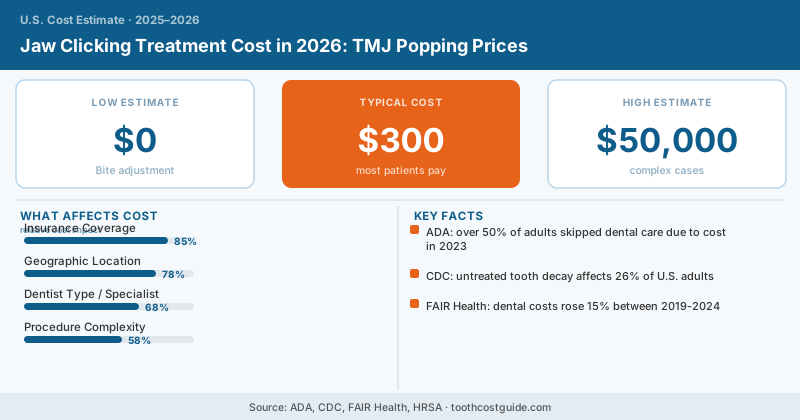
Does a clicking jaw need treatment at all? Honest answer: often not. A jaw that pops or clicks but doesn’t hurt is incredibly common and may need nothing more than a watchful eye. But once clicking comes with pain, locking, or limited opening, you’re into treatment — and the cost ladder runs from free exercises all the way to five-figure surgery.
Cost by Treatment Level
| Treatment | Typical Cost (No Insurance) |
|---|---|
| Exam + evaluation | $100–$300 |
| Jaw exercises / self-care guidance | $0–$150 |
| Physical therapy (per session) | $75–$200 |
| Custom night guard / splint | $300–$800 |
| Bite adjustment | $100–$500 |
| Trigger-point / Botox injections | $300–$1,500 |
| Arthrocentesis (joint flushing) | $2,000–$4,000 |
| TMJ surgery | $5,000–$50,000 |
What’s Actually Clicking
The clicking comes from the temporomandibular joint (TMJ) — the hinge connecting your jaw to your skull. Inside sits a small cushioning disc. When that disc slips out of position and snaps back as you open or close, you get the click or pop. The National Institute of Dental and Craniofacial Research estimates that TMJ disorders affect a substantial share of adults, with women more commonly affected than men.
A painless click usually means the disc is displaced but reducing on its own — your jaw is managing. Add pain or locking, and the joint needs help.
If your jaw clicks but doesn’t hurt, doesn’t lock, and opens normally, most dentists recommend simple self-care: soft foods during flare-ups, avoiding wide yawns and gum chewing, and gentle jaw exercises. That costs nothing. Jumping straight to a $500 night guard for a painless click is often money you don’t need to spend. Get it evaluated, then start conservative.
The Conservative Tier ($0–$800)
This is where most people get relief, and where you should start:
- Self-care and exercises: Free to $150 for guided instruction.
- Physical therapy: $75–$200 per session to retrain jaw muscles and improve disc positioning.
- Night guard/splint: $300–$800. If grinding or clenching is straining the joint, a custom guard takes the load off. This overlaps heavily with broader TMJ treatment and bruxism care.
The Intermediate Tier ($300–$4,000)
When conservative care isn’t enough:
- Bite adjustment: $100–$500 to reshape how your teeth meet, sometimes after restoring worn crowns or fillings that threw off the bite.
- Botox or trigger-point injections: $300–$1,500 to relax overactive jaw muscles.
- Arthrocentesis: $2,000–$4,000 to flush the joint of inflammatory debris — a minimally invasive option before surgery.
The Surgical Tier ($5,000+)
True jaw surgery is rare and reserved for severe structural problems that resist everything else. Costs range widely — from $5,000 for arthroscopic work to far more for open joint or total joint replacement. The vast majority of clicking jaws never reach this point.
Be wary of any provider who jumps straight to surgery for a clicking jaw. The accepted approach is to exhaust conservative options first — exercises, a splint, physical therapy — because they resolve most cases and surgery on the TMJ carries real risks. If someone’s pushing irreversible joint surgery for a click that hasn’t even tried a night guard yet, get a second opinion before you commit to that bill.
Insurance: The Frustrating Part
TMJ care is notoriously hard to insure. Some dental plans cover splints; some medical plans cover surgery; many cover little in between, treating it as a gray zone. Always get pre-authorization before pricey procedures. Our how dental insurance works guide explains the medical-vs-dental split that trips people up here.
Uninsured? Start with the free and low-cost conservative options — they resolve a lot of cases. A dental savings plan helps with the night guard and exams.
A jaw that locks open or shut and won’t move, sudden severe jaw pain, or clicking after a blow to the face needs prompt care — those can signal a dislocation or joint injury. Don’t force a locked jaw. See our dental emergency cost guide for urgent pricing.
Bottom Line
A clicking jaw ranges from a free fix to a five-figure surgery, but the truth is most cases land at the cheap end. Start conservative, treat pain before it escalates, and don’t pay for aggressive intervention a painless click doesn’t need.
Frequently Asked Questions
A custom night guard typically costs $300–$500 without insurance, while over-the-counter options run $20–$100. Most dental insurance plans cover 50% of a custom guard after you meet your deductible, reducing your out-of-pocket cost to $150–$250.
Coverage varies by plan—some insurance covers diagnostic exams and night guards at 50% after deductible, but others classify TMJ treatment as cosmetic or excluded. Always call your insurer first, as many patients end up paying $100–$300 out-of-pocket for the initial evaluation even with coverage.
Yes—jaw stretches and relaxation exercises cost nothing and resolve mild clicking in 2–4 weeks for many people. If clicking persists beyond a month or pain develops, that's when a $300–$500 night guard or $100–$300 specialist evaluation becomes worth considering.