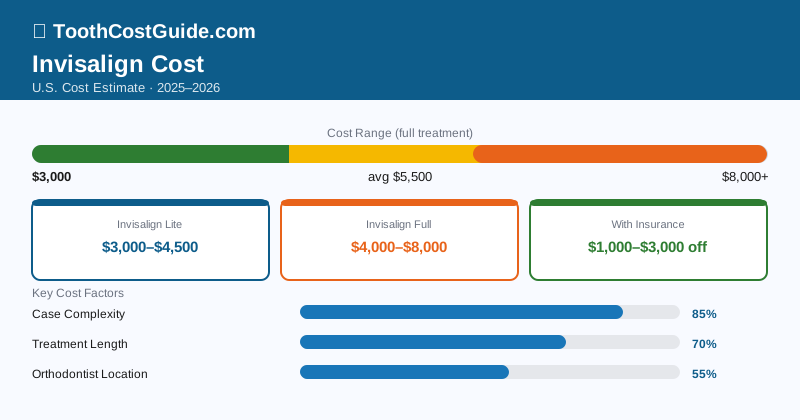
Invisalign doesn’t have a fixed price — it has a starting point and a range that depends entirely on your case, your provider, and your city. A mild crowding case might qualify for $2,500. A complex bite correction with an experienced orthodontist in a major metro can run $8,000. Knowing which category you’re actually in, before you sit down for a consultation, is the difference between being appropriately quoted and being upsold.
What Invisalign Costs by Case Type
| Product | What It Treats | Typical Cost |
|---|---|---|
| Invisalign Lite | Mild crowding/spacing, 14 aligners | $1,500–$3,500 |
| Invisalign Moderate | Moderate corrections, 26 aligners | $2,500–$5,000 |
| Invisalign Full | Comprehensive, unlimited aligners + refinements | $3,500–$8,000 |
| Invisalign First | Children, mixed dentition phase | $2,000–$4,500 |
| Vivera retainers (post-treatment, set of 4) | — | $400–$900 |
| At-home aligners (Byte, ALIGNERCO) | Very mild cases only | $1,500–$2,800 |
How to Know What Tier You Actually Need
This is the question most patients can’t answer before their consultation — and the one they should try to understand beforehand.
Invisalign Lite is appropriate for patients with mild crowding or spacing, with no significant bite issues (overbite, underbite, crossbite). If your teeth are slightly crooked but your bite is fine, there’s a real chance you qualify for Lite. The 14-aligner limit means complex tooth movements aren’t possible.
Invisalign Full — what most orthodontists default to recommending — includes unlimited refinements and handles moderate to complex movements including rotations, vertical shifts, and bite correction. It’s the right call for complex cases. For mild cases, it’s sometimes recommended when Lite would suffice.
The practical test: Before any consultation, look at photos of your teeth. Are your back teeth biting together evenly? Is the concern primarily cosmetic (a few crooked front teeth) or functional (teeth don’t meet properly, jaw discomfort)? If it’s primarily cosmetic with mild concerns, ask directly at each consultation: “Would my case qualify for Invisalign Lite?”
Getting three providers’ opinions often reveals one who says Lite is appropriate — at half the price of Full.
Orthodontist vs. General Dentist: Does It Matter for Cost and Quality?
Both can prescribe Invisalign. The price difference is real, but so is the difference in experience for complex cases.
General dentists with Invisalign certification often charge $500–$1,500 less than orthodontists for equivalent cases. For straightforward mild to moderate corrections, many general dentists with high Invisalign case volume produce excellent results. Ask how many Invisalign cases they complete per year and ask to see before/after photos of completed cases.
Orthodontists — particularly those with Invisalign Platinum or Diamond status, meaning they complete 50+ cases per year — have deeper experience with complex movements: significant bite correction, substantial rotation, vertical tooth movement. For complex cases, their more expensive fee is justified by better outcomes and fewer prolonged refinement rounds.
A general dentist’s lower price isn’t automatically a better deal if a complex case needs extensive refinements or ultimately requires transfer to an orthodontist anyway.
Invisalign consultations are always free. Go to at least two providers — ideally one orthodontist and one experienced general dentist. Tell each what the other quoted. Ask each why they’d choose the tier they’re recommending. The one who explains it in terms of your specific tooth movements (not just “Full is better”) is giving you a more honest assessment.
Insurance: What It Actually Covers
Most dental plans with orthodontic benefits treat Invisalign identically to metal braces — they don’t care about the method, just the code. Adult comprehensive orthodontic treatment is code D8090; adolescent comprehensive is D8080.
What your plan likely covers:
- 50% of total fee, up to the lifetime orthodontic maximum
- Lifetime maximum typically $1,000–$3,000 — often set at $1,500 and never updated
- Adult coverage excluded on some plans (check the fine print — many plans stop at age 18 or 19)
Example: Invisalign Full at $5,500, insurance lifetime max of $1,500.
- Insurance pays $1,500
- You pay $4,000
To verify your benefits: Call your insurance company with codes D8080 or D8090. Ask: what’s my lifetime orthodontic maximum? How much has been used? Does the plan cover clear aligners specifically, or only “braces”? Some plans have specific language requiring “fixed appliances” — those plans may not cover Invisalign. Worth confirming in writing before treatment starts.
A note on FSA/HSA: Orthodontic treatment qualifies for both. FSA accounts can be front-loaded (you can claim the full annual election amount on January 1), which some patients use to cover their first-year orthodontic installments. HSA funds roll over and can be invested — using them for Invisalign is a sound move.
The Comparison With Traditional Braces
For equivalent case complexity, Invisalign costs $500–$1,500 more than metal braces. The gap has narrowed as Invisalign has become more mainstream, but it generally still exists.
Invisalign makes sense over braces when:
- Price difference is under $500 — negligible for a 12–18 month treatment
- You’re an adult in professional settings where visible hardware matters
- Compliance won’t be an issue (you’ll actually wear them 20–22 hours/day)
Braces still make more sense when:
- Case involves significant bite correction or complex rotations — braces move certain tooth types more reliably and predictably
- The patient is a teenager who may not comply with aligner wear (braces can’t be removed)
- The price difference is $1,500+ and budget is a real constraint
The AAO (American Association of Orthodontists) notes that patient compliance is the most significant predictor of Invisalign outcome quality. If you wear them 22 hours a day, the results rival braces. If you’re routinely wearing them 15–16 hours, the timeline extends and results suffer — and that $1,500 premium over braces becomes harder to justify.
At-Home Aligners: Honest Assessment
Since Smile Direct Club’s closure in 2023, the at-home aligner market includes Byte, ALIGNERCO, and others at $1,500–$2,800 with no in-person orthodontic involvement.
These work as advertised for a very narrow patient population: mild crowding in otherwise healthy mouths with no gum disease, no significant bite issues, and no dental work (crowns, implants, bridges) that complicate movement. If that describes you, and a dentist has recently confirmed your gum health is fine, they’re a legitimate cost-saving option.
The cases that go wrong: patients with undetected gum disease, patients whose bite is more complex than it appears, and patients whose roots are moved in ways that cause bone loss — none of which is detectable without clinical x-rays and examination. The AAO and ADA both recommend against unsupervised orthodontic treatment for this reason. If you’re considering at-home aligners, at minimum have a dentist evaluate your current oral health before starting.
Financing
Orthodontic practices structure Invisalign as a time-payment by default — they collect over the treatment period.
In-office payment plans: Standard practice. Most orthodontists will spread the Invisalign fee over 12–24 months with $0 down, interest-free during treatment. A $5,000 case over 18 months = ~$278/month. Affordable even for significant cases.
CareCredit: 0% promotional financing for 18–24 months on qualifying amounts. Widely accepted at orthodontic offices. Pay the full balance before the promotional period ends.
Negotiate inclusions: Ask what can be added to make the deal more competitive — whitening trays (usually $200–$400 if purchased separately), Vivera retainers ($400–$900), or additional refinements beyond what’s included in the tier. Some providers throw these in when asked. Some don’t. Worth trying.
Bottom Line
Invisalign full treatment runs $3,500–$8,000 depending on case complexity, provider experience, and location. Insurance contributes $1,000–$3,000 in lifetime orthodontic benefits for most plans. The most reliable way to find a fair price is free consultations at multiple providers — prices for the same case can vary $1,500+ between offices.
If your concerns are genuinely mild, ask specifically about Invisalign Lite at each consultation. If you have decent orthodontic insurance, make sure the provider submits a predetermination to verify your benefit before treatment starts. And if you’re comparing to mail-order aligners, be honest with yourself about whether your case fits their narrow appropriate-use criteria.
Before committing to Invisalign, get the specifics in writing: which product tier (Lite/Moderate/Full), how many initial aligners are planned, how many refinement rounds are included in the fee, and what the retainer plan is post-treatment. Ask whether all in-office progress appointments are included or billed separately. Then verify your insurance orthodontic benefit and remaining lifetime maximum before your first aligner is ordered.
Frequently Asked Questions
Mild crowding cases typically start around $2,500–$3,500, while moderate cases range from $4,000–$6,000. Complex bite corrections with experienced orthodontists in major cities can reach $7,000–$8,000 depending on treatment duration and provider location.
Many dental insurance plans cover Invisalign similarly to traditional braces, typically paying 40–50% of the cost after your deductible, up to a lifetime orthodontic benefit cap of $1,000–$2,000. However, some plans exclude clear aligners entirely, so you should verify your coverage before scheduling a consultation.
Most Invisalign treatments take 12–18 months, though mild cases may finish in 6–9 months and complex cases can extend to 24+ months. You are typically a good candidate if you have mild to moderate crowding or bite issues and can commit to wearing aligners 20–22 hours daily; severe skeletal problems may require traditional braces instead.