If you’re paying for dental work out of pocket — or even with insurance — and you have a high-deductible health plan, there’s a legal way to get a 22–37% discount on every qualified dental procedure. It’s your HSA, and most people underuse it.
A $1,400 crown paid from HSA funds effectively costs $980–$1,092, depending on your tax bracket. A $5,000 implant effectively costs $3,350–$3,900. That’s not a promotional offer — it’s the tax math on pre-tax dollars.
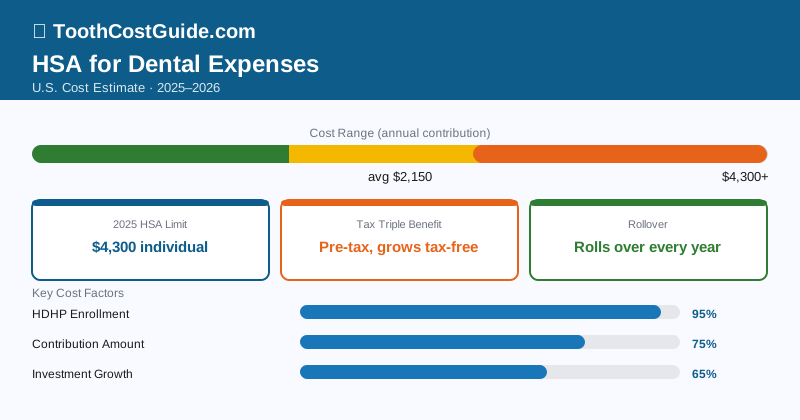
2025 HSA Contribution Limits
| Coverage Type | 2025 Limit |
|---|---|
| Individual (self-only) | $4,300/year |
| Family coverage | $8,550/year |
| Age 55+ catch-up addition | +$1,000/year |
| Employer contributions | Count toward your limit |
The Triple Tax Advantage (Why This Beats Everything Else)
HSAs have three tax benefits that no other savings vehicle combines:
- Contributions reduce your taxable income — whether through payroll deductions (pre-FICA) or direct contributions deducted on your tax return
- Investment growth is tax-free — you can invest HSA balances in index funds and they compound without capital gains tax
- Withdrawals for qualified medical expenses are tax-free — at any age, any amount, no questions
The real-world dental savings look like this at a 27% marginal rate (24% federal + 3–5% state):
| Procedure | Cost Paid | Tax Savings | Effective Cost |
|---|---|---|---|
| Root canal | $1,200 | $324 | $876 |
| Crown | $1,400 | $378 | $1,022 |
| Dental implant | $4,500 | $1,215 | $3,285 |
| Braces | $5,000 | $1,350 | $3,650 |
| Full dentures | $3,000 | $810 | $2,190 |
| Annual maintenance (2 cleanings + X-rays) | $350 | $95 | $255 |
These aren’t hypothetical — this is the arithmetic of pre-tax spending. Every dollar in your HSA has already had the tax taken off the top before you put it in.
Who Can Use an HSA
You must be enrolled in an HSA-qualifying High-Deductible Health Plan (HDHP). For 2025, that means:
- Minimum annual deductible: $1,650 (self-only) or $3,300 (family)
- Maximum annual out-of-pocket: $8,300 (self-only) or $16,600 (family)
- Not enrolled in Medicare
- Not covered by any other non-HDHP health insurance
- Not claimed as a dependent on someone else’s return
Your plan documents will state whether it’s “HSA-qualified.” If unsure, call your health insurer and ask directly: “Is my health plan HSA-eligible under IRS guidelines?”
Important: Your dental coverage (or lack of it) doesn’t affect HSA eligibility. If your HDHP has no dental component at all, you can still use HSA funds freely for any qualified dental expense.
Using your HSA for a spouse or dependent: Yes — you can pay for qualifying dental expenses for your spouse and dependents from your own HSA, even if they’re not on your health plan.
What’s Covered and What Isn’t
Fully HSA-eligible dental expenses:
- Preventive care (cleanings, exams, X-rays, fluoride treatments, sealants)
- Fillings — composite and amalgam
- Root canals and endodontic treatment
- Dental crowns (when medically necessary, which covers nearly all crown indications)
- Tooth extractions
- Dentures, partials, and dental bridges
- Dental implants for missing teeth
- Orthodontic treatment — braces and clear aligners
- Periodontal treatment — scaling, root planing, gum grafts
- Oral surgery
- Emergency dental care
- Prescribed medications for dental conditions
Not HSA-eligible:
- Teeth whitening (cosmetic with no medical basis)
- Veneers placed for purely cosmetic reasons
- Toothbrushes, toothpaste, floss (general health items, not medical treatment)
- Cosmetic gum contouring without medical indication
Paying for cosmetic procedures (teeth whitening, elective veneers) from your HSA is a non-qualified distribution. The IRS charges income tax plus a 20% penalty on the amount. This is a real enforcement risk. When in doubt, check whether the procedure has a CDT (Current Dental Terminology) code — if it does, it’s likely a medical procedure; if it’s purely aesthetic without a dental diagnosis, it probably doesn’t qualify.
How to Actually Use It
Step 1: Confirm your health plan is HSA-eligible. Check your plan documents or call your insurer. The plan summary should state “HSA-eligible HDHP” or equivalent language.
Step 2: Open an HSA account. Your employer may offer one through a benefits platform. If not, open one independently. Fidelity’s HSA is widely considered the best option for people who want to invest — no account fees, excellent investment options including Fidelity’s zero-fee index funds. Lively and HealthEquity are also strong options.
Step 3: Contribute the 2025 maximum. For self-only: $4,300. For families: $8,550. Payroll deductions are the most tax-efficient (they reduce FICA taxes in addition to income tax). Direct contributions are deductible on your federal return.
Step 4: Invest the balance you don’t need immediately. Most HSA custodians let you invest once your balance exceeds $500–$1,000. Index funds in your HSA grow tax-free — potentially for decades. This is where the real power compounds.
Step 5: Pay dental bills with your HSA debit card, or reimburse yourself. At the dental office, pay with the HSA debit card directly. Or pay out of pocket, save the receipt, and transfer the reimbursement from your HSA later — at any time, with no deadline.
Step 6: Keep every receipt. The IRS can audit HSA distributions years later. A dental receipt for $400 should be saved (scan it to a cloud folder) indefinitely as proof of qualified use.
You can pay dental expenses out of pocket today, let your HSA investments grow for 10–15 years, and reimburse yourself the original expense later — with no time limit, as long as you kept the receipt and the expense occurred after you opened the HSA. Pay your $1,400 crown out of pocket in 2025, let that $1,400 compound in index funds for 15 years, then reimburse yourself tax-free. The longer you let it grow, the more powerful the triple-tax advantage becomes.
Planning Major Dental Work Around Your HSA
If you know a large dental expense is coming — an implant, dentures, braces, multiple crowns — there are specific strategies to maximize your HSA benefit:
Front-load contributions: You can contribute the full annual limit on January 1 and withdraw it immediately for expenses in the same calendar year. The IRS allows this.
Time the procedure: If you’re mid-year and haven’t contributed this year’s maximum yet, contributing now (up to the limit) before the appointment means more pre-tax money available.
The family limit is generous: At $8,550 for families in 2025, a family with significant dental needs — orthodontics for two kids, a parent needing a crown and implant — can shelter substantial spending from taxation in one year.
After age 65: HSA funds can be withdrawn for any purpose (not just medical) without the 20% penalty, though non-medical withdrawals are subject to regular income tax. This makes an HSA function somewhat like a traditional IRA after 65 — with the bonus that medical/dental withdrawals remain completely tax-free forever.
Bottom Line
An HSA is the single highest-leverage tax tool available for reducing dental costs. The 22–37% effective discount applies to every qualified dental procedure — routine maintenance, fillings, root canals, implants, braces. The investment growth benefit turns it into a long-term financial tool beyond just dental spending.
If you have an HDHP and aren’t maxing your HSA contributions, you’re leaving real money on the table. Start at Fidelity (fidelity.com/hsa) or through your employer’s benefits platform. Contribute the maximum, invest what you don’t need immediately, and pay all qualified dental expenses from this account rather than after-tax income.
Frequently Asked Questions
A single dental crown typically costs between $1,200 and $2,500 depending on the material and your location. Porcelain crowns run $1,400–$2,000, while gold or zirconia crowns may reach $2,000–$2,500. When paid from an HSA, the effective cost drops to $980–$1,092 for a $1,400 crown after accounting for your 22–37% tax savings.
Most dental insurance plans cover 50% of crown costs after your deductible, leaving you responsible for $600–$1,250 out-of-pocket. Dental implants are typically not covered or only partially covered (10–20%), meaning you'll pay $3,500–$5,500 from your own pocket—which is where HSA funds provide significant tax-free savings. Check your specific plan, as major restorative work often has annual maximums of $1,000–$1,500.
No, purely cosmetic procedures like whitening are not HSA-eligible since they don't treat a medical condition. However, if your dentist documents that whitening is medically necessary (such as for discoloration from medication or dental work), it may qualify. Stick to treatment-based procedures like fillings, extractions, root canals, crowns, and implants, which are universally HSA-eligible.