The CDC estimates that nearly 47% of American adults 30 and older have some form of gum disease, and over 70% of adults 65 and older are affected. Most of them don’t know it, because gum disease is often painless in its early stages — until it isn’t.
Here’s the cost reality across every stage of treatment, and how the math changes dramatically with how early you catch it.
Treatment Costs by Stage
| Treatment | Cost (No Insurance) |
|---|---|
| Gingivitis: improved cleaning (D1110) | $75–$200 |
| Scaling & root planing — per quadrant | $200–$400 |
| SRP — full mouth (4 quadrants) | $800–$1,600 |
| Periodontal maintenance (3–4x per year) | $100–$250 per visit |
| Localized antibiotic — Arestin, per site | $35–$75 |
| Osseous (flap) surgery — per quadrant | $1,000–$2,000 |
| Full-mouth osseous surgery | $3,000–$8,000 |
| LANAP laser periodontal therapy — per arch | $2,000–$4,000 |
| Soft tissue graft (recession repair) | $600–$3,000 |
| Bone graft (regenerative procedure) | $600–$1,200 per site |
The financial case for early treatment writes itself: gingivitis costs $75–$200. Left untreated, it progresses to periodontitis requiring $800–$1,600 in deep cleaning, then potentially $3,000–$8,000 in surgery. Every year of delay is a multiplication of cost.
Understanding the Stages
Gingivitis — the reversible stage: Inflammation limited to the gum tissue, no bone loss. Treated with a thorough cleaning, improved home care, and in some cases an antimicrobial rinse. Completely reversible. Cost: $75–$200. With insurance: often covered at 100% as preventive care.
If you catch it here, you’re done.
Early to moderate periodontitis (Stage I–II): Bacteria have spread below the gumline; the bone supporting your teeth has begun to erode. Pockets of 4–6mm around teeth. Treatment is scaling and root planing — a deep cleaning under local anesthesia that removes deposits from below the gumline and smooths root surfaces so tissue can reattach. Done per quadrant, typically two quadrants per appointment.
Full-mouth SRP: $800–$1,600. With insurance at 80% coverage: $160–$320 out of pocket. With insurance at 50%: $400–$800 out of pocket.
After SRP, re-evaluation happens at 6–8 weeks. If pockets have resolved to 3mm or less: success, transition to maintenance. If pockets remain deep: advance to surgical consideration.
Advanced periodontitis (Stage III–IV): Significant bone loss, pockets 6mm+, possible tooth mobility. When SRP doesn’t adequately resolve the condition, periodontal surgery (osseous surgery) provides direct access to the bone to reshape defects, eliminate pockets, and allow proper healing.
Cost: $1,000–$2,000 per quadrant. Four quadrants: $4,000–$8,000. The annual maximum on most dental plans ($1,000–$2,000) barely registers against this cost.
LANAP (Laser-Assisted New Attachment Procedure): A laser-based surgical alternative that uses a specific wavelength to remove diseased tissue and bacteria without the cutting and suturing of traditional surgery. Recovery is generally faster and less uncomfortable. Available from LANAP-certified periodontists only. Cost: $2,000–$4,000 per arch (two arches = full mouth). Insurance coverage varies — some plans treat it as equivalent to osseous surgery; others have specific exclusions for laser periodontal therapy.
The Maintenance Reality
After any active periodontal treatment — SRP, surgery, or LANAP — you don’t return to twice-yearly routine cleanings. You enter periodontal maintenance for life: more thorough visits every 3–4 months, indefinitely.
Why this matters financially:
- Routine cleaning (D1110): usually 100% covered by insurance as preventive
- Periodontal maintenance (D4910): covered at 50–80% as a basic/major service
Four periodontal maintenance visits per year × $175 average per visit × 25% patient share = $175/year ongoing. Over 10 years: $1,750 in maintenance copays — not including the treatment itself. This is a long-term commitment.
Patients who skip maintenance appointments typically see disease return and require another round of active treatment within 1–2 years. The math strongly favors showing up for the quarterly visits.
General dentists with hygienists perform SRP routinely. For Stage I–II periodontitis in otherwise uncomplicated cases, your general dentist or hygienist is appropriate. For Stage III–IV disease, persistent pockets after SRP, or any surgical treatment, a periodontist (3 years of post-doctoral specialty training in gum disease) is the right provider. Periodontist fees run 20–35% higher per quadrant — but for complex cases, their diagnostic precision and surgical skill justify the premium.
What Insurance Covers (And Where It Runs Out)
SRP is typically covered at 50–80% after deductible under basic or major periodontal benefits. Most plans also cover 2–4 periodontal maintenance visits per year for patients with documented periodontal history.
Where it breaks down: The annual maximum of $1,000–$2,000. For a patient needing full-mouth osseous surgery at $6,000, insurance at 50% should pay $3,000 — but a $2,000 annual maximum caps the benefit at $2,000. You pay $4,000 regardless of the stated 50%.
Strategies:
Stage treatment across calendar years. Osseous surgery on two quadrants in December, two quadrants in February gives you two annual maximums. Many periodontists structure treatment timelines this way for patients with significant disease.
Pre-authorization before surgery. Before committing to any periodontal surgical procedure, have your periodontist submit full-mouth X-rays, current periodontal charting, and clinical notes to your insurer for a coverage estimate. Free to request, takes 5–10 business days, eliminates financial surprises.
Coordinate dental and medical insurance. In some cases — periodontal disease linked to poorly controlled diabetes, for example — medical insurance may contribute to coverage. This is more complicated to arrange, but worth asking about with a periodontist who handles insurance billing.
Where to Pay Less
University periodontal residency programs. Licensed periodontists in advanced training perform SRP and surgical treatment under faculty supervision at 40–60% below private practice rates. SRP: $75–$150 per quadrant vs. $200–$400 privately. Osseous surgery: $400–$800 per quadrant vs. $1,000–$2,000. For a patient facing $8,000 in periodontal surgery, a university program can reduce that by $3,000–$5,000.
Compare periodontist fees before committing. Periodontal fees vary $200–$500 between practices for the same procedures. An initial consultation ($75–$150) at two offices before choosing is worth the investment for high-cost cases.
FSA/HSA for all treatment. All periodontal procedures are qualified medical expenses. Pre-tax spending saves 22–37% depending on your tax bracket — the most reliable discount available.
Dental discount plans for uninsured patients. Plans like Careington 500 or Cigna Dental Savings provide 20–40% off periodontal procedures at participating offices. No waiting period. For a patient without dental insurance facing $1,600 in SRP, a $100/year discount plan saves $320–$640 — a strong return.
Bottom Line
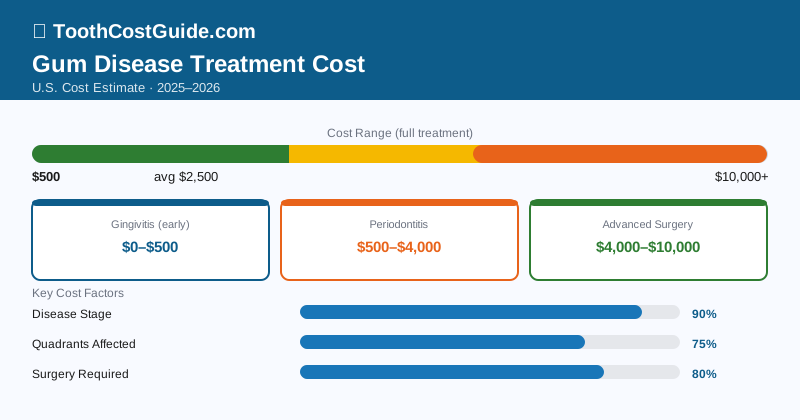
Gum disease treatment costs $75–$200 if caught at gingivitis, $800–$1,600 if treatment starts at Stage I–II periodontitis, and $4,000–$10,000+ for advanced Stage III–IV disease requiring surgery. Annual dental checkups with periodontal probing are the intervention that determines which number you face.
If you’ve been diagnosed with periodontitis, ask for your full periodontal chart (probing depths at six points per tooth), understand which stage you’re at, ask your periodontist how many quadrants require treatment and whether staging across calendar years maximizes your insurance benefit, and look into periodontal residency programs if cost is a significant barrier.
Gum disease is a chronic condition that doesn’t heal without treatment — it progresses. “Watching and waiting” without active treatment means bone loss continues. If you’ve been told you have pockets of 5mm or more with bone loss on X-rays, that diagnosis warrants treatment, not monitoring. Get a second opinion if you’re uncertain, but don’t delay indefinitely. Lost bone doesn’t regenerate without intervention, and teeth lost to advanced periodontitis require expensive replacement.
Frequently Asked Questions
Gum disease treatment ranges from $500–$10,000+ depending on severity. Early-stage gingivitis typically costs $500–$1,500 for scaling and root planing, while advanced periodontal surgery or bone grafting can exceed $5,000–$10,000 per tooth or area treated.
Most dental insurance plans cover gingivitis treatment (scaling and root planing) at 80–100% after your deductible, but coverage for advanced periodontal procedures drops to 50% and may include annual limits. Some plans classify periodontal surgery as a major service with higher out-of-pocket costs or waiting periods.
Early gingivitis may require only one or two professional cleanings plus improved home care, but moderate to severe periodontitis typically needs ongoing treatment every 3–4 months for maintenance cleanings. Prevention through daily brushing, flossing, and annual cleanings can reduce your risk significantly and save thousands in future treatment costs.