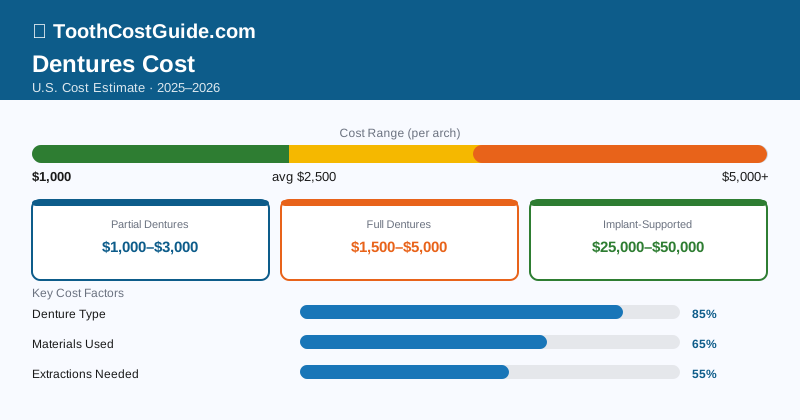
There are $400 dentures and $5,000 dentures. Both are called dentures. The difference in daily function, fit, and appearance is significant enough that most prosthodontists describe the cheapest options as a false economy — patients who can’t chew with them properly often return for expensive corrections or replacements within 2–3 years.
Here’s what different price tiers actually get you, what insurance covers, and where to get good quality work at substantially lower cost.
Cost by Denture Type
| Type | Cost Per Arch (No Insurance) |
|---|---|
| Economy full denture (chain clinic) | $300–$800 |
| Mid-range full denture (private practice) | $1,000–$2,500 |
| Premium custom full denture | $2,500–$5,000 |
| Complete set (upper + lower, mid-range) | $2,000–$5,000 |
| Acrylic flipper partial | $300–$700 |
| Cast metal partial | $1,000–$2,500 |
| Flexible partial (Valplast) | $1,000–$2,000 |
| Immediate denture (placed day of extraction) | Add $500–$1,500 |
| Implant-supported overdenture | $10,000–$22,000 per arch |
| Denture reline | $250–$500 |
Additional costs that aren’t always in the quoted price: extractions ($75–$550 per tooth) if remaining teeth need to come out first, and bone grafting if needed for implant-supported options.
What the Price Tiers Actually Mean
Economy dentures ($300–$800/arch): Standardized fabrication, minimal customization. Stock teeth in prefabricated shades, limited try-in appointments. What you see in dental chain advertisements. They function as dentures — some patients are fine with them. But poor fit is common, and fit problems cause sore spots, reduced chewing ability, and accelerated bone loss under the denture base.
Mid-range dentures ($1,000–$2,500/arch): Custom impressions, multiple appointments including at least one wax try-in where you see and approve the appearance before the final acrylic is processed. Better tooth shade and shape selection. More precise bite registration. This is where most patients who invest appropriately end up — functional, reasonably natural-looking, 5–8 year lifespan with good care.
Premium custom dentures ($2,500–$5,000/arch): High-grade acrylic, meticulous shade matching, multiple try-in appointments, often fabricated by a dental lab with a specialized denture technician. For patients where aesthetics are a priority or whose mouth anatomy requires more complex fitting. Prosthodontists (specialists in dental prosthetics) typically do this level of work.
The wax try-in test: A legitimate denture fabrication process always includes at least one appointment where you wear wax dentures — before the final acrylic is processed — and can approve the look and bite. You can see yourself in a mirror. You can request adjustments. Any denture provider who skips this step is cutting corners. Ask explicitly before booking: “Is a wax try-in appointment included?”
Partial vs. Full Dentures
When you still have some natural teeth: partial dentures. They clip onto remaining teeth with metal clasps (cast metal partial) or flexible polymer (Valplast), replacing only the missing segments. This preserves natural teeth — which are always better than prosthetics for chewing and bone preservation.
Cast metal partials ($1,000–$2,500) are the most durable. The cobalt-chrome framework is precisely fitted and lasts 10–15 years with proper care. More visible clasps.
Flexible partials (Valplast, $1,000–$2,000) use nylon-like material — lighter, no visible metal. Cosmetically preferred for front teeth. Less adjustable and harder to reline over time.
Acrylic flippers ($300–$700) are temporary. They’re used to fill the gap while waiting for implants or permanent partials, or as an emergency cosmetic solution after tooth loss. Not meant for long-term primary use.
When all teeth in an arch are gone: full/complete dentures. The entire upper or lower arch is replaced.
The Immediate Denture Tradeoff
Immediate dentures are made in advance and inserted the same day as extractions. You go home with teeth — cosmetically helpful, psychologically meaningful.
The limitation: gums shrink significantly during the 2–4 months after extraction as bone remodels. An immediate denture that fit perfectly on day one often becomes loose within 6–8 weeks. It then needs a temporary reline ($250–$500) and eventually a permanent reline or replacement. Some practices include one reline in the immediate denture fee; others charge separately.
Conventional dentures — made after full gum healing (8–12 weeks post-extraction) — typically fit better from day one and require fewer adjustments. The tradeoff is being without teeth during the healing period, which many patients find difficult emotionally and functionally.
Some patients do both: an immediate denture for the healing period, then a conventional denture fabricated after healing. That’s a more expensive path but avoids the edentulous (toothless) period.
For patients who can eventually afford it, implant-supported overdentures ($10,000–$22,000 per arch) are dramatically better than conventional dentures. Two to four implants per arch anchor the denture firmly — no adhesive, no movement, much better chewing function. More importantly, the implants prevent bone resorption that otherwise occurs throughout life under conventional dentures. Patients with conventional dentures often notice their face shape changing over decades; implant-supported dentures prevent this. If cost is the immediate constraint, starting with conventional dentures while planning for future implants is a reasonable path.
With Insurance
Dentures fall under “major restorative” or “prosthodontics” — covered at 50% after deductible on most PPO plans, up to the annual maximum.
Example: Upper and lower full dentures at $3,500 total (mid-range). Plan covers 50%, $100 deductible, $2,000 annual max.
- Deductible: $100
- Insurance pays 50% of remaining $3,400 = $1,700 (annual max allows up to $2,000, so $1,700 is within limit)
- Patient pays: $1,900
Where it gets complicated: Most plans cover denture replacement only every 5 years. If your denture fails at 4 years, you pay out of pocket for the replacement. And most plans have “least expensive alternative treatment” provisions — if you want premium custom dentures when the insurer considers mid-range adequate, you pay the premium difference out of pocket.
Medicaid: Approximately 30 states cover dentures for qualifying low-income adults. Coverage quality varies significantly — some states cover comprehensive denture services, others cover emergency extractions only. Check with your state Medicaid dental program specifically.
Where to Pay Significantly Less
Dental school prosthodontics clinics. Dentures fabricated at dental schools under faculty supervision cost 50–65% less than private practice. A full-mouth mid-range denture set that costs $4,000 privately might run $1,500–$2,500 at a dental school prosthodontics clinic. Multiple appointments, longer timeline (8–12 weeks), but careful faculty oversight at each impression, try-in, and delivery appointment.
Corporate dental chains (carefully selected). Chains like Affordable Dentures & Implants operate on volume and price economy dentures at $350–$600 per arch. Quality varies by location. Read location-specific reviews (not just chain-wide), ask specifically about the number of try-in appointments included, and understand what “economy” means in terms of teeth quality and fit customization.
Medicaid programs. If you qualify, dentures through Medicaid are the lowest-cost path. Application and coverage vary by state — worth checking even if you’re unsure whether you qualify.
Bottom Line
Dentures range from $300 to $5,000 per arch depending on quality tier, type, and provider. With insurance covering 50% up to annual maximums, most patients pay $1,000–$3,000 for a complete set. Economy options exist but often represent a false savings — poorly fitting dentures cause ongoing problems that cost more to address than the initial savings.
Dental school prosthodontics clinics offer the most reliable combination of quality supervision and dramatically reduced cost. Medicaid covers dentures in most states for qualifying patients. For any patient with access to the budget over time, planning toward implant-supported overdentures delivers meaningfully better long-term function and bone preservation.
Before committing to any denture provider, ask: How many appointments are included? Is a wax try-in appointment part of the process? Are extractions included in the quoted price or billed separately? What does the reline/adjustment policy look like in the first year? Get these answers in writing. And if a denture provider skips the wax try-in step — where you see and approve the appearance before the final denture is processed — that’s a quality concern worth asking about directly.
Frequently Asked Questions
Full dentures typically cost $1,500–$5,000 per arch (upper or lower) without insurance. Budget dentures start around $400–$800 per arch but often require costly adjustments or replacements within 2–3 years, while higher-quality dentures in the $2,500–$5,000 range provide better fit, durability, and chewing function.
Many dental insurance plans cover 40–50% of denture costs after meeting your deductible, though some plans cap coverage at $1,000–$2,000 per year. Medicare does not cover dentures, and you should verify your specific plan's exclusions since some insurers limit coverage to one set per 5 years.
Immediate dentures can be placed the same day as extraction, but they require multiple adjustments over 3–6 months as your mouth heals and bone shrinks. Conventional dentures typically involve 2–3 weeks of appointments before fitting, making them a better option if you can wait for optimal fit and comfort.