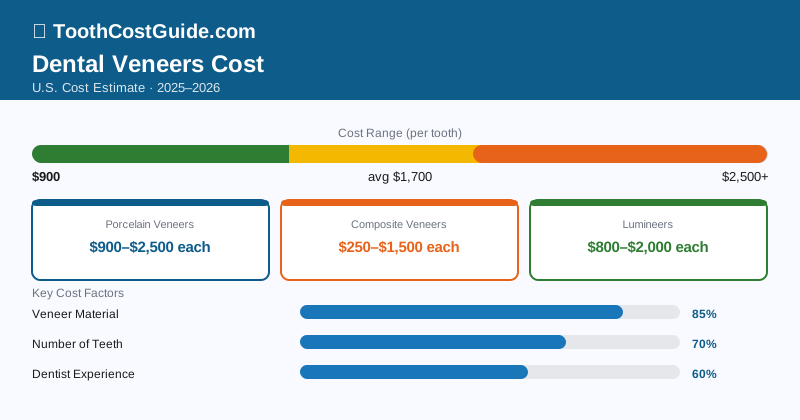
Most people who want veneers are shocked by the price. Then they’re confused by the range — because how does the same procedure cost $400 at one office and $2,200 at another? The answer involves the material, who’s doing it, and whether you’re in Manhattan or Memphis. Here’s how to figure out what you’d actually pay, and whether it’s worth it.
Veneer Costs at a Glance
| Veneer Type | Cost Per Tooth |
|---|---|
| Composite resin (direct, same-day) | $250–$600 |
| Porcelain (lab-fabricated, 2 visits) | $900–$2,500 |
| Lumineers / minimal-prep thin veneers | $800–$2,000 |
| Snap-on / removable veneers | $300–$1,500 total set |
| 6-veneer porcelain set (upper front) | $5,400–$15,000 |
| 10-veneer full smile (porcelain) | $9,000–$25,000 |
Insurance covers none of this. Veneers are classified as cosmetic treatment in virtually all dental plans. Budget the full cost out of pocket or through financing.
Porcelain vs. Composite: The Real Difference
This is the most important decision you’ll make, and most consultation rooms don’t give you enough time to think it through properly.
Composite veneers ($250–$600/tooth): Applied in one appointment. The dentist bonds tooth-colored resin directly to your teeth, sculpting it by hand. No lab involved. The upside: single visit, much lower cost, repairable if a piece chips — composite can be patched, porcelain can’t. The downside: composite stains more readily than porcelain (coffee, wine, curry), and the surface isn’t quite as smooth or light-reflective as ceramic. Realistic lifespan: 5–8 years before noticeable staining or wear leads to replacement or touch-up.
Porcelain veneers ($900–$2,500/tooth): Lab-fabricated ceramic shells bonded to the front of your teeth over two appointments. First visit: the dentist removes 0.3–0.5mm of enamel (this is permanent and irreversible), takes an impression or digital scan, places temporaries. Second visit, 2 weeks later: the porcelain shells are bonded. Stain-resistant, translucent, looks like natural enamel. Lifespan: 10–20 years with good oral hygiene.
The irreversibility point is important. Once you’ve had tooth preparation for traditional porcelain veneers, those teeth will always need restorations — you cannot undo enamel removal. Decades from now, if those veneers wear out, they’ll need to be replaced with new veneers or crowns. That’s a permanent commitment to a cosmetic choice you’re making today.
Lumineers and no-prep veneers: Marketed as “reversible” because they require minimal tooth reduction. In practice, they’re thicker to compensate and can look bulky or opaque on some patients. Appropriate for specific clinical situations — not universally better.
If you’re under 35 and considering veneers primarily out of curiosity about your potential new smile — or if budget is a real concern — composite veneers done by a skilled cosmetic dentist are a legitimate starting point. Many patients are satisfied for 5–7 years, then upgrade to porcelain with full knowledge of what they’re getting. You’ll have seen how veneers feel in your daily life before making an irreversible commitment.
What Drives the Price So Wide
The dentist’s experience and specialty. Cosmetic dentistry is not a formally regulated specialty in the U.S. — any dentist can offer veneers. A dentist with 500 completed veneer cases and ongoing cosmetic continuing education is doing something fundamentally more complex than a general dentist who places veneers occasionally. At the top end, cosmetic dentists in major cities charge $1,800–$2,500/tooth. At the lower end, $900–$1,200 in smaller markets.
Before choosing a provider based on price: look at their case portfolio in detail. Completed cases, ideally with photos taken at 1–2 years post-treatment (not just the day of placement). The work should look like natural teeth, not uniform white tiles.
Geographic market. A highly experienced cosmetic dentist in Austin charges less than a less-experienced one in New York. Cosmetic dentistry pricing tracks urban cost of living dramatically. If you can travel 2–3 hours for treatment, you may access equivalent skill at 40–60% of the local price.
Number of teeth being treated. Single-veneer cases ($900–$2,500) are challenging because shade-matching a single veneer to surrounding natural teeth requires exceptional skill. Full-smile cases (8–10 veneers) are actually easier to shade-match and give dentists flexibility to achieve a uniform result. Most cosmetic dentists offer volume pricing — ask for a per-tooth discount for cases of 6+ veneers. A dentist who charges $1,800/tooth individually may price a 10-veneer case at $1,400/tooth.
What to Demand Before Saying Yes
A digital smile design or composite mock-up. Reputable cosmetic dentists provide a preview of your new smile before any irreversible tooth reduction occurs — either digitally rendered or as a temporary composite placed over your existing teeth. You should be able to see it, smile in a mirror, and approve it. No preview = no commitment.
A wax-up model. For porcelain cases, a physical or digital wax-up shows the planned final tooth shapes. Some practices charge $100–$300 for this separately; better ones include it.
A clear answer on what happens if one debonds or chips. Porcelain veneers typically carry a 1–2 year warranty in most practices. After that, repair costs $200–$500. Composite veneers can be patched for $50–$100. Know what you’re committing to before the temporary cement comes off.
For Most People, Insurance Is Irrelevant Here
Dental insurance excludes elective cosmetic treatment — explicitly and consistently. There’s effectively no plan you can buy that will cover veneers as a cosmetic choice.
The narrow exception: if a front tooth is fractured due to documented trauma (a car accident, a sports impact) and a veneer is the clinically appropriate restoration, some plans will cover it under accident benefits. This is situational and claim-specific.
FSA/HSA: Cannot be used for purely cosmetic procedures. If a veneer is clinically necessary due to structural damage — not cosmetic preference — it may qualify. Ask your plan administrator.
Financing Options
At $5,000–$25,000 for comprehensive cases, financing is standard.
In-office payment plans: Most cosmetic dental practices spread the treatment cost over 12–30 months, interest-free during active treatment. Ask what the in-house plan terms are before looking at third-party options.
CareCredit: For veneer cases over $2,500, 18–24 month 0% promotional periods are standard. Larger cases ($10,000+) may qualify for 48–60 month plans at a stated APR (these are true installment loans, not deferred interest). Read the terms.
Personal loans: For $8,000–$25,000 cosmetic cases, a personal loan from a credit union or competitive lender (LightStream, SoFi) often offers better rates than dental-specific financing. Compare before you commit.
Staged treatment: You don’t have to do the whole smile at once. Starting with the 4 most visible front teeth and adding later spreads the cost — though shade-matching additions to existing veneers takes extra skill.
Bottom Line
Porcelain veneers cost $900–$2,500 per tooth — more in major cities, less in smaller markets, and significantly less if you choose composite. A complete upper-front-teeth set runs $5,000–$25,000. No insurance coverage applies.
This is a big financial and physical commitment. The right move is to see 2–3 cosmetic dentists before deciding, review extensive case portfolios rather than just testimonials, and insist on a preview of your result before any enamel is touched. The dentists worth their premium show you what you’re getting before the procedure begins. The ones who skip that step are the ones to avoid.
Before committing to porcelain veneers: confirm the exact tooth preparation involved (how much enamel is removed), request a digital mock-up or composite preview, ask what the warranty covers and for how long, and verify the cost of replacement or repair if a veneer debonds within 5 years. Get this in writing. These procedures are permanent — the consultation is the time to ask every question you have.
Frequently Asked Questions
Porcelain veneers typically cost $900–$2,500 per tooth, depending on your dentist's experience, location, and lab quality. Most patients need 4–8 veneers for a full smile makeover, which puts the total cost between $3,600–$20,000 before insurance.
Most dental insurance plans do not cover veneers because they are considered cosmetic rather than medically necessary. You can expect to pay the full out-of-pocket cost, though some plans may cover a portion if veneers are placed for structural reasons like a broken tooth.
Composite veneers are completed in one same-day appointment (1–2 hours), while porcelain veneers require two visits over 1–2 weeks for fabrication and placement. There is no recovery period with either type—you can eat, drink, and return to normal activities immediately after your appointment.