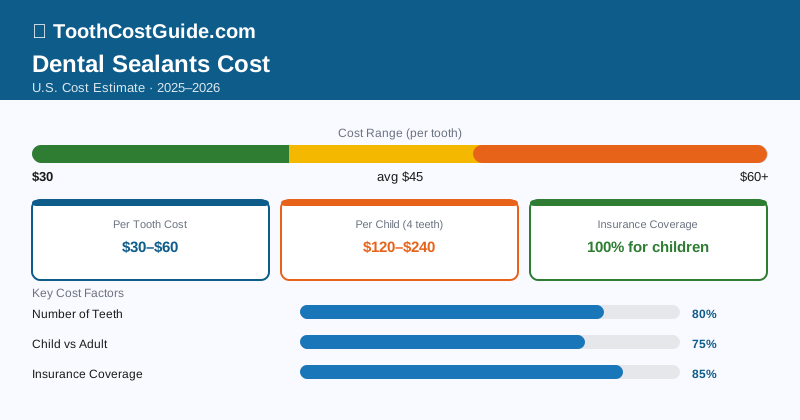
Dental sealants reduce cavity risk in back teeth by nearly 80%, the ADA reports — yet CDC data shows only about 43% of children aged 6–11 have ever received them. That gap is enormous. The CDC’s 2023 Oral Health Surveillance Report found that children without sealants are almost three times more likely to develop cavities in their first molars than kids who have them, and that closing the sealant gap could prevent millions of school hours lost to dental pain every year.
That’s the case for sealants in a nutshell. Cheap upfront, clinically proven, and widely covered for kids. For adults, the math gets a little murkier — but for the right patient, they’re still worth every dollar.
What a Sealant Actually Is
A sealant is a thin plastic coating painted directly onto the chewing surfaces of your back teeth — primarily molars and premolars. Those surfaces are full of tiny grooves and pits that trap food and bacteria. Brushing can’t always reach them. A sealant fills those grooves and creates a smooth surface that’s far easier to clean.
The application is quick and painless. No drilling, no anesthesia. Your dentist or hygienist cleans the tooth, applies an etching solution, rinses and dries the tooth, then paints on the sealant material. A curing light hardens it in about 30 seconds per tooth. Four molars done in under 20 minutes.
What Sealants Cost
| Sealant Scenario | Estimated Cost |
|---|---|
| Per tooth, no insurance | $30–$60 |
| Full set of 4 molars, no insurance | $120–$240 |
| Per tooth with insurance (children under 14) | $0–$10 copay |
| Per tooth with insurance (adults, if covered) | $15–$35 |
| Reapplication of worn sealant | $20–$50 per tooth |
| Dental school clinic (per tooth) | $15–$30 |
Children’s coverage is generous. Most dental plans cover sealants at 100% for kids under 14, and many extend to age 16 or 18. The ADA recommends sealing permanent first molars as soon as they erupt — around age 6 — and second molars around age 12.
Adult coverage is inconsistent. Some plans cover sealants for adults up to age 21 or 26 under extended dependent coverage. After that, many plans exclude sealants entirely or cover them at 50–80% under basic benefits. Call your insurer and ask specifically about procedure code D1351 before assuming anything.
Who Benefits Most
Children ages 6–14 are the primary candidates. These are the years when permanent molars erupt, and it’s the highest-risk window for decay. Sealing them before any decay begins is one of the most cost-effective moves in all of dentistry.
Adults with deep molar grooves are also strong candidates. Some people’s molars have unusually deep anatomical fissures that no amount of brushing can reliably clean. If your dentist has ever flagged “deep grooves” or “high cavity risk” on your chart, bring up sealants at your next visit.
Adults with no existing decay in the target teeth. Sealants only go on healthy tooth structure. If a tooth already has a filling or early decay, that has to be treated first — sealants aren’t applied over compromised enamel.
Run the math: a sealant costs $30–$60 per tooth. A composite filling in that same molar costs $150–$300. A crown, if decay progresses, runs $1,000–$1,800. If you’ve had cavities before, your risk of future cavities is real. Adults with a history of decay, dry mouth, or reduced saliva flow are the strongest candidates for adult sealants — regardless of whether insurance covers them.
How Long They Last
Sealants aren’t permanent. They typically hold for 5–10 years before wear or chipping becomes significant. Your dentist checks their integrity at every routine exam. Worn spots can be re-sealed at low cost; even partially intact sealants still provide protection over the areas they cover.
Chewing very hard foods — ice, hard candy, popcorn kernels — accelerates wear. If you grind your teeth, mention that before sealing chewing surfaces, since bruxism will wear sealants down faster than average.
The BPA Question
Some parents have concerns about bisphenol-A in sealant materials. Here’s the direct answer: some sealants contain BPA precursors (bis-GMA or bis-DMA), but the transient exposure during a sealant application is extremely low. The ADA has stated that this level of exposure poses no health risk, and the FDA monitors dental materials closely. If you want extra peace of mind, ask your dentist about BPA-free sealant formulations — they’re available and comparably priced.
Sealants only protect the chewing surfaces of back teeth. They don’t cover the sides of teeth or the spaces between teeth. You still need to floss every day. A sealant on your molar won’t protect you from an interproximal cavity forming between that molar and the tooth next to it.
Bottom Line
For most children, sealants are a straightforward call: low cost, high insurance coverage, no discomfort, and decades of clinical evidence behind them. The ADA and CDC both recommend them. The 80% cavity reduction number holds up across multiple studies.
For adults, it depends on your risk profile. If your molars are deep-grooved and still cavity-free, spending $30–$60 per tooth is almost certainly cheaper than the filling you’d need later. Ask your dentist to assess your molar anatomy at your next cleaning — it’s a five-minute conversation that can save hundreds down the road.
Frequently Asked Questions
Expect to pay $30–$60 per tooth. A full set of four molars runs $120–$240 out of pocket.
Most plans cover sealants at 100% for children under 14. Adult coverage varies widely — many plans exclude it entirely or cover only a portion.
Sealants typically last 5–10 years. Your dentist checks them at each cleaning; worn areas can be reapplied quickly and inexpensively.