Most people pick the cheaper plan. That’s usually the HMO, and sometimes that’s right. But there’s a way the cheap choice costs you more — and it has nothing to do with premiums.
Here’s how to actually compare these two plan types using your real dental situation, not marketing language.
Side-by-Side Numbers
| Dental HMO | Dental PPO | |
|---|---|---|
| Monthly premium | $15–$25 | $30–$60 |
| Annual deductible | None | $50–$200 |
| Annual benefit maximum | None | $1,000–$2,000 |
| Out-of-network coverage | None | Yes (reduced) |
| Need referral for specialists | Usually | No |
| Cleaning copay | $0–$15 | $0 (in-network) |
| Filling copay | $20–$60 | 20% after deductible |
| Crown cost to you | $150–$350 fixed | ~$400–$800 (50% of negotiated) |
How Each Plan Actually Works
Dental HMO (DHMO): You pick one dentist from the plan’s network — your “primary dental provider” — and that’s who you see. The plan pays that dentist a flat monthly fee per enrolled patient regardless of how often you show up (called capitation). You pay a fixed copay per procedure, listed in a fee schedule you can look up before enrolling. There’s no deductible and no annual maximum. If you need a specialist, your primary dentist refers you to one within the HMO network.
Dental PPO: You can see any licensed dentist, but in-network dentists cost less. The plan uses an annual deductible ($50–$200) and then covers a percentage of each procedure: 100% preventive, 70–80% basic, 50% major. Once your total annual benefit is exhausted ($1,000–$2,000), you pay everything else out of pocket until the plan year resets.
HMOs have no annual maximum. PPOs do. This sounds like a minor detail but it’s significant: in a year where you need a crown ($1,200) and a root canal ($1,200), your $1,500 annual maximum PPO benefit is exhausted by those two procedures — leaving you paying 100% of any additional care that year. HMOs continue paying regardless of how much you use.
The Real Cost Comparison — Two Scenarios
Scenario A: Healthy year, just cleanings and one small filling
| HMO | PPO | |
|---|---|---|
| Annual premiums | $240 | $540 |
| Two cleanings | $0–$20 | $0 |
| One 1-surface composite filling | $30–$50 | $25–$40 |
| Total | $270–$310 | $565–$580 |
HMO wins by $250–$270.
Scenario B: Rough year — one crown, one root canal
| HMO | PPO | |
|---|---|---|
| Annual premiums | $240 | $540 |
| Root canal (molar) | $150–$300 copay | $500–$700 (50% of negotiated) |
| Crown | $200–$350 copay | $500–$800 (50% of negotiated) |
| Annual maximum hit? | No | Yes — may run out |
| Total | $590–$890 | $1,540–$2,040 |
HMO wins here by $950–$1,150 — a substantial gap.
The HMO’s advantage is the no-cap, fixed-copay structure. In any year with significant dental work, HMOs can dramatically outperform PPOs even when PPO premiums are considered.
When the PPO Is Worth the Extra Cost
Your preferred dentist doesn’t take HMOs. Many of the best private practices participate only in PPO networks. If you have a dentist you trust and they’re PPO-only, your HMO option disappears. Check whether your dentist accepts any HMO plans before comparing premiums.
You’re seeing specialists. HMOs require referrals and limit you to in-network specialists. If you’re seeing an orthodontist, periodontist, oral surgeon, or any specialist on your own terms, the PPO’s no-referral flexibility is essential.
You live in a rural area. HMO networks are built around density — they need enough participating dentists in a geographic area to serve their members. In rural or suburban markets, HMO networks can be thin or non-existent. A $20/month HMO isn’t a bargain if the closest in-network dentist is 45 minutes away.
You travel or live between cities. HMOs don’t typically provide benefits when you’re outside the service area (except emergencies). If you split time between locations or travel frequently, a PPO’s ability to use any licensed dentist nationwide is practically relevant.
The Copay Schedule Question
This is where people make expensive mistakes with HMOs: they look at the low premium and assume everything is cheap. It’s not always.
HMO copay schedules vary enormously. Some plans have a $0 cleaning copay and a $200 crown copay — excellent value. Others have a $0 cleaning copay and a $500 crown copay — mediocre value that barely saves anything over self-pay. Before enrolling in any HMO, download the full copay fee schedule (usually available on the plan’s website or from the insurer’s enrollment materials). Price out your expected procedures for the year.
If a plan won’t provide its copay schedule before you enroll, that’s a problem.
Quick Decision Guide
| Your situation | Better choice |
|---|---|
| Have a dentist you’ve seen for years | PPO (if they’re PPO-network) |
| Open to any dentist in your city | HMO (if network is solid) |
| Anticipate a crown or root canal | HMO (no annual cap) |
| Need orthodontics | PPO (most HMO ortho benefits are limited) |
| Live in a rural area | PPO |
| Budget is the top priority, metro area | HMO |
| Self-employed, buying individual coverage | Compare both; HMO often wins on value |
The Out-of-Network Warning for PPO Holders
PPO plans cover out-of-network dentists at a reduced rate — but “reduced rate” is misleading. The plan pays a percentage of its “allowable amount,” not a percentage of the dentist’s actual fee. If the plan’s allowable for a crown is $900 but your out-of-network dentist charges $1,800:
- Plan pays 50% of $900 = $450
- You pay 50% of $900 + the $900 balance between allowable and actual fee = $1,350 total
Out-of-network care on a PPO is expensive. In-network care is where the benefit is actually delivered.
Bottom Line
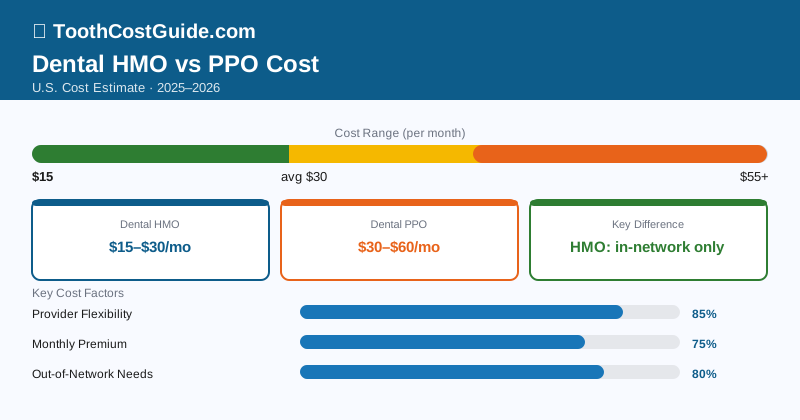
HMOs beat PPOs on premium cost and have no annual maximum — a real advantage in years with significant dental work. PPOs cost $15–$35 more per month but offer broader networks, no referrals, and out-of-network flexibility.
If you’re starting fresh in a metropolitan area without a preferred dentist, run the numbers on the HMO copay schedule for your likely procedures. In many cases, HMOs deliver better total value. If you have an established dentist or need specialist care on your own terms, the PPO is worth the premium difference.
Always download and review the full copay fee schedule before enrolling in a dental HMO — don’t assume the cheapest premium means the cheapest total cost. And verify your current dentist is in-network before choosing any plan; call the office directly rather than trusting online directories, which are frequently outdated.
Frequently Asked Questions
With a dental HMO, you typically pay $0–$50 per filling after your monthly premium, since HMOs cover preventive care at 100% and basic restorative work at 70–80%. With a PPO, you'll hit your $50–$200 deductible first, then pay 20–30% coinsurance, which usually means $75–$150 per filling depending on the dentist's fees.
Most dental HMOs do not cover orthodontics or implants, or cover them at very limited levels (if at all), since these fall outside their annual benefit structure. Dental PPOs more commonly include orthodontic coverage at 50% and may cover implants at 50% up to your $1,000–$2,000 annual maximum, making PPOs better if you need major restorative work.
With a dental HMO, you're locked into your assigned provider network and switching dentists requires re-assignment through your plan, which can delay care by 2–4 weeks. With a PPO, you can see any in-network or out-of-network dentist immediately with no approval needed, though out-of-network visits cost significantly more (typically 30–50% higher out-of-pocket).