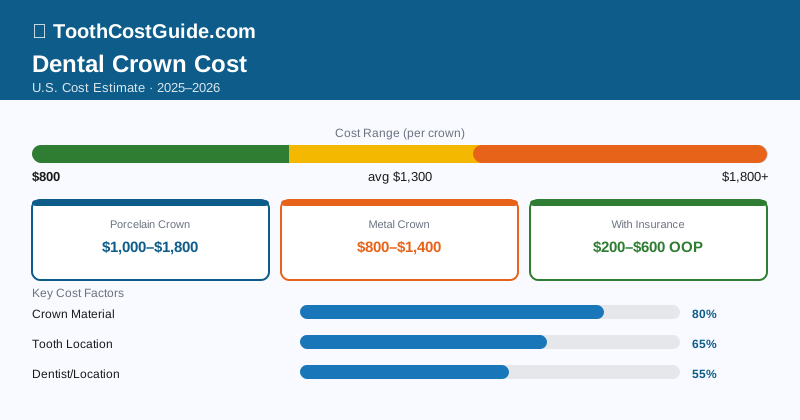
A crown is rarely the only thing on your bill. That’s the part dentists don’t always lead with. The crown itself runs $800–$1,800 depending on material and tooth location — but if the tooth needs a buildup first, add $150–$300. If it needs a root canal first, add $700–$1,800 more. By the time you’re done saving that molar, you might be looking at $2,500–$3,600 total.
Here’s how to understand what you’re actually paying for, which material makes sense for which tooth, and how to significantly reduce the final number.
Estimates based on 2026 national averages adjusted for your state. Actual costs vary by provider, complexity, and plan details. Get a written treatment estimate before proceeding.
Crown Types and Costs
| Crown Material | Cost Per Tooth (No Insurance) |
|---|---|
| Porcelain-fused-to-metal (PFM) | $800–$1,400 |
| All-ceramic / lithium disilicate (e.max) | $900–$1,600 |
| Zirconia | $1,000–$1,800 |
| Gold / metal alloy | $800–$1,600 |
| Stainless steel (temp or pediatric) | $300–$500 |
| Same-day CEREC (in-office milled) | $1,000–$1,800 |
Choosing a Crown Material: What Actually Matters
Dentists will often present material options without clearly explaining the tradeoffs. Here’s the honest breakdown:
PFM (porcelain-fused-to-metal) was the workhorse of dentistry for 30+ years. Durable, widely available, and at the lower end of the price range. The downside: over time, the metal margin at the gumline can become visible as a dark line — cosmetically noticeable on front teeth. On back molars that nobody sees? PFM holds up fine and costs less.
All-ceramic / e.max (lithium disilicate) looks the most like a natural tooth, which matters on incisors and premolars. More technique-sensitive to place than PFM. Slightly less fracture-resistant on heavy-chewing back molars, though it handles most molar cases well. This is the go-to material for visible teeth.
Zirconia has become the premium standard for posterior teeth in the last 5–7 years. Extremely strong, no metal, no dark margin, biocompatible. Newer “monolithic zirconia” is also more aesthetic than older generations. Expect to pay $200–$400 more than PFM, but on a molar that needs to last 15+ years, most dentists consider it worth it.
Gold — still unbeaten for longevity. Gold crowns routinely survive 20–30 years; no other material matches that durability record. Not cosmetically preferred (obviously), but for a lower second molar that’s rarely visible, a gold crown is a legitimate long-term investment. Price fluctuates with commodity markets but typically runs $800–$1,600.
CEREC / same-day crowns are milled in-office in about 2 hours from a digital scan — no temporaries, no return visits. Quality has improved dramatically. The caveat: the outcome depends heavily on the accuracy of your dentist’s scanner and how well the milling machine is maintained. Older equipment = less precise margins.
“Which material do you recommend for this specific tooth, and why?” Then ask what happens over 10–15 years with each option. A dentist who explains the tradeoffs honestly — rather than defaulting to whatever the lab they use prefers — is one worth trusting.
The Hidden Costs That Come With a Crown
Core buildup ($150–$300): When decay or a previous large filling has left too little natural tooth structure to support a crown, the dentist builds up the core of the tooth with composite or amalgam first. This is almost always necessary on heavily damaged teeth and is billed as a separate procedure. Ask upfront whether your treatment plan includes it.
Post and core ($200–$500): After a root canal, the tooth’s pulp chamber is empty. A post is inserted into the root canal space to help anchor the core buildup. Required when a root canal has been done and the remaining tooth structure is minimal.
Root canal ($700–$1,800): If the decay or fracture has reached the pulp, you need a root canal before the crown. Many patients learn this partway through their crown prep appointment — an expensive surprise. If you’re getting a crown on a deeply damaged tooth, ask your dentist whether they suspect pulp involvement before you start.
Temporary crown: Usually included in the crown fee, but verify. You’ll wear a temporary for 2–3 weeks while the lab fabricates the permanent crown.
With vs. Without Dental Insurance
Most plans classify crowns as “major restorative” — covered at 50% after your annual deductible ($50–$100). That sounds helpful, but two things limit it in practice.
First, the annual maximum problem. Most dental plans cap total annual benefits at $1,000–$2,000. A single crown at $1,200 with 50% coverage means insurance pays $600 — but if you’ve already used $500 of your annual maximum for other work, insurance only has $500 left to pay, covering far less than expected.
Second, waiting periods. If you purchase dental insurance knowing you need a crown, many plans won’t cover major restorative work for 6–12 months. Read the fine print before enrolling.
Practical example: $1,400 zirconia crown on a molar, patient with a $1,500 annual maximum, $50 deductible, $0 already used this year.
- Deductible: $50
- Insurance pays 50% of remaining $1,350 = $675
- Patient pays: $50 + $675 = $725 out of pocket
That’s a meaningful reduction. But add a root canal ($1,200) and buildup ($250) to that same tooth and the math changes quickly — total treatment $2,850, annual max of $1,500 reached partway through.
Pre-authorization: Before any crown work begins, ask your dentist to submit a predetermination to your insurer. It’s a written estimate of exactly what they’ll cover. Free to request, takes 1–2 weeks, eliminates billing surprises.
How to Significantly Cut the Cost
Dental school clinics are the single biggest cost lever. Crowns at accredited dental school clinics — performed by supervised students — typically run $400–$800, compared to $1,000–$1,800 at private practices. The tradeoff is time: appointments are longer, there are more of them, and scheduling can take weeks. But the quality is faculty-supervised and the savings are real.
Time your crowns across calendar years. If you need two crowns and have a $1,500 annual max, scheduling one in November and one in January doubles your coverage. Many people don’t think to do this — their dentist won’t mention it unless you ask.
Ask about PFM vs. zirconia on hidden teeth. If the crown is on a tooth that’s never visible when you smile, a PFM crown at $200–$400 less than zirconia works perfectly well. Mention that cost is a factor and ask which materials are clinically appropriate — not just aesthetically preferred.
Second opinions on the diagnosis itself. Before committing to a crown, it’s reasonable to ask whether a large composite filling (onlay) could work instead. Crowns cover the whole tooth; onlays cover only the damaged portion. An onlay costs $500–$1,200 — less than a full crown, and more conservative of natural tooth structure. Not every dentist will suggest it.
University dental clinics often have waiting lists, but if you have a flexible schedule, the savings are worth it. A crown that costs $1,400 at a private practice may run $500–$700 at a dental school. Search “[your city] dental school clinic crown” to find programs near you.
Financing
At $800–$1,800 per crown — and potentially $2,500+ when combined procedures are included — financing is worth planning for.
CareCredit is the most widely accepted dental financing option. Offers 0% promotional periods of 6–24 months. The critical warning: if you don’t pay the full balance before the promotional period ends, retroactive interest applies from the original purchase date at approximately 26–29% APR. Pay it off before the deadline.
Sunbit and LendingClub Patient Solutions are alternatives available at some practices. Sunbit offers straightforward installment loans (no deferred interest traps). LendingClub offers longer 24–84 month terms for larger balances.
HSA and FSA funds cover crowns, buildups, and root canals. Using pre-tax dollars for these expenses gives you an effective 22–37% discount depending on your tax bracket. If you have an HSA, this is one of the best uses for it.
Bottom Line
A dental crown costs $800–$1,800 for the crown alone — before factoring in what the tooth needs before it can be crowned. The total cost to save a heavily damaged molar can run $2,000–$3,600 without insurance, or $700–$1,500 with decent coverage.
The alternative is extraction ($150–$500), which is cheaper upfront but leaves a gap. Replacing that gap with an implant later runs $3,000–$5,000. In most cases, saving the tooth is still the better financial decision — just make sure you understand the full treatment plan cost before you start.
Always get a written, itemized treatment plan before any crown work begins. It should list every procedure code, the crown material being used, whether a buildup is included, and the fee for each item. Then submit a predetermination to your insurance before the first appointment. Surprises in dental billing are almost always avoidable with these two steps.
Frequently Asked Questions
A dental crown typically costs $800–$1,800 per tooth, depending on the material (porcelain, ceramic, or metal) and which tooth needs the crown. However, if your tooth requires additional procedures like a buildup ($150–$300) or root canal ($700–$1,800), your total out-of-pocket cost could reach $2,500–$3,600.
Most dental insurance plans cover 50% of crown costs after you meet your deductible, leaving you responsible for $400–$900 per tooth. However, many plans have annual maximums ($1,000–$2,000 per year) and may not cover crowns considered cosmetic rather than restorative, so check your specific policy.
A crown typically requires two appointments: the first visit involves tooth preparation, buildup if needed, and taking impressions (30–60 minutes), while the second visit 1–2 weeks later involves fitting and cementing the permanent crown (30 minutes). During the waiting period, you'll wear a temporary crown to protect the prepared tooth.