Why does your dentist want to add bone before placing an implant? It sounds counterintuitive — you’re trying to replace a tooth, not build a construction site in your jaw. But the answer is straightforward once you understand what an implant actually needs to succeed.
A titanium implant works by fusing directly with your jawbone through a process called osseointegration. That fusion requires adequate bone volume — enough width, height, and density to anchor the post and distribute bite forces over years of use. When a tooth is missing, that bone doesn’t stay put. According to the American Academy of Oral and Maxillofacial Surgeons (AAOMS), the alveolar bone that once supported a tooth begins resorbing within weeks of extraction and can lose 25% of its width in the first year. By year three, significant vertical loss follows.
A bone graft rebuilds what was lost — or preserves what’s still there — so an implant has a stable foundation.
The Four Types of Dental Bone Grafts
| Procedure | Cost Range | Purpose |
|---|---|---|
| Socket preservation graft | $300–$800 | Placed at time of extraction to prevent bone loss |
| Ridge augmentation | $1,000–$3,000 per site | Rebuilds bone width/height after significant loss |
| Lateral window sinus lift | $1,500–$3,000 | Major bone augmentation for upper posterior implants |
| Osteotome sinus lift (crestal) | $500–$1,500 | Minor sinus lift, done during implant placement |
| Periodontal bone graft | $600–$1,200 per site | Repairs bone lost to gum disease |
| Block bone graft (autograft) | $2,000–$3,000+ | Large-volume grafting from patient’s own bone |
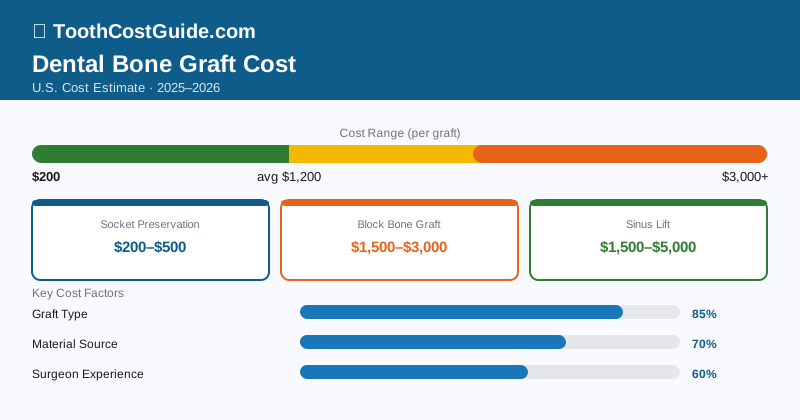
Socket Preservation ($300–$800)
This is the simplest, most commonly performed bone graft — and the one most patients could benefit from but don’t get because it wasn’t offered at the time of extraction.
When a tooth is extracted, the empty socket starts shrinking. A socket preservation graft fills that space with bone graft material immediately after the tooth comes out, then covers it with a collagen membrane to protect the clot and guide bone regeneration. Healing takes 3–4 months. When you return to place the implant, the bone volume is preserved and the procedure is far simpler (and less expensive) than trying to augment bone after it’s already collapsed.
Cost: $300–$800 per socket. If your dentist doesn’t mention this when extracting a tooth you plan to eventually replace with an implant, ask about it. The cost is modest compared to the $1,500–$3,000 ridge augmentation it can prevent.
Ridge Augmentation ($1,000–$3,000)
If you’ve had a missing tooth for a year or more, or if an extraction was done without socket preservation, the bone has likely already resorbed. Ridge augmentation rebuilds that collapsed area using graft material and a resorbable or titanium membrane to contain and shape the new bone.
This is a more involved procedure than socket preservation. It typically requires a separate surgical appointment, 4–6 months of healing, and a second surgery to place the implant. The cost reflects that complexity.
Sinus Lift ($1,500–$3,000)
The upper back jaw presents a unique challenge: the maxillary sinuses sit just above the roots of the upper premolars and molars. When those teeth are lost and the sinus can pneumatize downward — expanding into the space the tooth roots once occupied — that leaves little room for an implant.
A sinus lift elevates the sinus membrane and packs bone graft material below it, creating the height needed for an implant. Two techniques exist:
Lateral window (open) sinus lift: A small access window is cut in the outer wall of the sinus, the membrane is carefully elevated, and bone graft is packed in. Most appropriate when less than 4–5mm of bone exists. Requires a separate healing period of 4–9 months.
Osteotome (crestal) sinus lift: Done through the implant site itself using special instruments that gently tap the sinus floor upward. Requires at least 5–6mm of existing bone. Can sometimes be done simultaneously with implant placement. Less invasive, shorter recovery.
Periodontal Bone Graft ($600–$1,200 per site)
This graft has a different purpose: treating bone loss caused by periodontal (gum) disease, not preparing for an implant. When bacteria destroy the bone supporting a natural tooth, a periodontal surgeon can place regenerative materials — bone graft plus growth factors like Emdogain — to stimulate bone regrowth and save the tooth. Published data in the Journal of Periodontology shows bone fill rates of 40–70% with guided tissue regeneration in appropriate candidates.
Graft Materials: What Goes Into Your Jaw
Not all bone graft material is the same, and the type used affects both cost and biology.
Autograft (your own bone): The gold standard. Taken from your chin, ramus (back of jaw), hip, or tibia. Has living cells that actively contribute to new bone formation. Most expensive ($2,000–$3,000+) because it requires a second surgical site and donor site healing. Used when large-volume grafting is needed.
Allograft (donor human bone): Processed cadaveric bone from a tissue bank. Sterile, safe, and widely used. Acts as a scaffold for your body’s own bone-forming cells to grow into. Cost: $300–$800 per socket, depending on volume used. Most common graft material in socket preservation.
Xenograft (bovine or porcine bone): Animal-derived bone mineral. Bio-Oss (bovine) is the most studied xenograft material on the market, with decades of published data. Resorbs slowly — which can actually be beneficial for maintaining volume. Similar cost to allograft.
Synthetic (alloplast): Calcium phosphate ceramics, hydroxyapatite, or bioactive glass. No biological source, fully synthetic. Works as a scaffold but generally considered less biologically active than the above options. Used when patients object to human or animal-derived materials.
You have the right to know exactly what material is going into your body. Ask your surgeon what graft material they plan to use, what form it comes in (particulate, block, or membrane), and — if it’s an allograft — from which tissue bank it’s sourced. Reputable banks are AATB-accredited. Your surgeon should be able to name the product and bank without hesitation.
What Happens If You Skip the Graft?
Some oral surgeons will attempt implant placement in marginal bone — banking on angled placement or a shorter implant to work around inadequate volume. Sometimes it works. The published implant failure literature suggests it often doesn’t. A 2018 study in the International Journal of Oral and Maxillofacial Implants found implant failure rates 2–3x higher in sites with inadequate bone volume compared to properly grafted sites.
The math is unforgiving: a failed implant means removing the hardware, waiting for healing, potentially needing more bone work, and placing a new implant — paying for everything a second time. The graft you skipped to save $800 costs you $4,000–$6,000 to fix.
Does Insurance Cover Bone Grafts?
Coverage is inconsistent, but it’s not zero. Here’s the rough breakdown:
Socket preservation at extraction: Some PPO plans cover this at 50% under major restorative because it’s preventive for future bone loss. Getting a predetermination before the extraction is worthwhile.
Ridge augmentation and sinus lifts: Most plans exclude these when they’re preparatory to implants — especially if the plan already excludes implants. The language to look for in your policy is “preparatory services” and how they’re treated.
Periodontal bone grafts: These have the best coverage track record because they treat a diagnosed disease state (periodontitis). Typically covered at 50–80% under major restorative with appropriate documentation.
HSA and FSA: Bone grafts are qualified medical expenses for both. If you know you’re having grafting done, maximize your contributions.
If a provider quotes you one flat price for “implant including graft” without itemizing, ask for the breakdown. You should know exactly how much the graft costs, what material will be used, and what CDT code will be submitted to your insurance. Bundled quotes make it impossible to understand your coverage — and make it harder to compare prices if you get a second opinion.
Frequently Asked Questions
It depends on how much bone you have left at the implant site. Dental implants need at least 8–10mm of bone height and 6mm of width to be placed with primary stability. If you lost a tooth months or years ago — or had an extraction without socket preservation — significant bone resorption may have already occurred. Your oral surgeon or implantologist will evaluate with a CBCT 3D scan. If the numbers aren't there, a graft isn't optional — it's the difference between an implant that integrates and one that fails. Skipping a recommended graft to save money often means a failed implant and the full cost twice over.
Socket preservation grafts placed at the time of extraction typically heal in 3–4 months before an implant can be placed. Ridge augmentation for larger defects takes 4–6 months. Sinus lifts — the most involved grafting procedure — require 4–9 months of healing depending on the amount of bone being generated and the grafting material used. Lateral window sinus lifts (open approach for significant augmentation) take longer than osteotome sinus lifts (closed approach for smaller lifts). Your provider should give you a specific timeline based on your anatomy and the material used.
Coverage varies significantly by plan. Socket preservation grafts placed at the time of extraction are covered by some plans at 50% under major restorative benefits — because the procedure prevents greater bone loss and future cost. Ridge augmentation and sinus lifts are less commonly covered; many plans exclude them as preparatory procedures for implants, which are themselves often excluded. Periodontal bone grafts performed to treat active bone loss from gum disease have a better coverage track record. Always get a predetermination before scheduling — submit the CDT codes and supporting X-rays so your insurer can make a formal coverage determination.