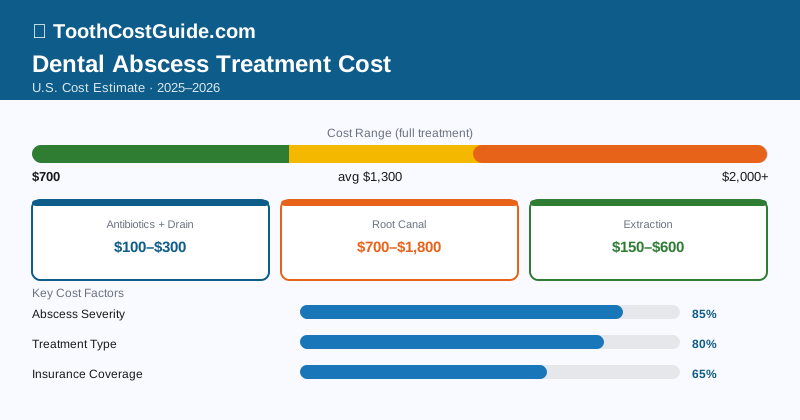
In 2010, the average cost to treat a dental abscess at a dentist’s office was around $400. In 2026, depending on what’s driving the infection, you might spend $150 for antibiotics and an extraction — or $2,000+ for a root canal, drainage, and crown. The range is wide, but the underlying logic is simple: the treatment cost scales directly with what caused the abscess and how long it’s been there.
Understanding which type you have changes everything about your treatment path and your bill.
Periapical vs. Periodontal Abscess: Two Different Animals
Periapical abscess forms at the tip of the tooth root when bacteria invade the pulp — usually through a deep cavity, a cracked tooth, or a failed old filling. The pulp dies, bacteria colonize the dead tissue, and infection spreads into the surrounding bone. This is the most common type.
Periodontal abscess forms in the gum tissue and bone alongside the tooth root, usually in a deep periodontal pocket in patients with gum disease. The tooth’s pulp may still be alive.
The distinction matters because the treatments are different.
| Type | Cause | Treatment | Cost Range |
|---|---|---|---|
| Periapical abscess | Dead tooth pulp | Root canal + crown OR extraction | $900–$3,600 |
| Periodontal abscess | Gum disease pocket | Drainage + scaling and root planing | $400–$1,400 |
| Incision and drainage (I&D) | Any swollen abscess | Lancing and irrigating the pocket | $150–$400 |
| Antibiotics (prescription only) | Temporary infection control | Amoxicillin or clindamycin course | $15–$60 |
| ER visit | After-hours swelling/pain | Antibiotics, imaging, referral | $500–$3,000 |
Treatment Options Broken Down
Root Canal (Periapical Abscess)
The definitive treatment for a periapical abscess is removing the infected pulp through root canal therapy. The procedure cleans out the bacterial infection at its source, seals the canal, and saves the tooth. A crown is usually required afterward.
- Root canal (molar): $1,000–$1,800
- Crown: $900–$1,800
- Total: $1,900–$3,600
With insurance covering root canals at 50–80%, your out-of-pocket portion might be $700–$1,200 — assuming you haven’t hit your annual maximum.
Extraction (Periapical Abscess — Lower-Cost Option)
If you can’t afford or don’t want a root canal, extraction removes the infected tooth entirely. It’s cheaper upfront but leaves a gap that should eventually be replaced.
- Simple extraction: $150–$300
- Surgical extraction: $250–$600
- Implant replacement later: $2,500–$5,500
- Bridge replacement later: $2,500–$4,500
Don’t let cost pressure you into extraction if the tooth is restorable. A root canal + crown is a permanent fix. An extraction creates a gap that shifts neighboring teeth over time — and replacement eventually costs more than the root canal would have.
Incision and Drainage (I&D)
When a visible swelling is present, the dentist may lance it to drain the pus before or alongside definitive treatment. This gives immediate pain relief and reduces swelling.
- Cost: $150–$400
- Usually combined with root canal or extraction on the same visit or within 48–72 hours
Scaling and Root Planing (Periodontal Abscess)
For periodontal abscesses, the priority is draining the infected pocket and deep-cleaning the root surface to remove bacterial deposits. Root planing plus drainage runs $400–$1,000 for the affected area. Long-term, underlying gum disease requires ongoing periodontal maintenance at $100–$300 per quarter.
Go to the ER immediately if you have: swelling spreading to your neck, jaw, or eye; difficulty swallowing or breathing; fever above 101°F with swelling; or severe pain you can’t manage. These are signs the infection is spreading beyond the tooth. An ER can provide IV antibiotics and call in oral surgery — it’s not overreacting, it’s appropriate care.
The ER Route: What It Costs and What It Does (and Doesn’t) Do
The CDC estimates dental conditions account for approximately 2 million ER visits annually in the US. But here’s what an ER actually provides:
What the ER does: Evaluates severity, prescribes antibiotics and pain medication, may drain a surface abscess, rules out spreading infection via CT scan if indicated.
What the ER doesn’t do: Root canals. Extractions. Any definitive dental treatment. You leave with antibiotics and a referral.
Typical ER costs for a dental abscess:
- With insurance: $150–$500 copay or coinsurance
- Without insurance: $800–$3,000 (facility fee + physician fee + imaging)
- Most hospitals have charity care programs that significantly reduce uninsured costs — ask at registration
Antibiotics Alone: Why They’re Not a Fix
Amoxicillin or clindamycin will knock back a dental infection. The swelling goes down. The pain eases. That feels like success — but the tooth is still the source. Once the antibiotic course ends and bacteria start multiplying again in the same dead pulp tissue or periodontal pocket, you’re back where you started. Often worse, because repeated antibiotic exposure can select for resistant bacteria.
Get the antibiotics. Absolutely. But treat them as a 5–7 day window to get a dental appointment, not as a complete solution.
Uninsured Options
Community health centers (Federally Qualified Health Centers) provide dental care on a sliding fee scale. An extraction at an FQHC might cost $30–$100 for low-income patients. Find one at findahealthcenter.hrsa.gov.
Dental schools perform root canals and extractions at 40–60% discounts under faculty supervision. For an abscess that needs treatment today, call and explain it’s an emergency — most dental school clinics have urgent care slots.
Discount dental plans (Careington, Aetna Dental Access) cost $80–$200/year and offer immediate 15–40% discounts. No waiting periods like insurance, so they’re useful even if you sign up today.
State Medicaid covers emergency dental services in most states, including exams, X-rays, extractions, and sometimes root canals. Coverage varies significantly — California, Massachusetts, Oregon, and New York offer robust dental Medicaid. Call your state Medicaid coordinator or check your state’s benefits portal.
Avoid “dental drain” or self-lancing suggestions found online. Attempting to drain an abscess at home risks pushing bacteria deeper into tissue planes, spreading the infection, and introducing new bacteria into the wound. The only safe drainage is performed by a dentist or physician using sterile technique.
Frequently Asked Questions
An ER visit for a dental abscess typically costs $500–$3,000 depending on the hospital, your insurance, and whether imaging is done. The ER will prescribe antibiotics and pain medication — they won't perform the definitive dental treatment. You'll still need to see a dentist for the root cause. If you have insurance, the ER copay or coinsurance applies. Without insurance, many hospitals have financial assistance programs.
Antibiotics reduce the infection temporarily but don't cure an abscess. The source of the infection — a dead tooth pulp or a deep gum pocket — remains. Without definitive treatment (root canal, drainage, or extraction), the abscess will return, often worse. Antibiotics are a bridge to dental treatment, not a substitute. The CDC warns against unnecessary antibiotic prescribing for dental infections without source control.
An untreated dental abscess can spread infection to the jaw, neck, or airway — a life-threatening emergency requiring hospitalization. The CDC reports that dental infections contribute to approximately 2 million ER visits annually in the US. Even before reaching that severity, an untreated abscess causes worsening pain, bone loss, and eventual tooth loss. Treat it promptly.