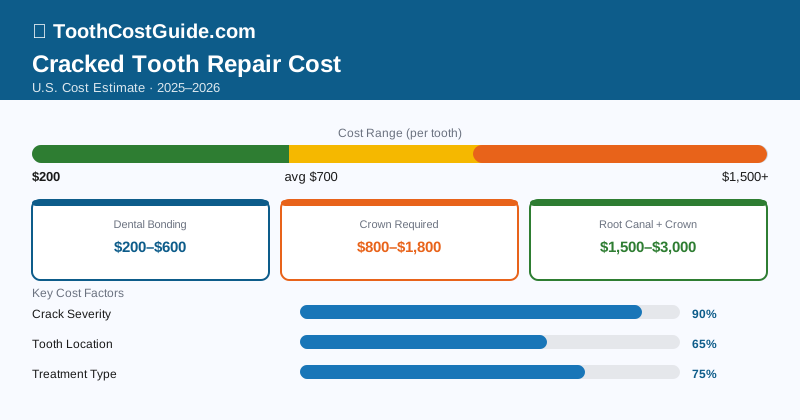
Bite down on an olive pit at dinner. Feel that sharp flash of pain that disappears as quickly as it arrived. That’s classic cracked tooth syndrome — and dentists see it constantly. The catch is that what you pay to fix it ranges from literally $0 (craze lines that need no treatment) to over $3,600 when a crack has worked its way into the nerve. Location, depth, and timing are everything.
| Crack Type / Treatment | Cost Without Insurance |
|---|---|
| Minor chip – dental bonding | $200–$600 |
| Craze lines (surface only) – no treatment needed | $0 |
| Crown fracture – dental crown | $800–$1,800 |
| Cusp fracture – onlay or crown | $800–$1,800 |
| Cracked tooth with pulp involvement – root canal + crown | $1,700–$3,600 |
| Vertical root fracture – extraction | $75–$550 |
| Extraction + implant (replacement) | $3,500–$6,000 |
The Five Types of Tooth Cracks — and Their Price Tags
Dentistry classifies cracks into five distinct categories, and understanding them is the fastest way to understand why one crack costs $200 while another costs $3,000+.
Craze lines are superficial fractures in the outer enamel. Almost every adult has them. They cause no pain, require no treatment, and cost nothing. If a dentist tells you craze lines need intervention without a clinical reason, that’s worth questioning.
Fractured cusp means a piece of the outer tooth has broken away. Small chip on a front tooth? Bonding at $200–$600 handles it in a single appointment. Large piece from a back molar? You’re looking at a crown ($800–$1,800) to restore shape and protect what’s left.
Cracked tooth — the category that catches people off guard — is a crack that extends down toward the root but hasn’t split the tooth or reached the pulp yet. Pain when biting on a specific spot, then immediate relief when you release pressure: that’s the hallmark. A crown placed at this stage holds the crack together and costs $800–$1,800. Wait until the crack reaches the pulp, and you’re adding a root canal ($700–$1,800) on top of the crown.
Split tooth is what happens when that cracked tooth goes untreated long enough. The tooth divides into segments. Sometimes one segment can be saved and restored; often extraction is the only option. Add implant replacement ($3,500–$6,000) if you want to fill the gap.
Vertical root fracture starts below the gumline and travels upward. Almost impossible to save. These are often discovered only when an old root-canal-treated tooth develops a new abscess years later. Extraction ($75–$550) followed by implant placement is typically the path forward.
The One Variable That Doubles Your Bill
Whether the pulp is involved. Full stop.
A crack treated with a crown before it reaches the nerve costs $800–$1,800. That same crack, once it’s infected the pulp, requires root canal therapy before anything else — adding $700–$1,800 to the total. According to ADA research on treatment sequencing, patients who delay addressing cracked tooth pain by more than six months are significantly more likely to need root canal treatment alongside their crown.
Timing isn’t just about money, either. A crack caught early has a salvageable tooth. A crack ignored until it splits below the gumline often doesn’t.
Cracked tooth syndrome is notorious for intermittent symptoms — pain when biting on certain foods, sharp pain that releases quickly, or sensitivity to cold. If you experience these symptoms on a specific tooth, see a dentist promptly. Early treatment of a crack is always cheaper than treating a crack that has propagated to the pulp.
Other Factors Shaping the Final Number
Which tooth is cracked. Back molars absorb the most chewing force and fracture most often. They also require the most durable restorations. Front tooth cracks are usually cosmetic concerns addressed with bonding or tooth-colored crowns.
Diagnosis complexity. Some cracks are invisible on X-rays. Dentists use bite tests with a Tooth Sleuth instrument, transillumination, and sometimes dye to pinpoint crack location. If your dentist can’t tell definitively whether the pulp is involved, they may suggest a provisional crown to monitor symptoms over a few weeks before committing to a root canal. That’s legitimate clinical reasoning, not fence-sitting.
Your geography. Dental fees vary 30–40% between urban and rural markets. The same crown costs $1,800 in Manhattan and $900 in rural Ohio.
Insurance Coverage Breakdown
Cracked tooth repair spans multiple coverage categories depending on treatment:
- Bonding (restorative, not cosmetic): 70–80% covered under basic benefits
- Crown: 50% covered under major restorative after deductible
- Root canal: 50–80% covered depending on plan and tooth location
Running the numbers on a root canal + crown totaling $3,000:
- Insurance pays 50% = $1,500
- Deductible: $100
- Patient owes: approximately $1,600
- But note: most plans cap benefits at $1,000–$2,000 annually, meaning you may hit your maximum before full coverage kicks in
Check your plan’s annual maximum and whether you’ve already used any of it this year before treatment.
Three Ways to Keep Costs Down
Catch it early. A crown at the cracked-tooth stage costs $800–$1,800. The same tooth treated six months later after pain becomes constant often needs a root canal added — $1,500–$1,800 more. Regular checkups that catch cracks before symptoms develop are genuinely worth it financially.
Get the diagnosis right first. Don’t agree to a root canal on a cracked tooth without clinical evidence of pulpal involvement — either irreversible pulpitis symptoms (spontaneous pain, lingering heat sensitivity) or necrosis confirmed on testing. A crown that relieves pressure sometimes allows an irritated pulp to recover without root canal treatment.
Dental school clinics. Crown treatment at dental school clinics runs 40–65% below private practice rates. A $1,500 private-practice crown might be $600–$800 at a school clinic. Trade-off: appointments take longer and scheduling windows are less flexible.
If your dentist diagnoses a cracked tooth but says it’s unclear whether the pulp is involved, ask about a diagnostic crown buildup — a crown placed to relieve symptoms and monitor whether the pulp recovers or continues to deteriorate. This approach can sometimes avoid a root canal if the pulp heals once pressure is removed from the crack.
Financing Options
Cracked tooth repair can be unexpected and range from affordable ($300 bonding) to substantial ($3,600 for root canal, buildup, and crown).
CareCredit: Ideal for unplanned cracked tooth emergencies. Apply at the dental office and receive a credit decision in minutes. Manage the $1,500–$3,000 cost over 12–18 months at 0% with a promotional period.
FSA/HSA: All dental restorations — bonding, crowns, root canals — are FSA and HSA eligible. If you have remaining FSA funds before year-end, this is the right time to address a cracked tooth.
In-house payment plans: For established patients, most dental offices will arrange installment payment for a multi-thousand dollar crown and root canal case. Ask before assuming financing isn’t available.
What You’re Actually Paying For
Cracked tooth repair costs $200–$600 for minor chips treated with bonding, $800–$1,800 for a crown on a crack that hasn’t reached the pulp, and $1,700–$3,600 when root canal treatment is also required. With insurance covering 50% of major restorative work, most patients pay $500–$2,000 depending on what’s needed.
The math is consistent across every scenario: a crack caught and treated early is always the cheaper version of that same crack treated later. It’s not a coincidence — it’s just how dental disease progresses.
Always get a written treatment plan before agreeing to any dental work. For a cracked tooth, ask your dentist to specify the type of crack, whether the pulp is definitely involved or potentially involved, and what the treatment plan looks like at each possible diagnosis — so you understand both the minimum and maximum potential cost before any work begins.
Frequently Asked Questions
Cracked tooth repair costs $200–$1,500+ depending on severity and treatment type. Minor cracks treated with bonding run $200–$400, while moderate cracks requiring crowns cost $800–$1,500, and severe cracks needing root canals plus crowns can exceed $2,500–$3,600.
Most dental insurance plans cover 50–80% of cracked tooth treatment after you meet your deductible, but coverage depends on whether the crack is deemed cosmetic or necessary for function. You'll typically pay 20–50% out-of-pocket, with your annual maximum benefit (usually $1,000–$1,500) limiting total coverage per year.
Minor surface cracks can wait weeks or months without risk, but cracks that cause pain or reach the nerve should be treated within days to prevent infection and additional damage. Delaying treatment on deep cracks can result in the need for root canal therapy instead of simpler bonding, nearly tripling your repair costs.