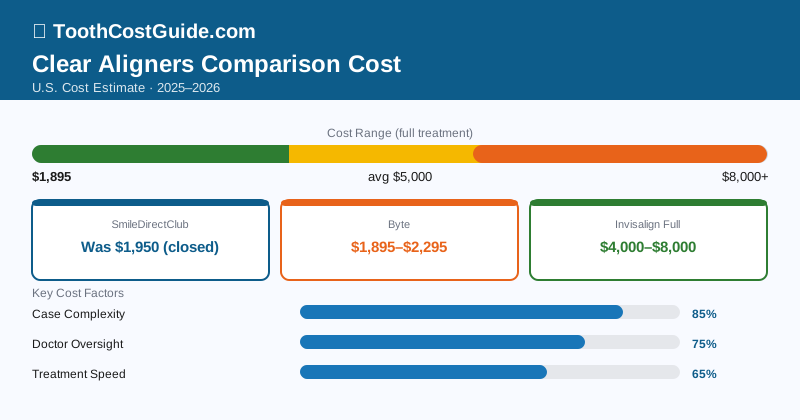
September 2023 should have been a wake-up call for anyone considering mail-order orthodontics. SmileDirectClub — once valued at $8.9 billion — shut down permanently, leaving thousands of patients mid-treatment with no access to replacement aligners and no recourse. The company was gone. The treatment wasn’t finished. Lesson noted.
That context matters as you compare your clear aligner options. The price range runs from $1,895 for at-home direct-to-consumer brands to $8,000 for comprehensive in-office Invisalign. The gap isn’t just about cost — it’s about what happens when something goes wrong, how serious your case is, and whether a licensed professional is actually watching what happens to your teeth.
| Brand | Cost Range | Care Model |
|---|---|---|
| Invisalign Full | $3,000–$8,000 | In-office with orthodontist/dentist |
| Invisalign Lite/Express | $1,800–$3,500 | In-office, mild cases only |
| ClearCorrect (by Straumann) | $2,000–$8,000 | In-office with dentist/orthodontist |
| Byte At-Home | $1,895–$2,295 | Remote monitoring only |
| SmileDirectClub | Closed in 2023 | N/A (company shut down) |
| Candid | $2,400–$3,500 | Hybrid in-office + remote |
| NewSmile | $1,195–$1,895 | Remote monitoring only |
| SureSmile | $2,000–$5,000 | In-office |
The Core Difference: In-Office vs. Direct-to-Consumer
Every decision point in this comparison traces back to one question: do you want a licensed provider examining your teeth in person, or are you comfortable with remote monitoring via app photos?
In-office brands (Invisalign, ClearCorrect, SureSmile) require X-rays, clinical examination, and regular in-person check-ups. A licensed orthodontist or dentist prescribes the treatment, monitors progress hands-on, and handles complications as they arise. This adds cost — but it also adds a safety net.
DTC brands (Byte, NewSmile) send impression kits to your home. A remote dental support team reviews impressions and generates a treatment plan. Monitoring happens through photos you take yourself and submit via app. No one physically examines your teeth before, during, or after treatment. No X-rays. No bite assessment.
Case complexity determines which model is appropriate. Mild tooth movement in a healthy mouth with no bite issues — DTC can work. Anything more complex, and the absence of clinical oversight becomes a genuine risk rather than an acceptable tradeoff.
Invisalign ($3,000–$8,000)
Invisalign is the market leader by a large margin. Align Technology reports over 15 million patients treated globally, giving it by far the largest clinical evidence base of any clear aligner system. Aligners are made from Align’s proprietary SmartTrack material, and tooth-colored attachments bonded to the teeth enhance control of difficult movements.
Best for: Mild through severe crowding, spacing, overbite, underbite, open bite, and crossbite. Patients who need the closest approximation of fixed-appliance effectiveness in removable format. Complex cases that require significant molar control or bite correction.
Know before you go: Initial records typically run $150–$350. Retainers after treatment are $100–$600 and often not included in the quoted fee. Refinements (extra aligner trays) may be included in the comprehensive program or charged separately at $500–$1,500 per set — confirm this before signing.
ClearCorrect ($2,000–$8,000)
ClearCorrect is Invisalign’s most direct competitor in the in-office market. Owned by Straumann Group (a major Swiss dental manufacturer), it uses BPA-free TriPlex multilayer polyurethane material and is prescribed by orthodontists and general dentists.
Best for: Mild to moderate crowding and spacing. Clinically comparable to Invisalign for most standard cases. Some orthodontists actually prefer ClearCorrect for specific bite correction scenarios based on biomechanical characteristics.
The cost advantage: ClearCorrect providers typically price treatment $500–$1,500 less than Invisalign for equivalent case complexity. Align Technology’s licensing fees are embedded in Invisalign’s cost structure — ClearCorrect’s pricing doesn’t carry that overhead. For appropriate cases, it’s the same clinical quality at a lower price.
Byte ($1,895–$2,295)
Byte ships impression kits to your door. You make your own impressions, mail them back, and a remote treatment team designs your plan. The included HyperByte device — a high-frequency vibration tool — is marketed to speed up treatment, though independent evidence supporting that claim is limited.
Best for: Adults with very mild crowding or spacing only, healthy gums, no bite issues, no significant prior orthodontic history, and the discipline to wear aligners 22 hours per day without reminders. Post-treatment relapse cases (teeth shifted slightly after prior braces) are often the ideal use case.
Risk factors to weigh: Because there’s no in-person examination, undiagnosed gum disease, bone loss, cavities, or bite problems can go undetected before aligners are fabricated. Some patients have reported worsened bite or root issues. The American Association of Orthodontists has raised formal concerns about DTC aligner safety.
Candid ($2,400–$3,500)
Candid sits between the two models. Patients start with an in-person visit at a Candid Studio or partner dental office, then shift to remote monitoring via the CandidMonitoring app with periodic in-person check-ins. Aligners are manufactured by Ormco, a major orthodontic manufacturer.
Best for: Mild-to-moderate cases where patients want more oversight than pure DTC brands provide, at a price below full Invisalign. The hybrid model is clinically more sound than fully remote DTC — the initial exam catches major issues.
SmileDirectClub, once the largest DTC aligner company, permanently closed in September 2023 after filing for bankruptcy. Thousands of patients mid-treatment were left without support or access to replacement aligners. This illustrates the risk of DTC orthodontic treatment from companies without in-office infrastructure — if the company closes, your treatment may be abruptly abandoned. This is a significant consideration when choosing between DTC and in-office care.
ClearCorrect vs. Invisalign: What Actually Differs
For most mild-to-moderate cases, the clinical outcomes are comparable. Choose based on what’s available from your orthodontist and what the pricing looks like.
- Cost: ClearCorrect runs $500–$1,500 less for equivalent complexity as a rule of thumb
- Attachments: Both systems use tooth-colored attachments for complex movements
- Provider availability: Invisalign has more US providers; ClearCorrect is available through most dental offices
- Refinements: Both include refinements in comprehensive cases, but policies vary by individual provider
- Insurance: Both are treated identically — covered to the same lifetime maximum, same terms
In-office clear aligners (Invisalign, ClearCorrect) offer professional oversight, treatment of complex cases, and in-person complication management. DTC aligners (Byte, NewSmile) cost $1,000–$5,000 less but are appropriate only for very mild cases, carry higher risk if underlying dental problems exist, and leave patients without in-office support. The SmileDirectClub bankruptcy is a cautionary tale about DTC aligner risks.
Insurance Coverage by Brand Type
In-office brands (Invisalign, ClearCorrect, SureSmile): Covered by dental insurance plans with orthodontic benefits on the same terms as traditional braces.
- Lifetime maximum: $1,000–$3,000
- Coverage rate: 50% up to the lifetime maximum
- Age restrictions: Most plans cover patients under 18–19; adult coverage varies by plan
DTC brands (Byte, NewSmile): Generally not covered. Insurance coverage requires that treatment be supervised by an in-network provider. Since DTC treatment isn’t supervised by an in-network clinical provider, it typically falls outside coverage criteria.
Financing Options
In-office providers: Same financing as traditional braces — in-house 0% installment plans, CareCredit, and FSA/HSA eligibility. Both Invisalign and ClearCorrect providers routinely offer these.
DTC brands: Byte and NewSmile offer monthly payments through third-party healthcare lenders starting around $65–$85/month. Interest rates and total cost vary by repayment term and creditworthiness.
FSA/HSA for DTC: Eligibility varies by plan administrator. Some require a prescription or Letter of Medical Necessity for DTC brands. Confirm before paying.
Ways to Save Without Compromising Care
Consider ClearCorrect when both options are clinically appropriate. Ask your orthodontist explicitly whether your case could be treated with ClearCorrect and what the price difference would be.
Seek high-volume Invisalign providers. The Invisalign doctor locator shows provider tier. Diamond and Platinum Elite providers often price competitively because of volume discounts from Align Technology.
Use dental school clinics. Many orthodontic residency programs offer Invisalign or ClearCorrect at 30–50% below private practice fees. The care is supervised by faculty specialists.
Skip DTC if anything is uncertain. If you have any bite issues, gum sensitivity, bone loss concerns, or it’s been more than 2 years since your last dental exam — the cost savings from a DTC brand are not worth the risk of undetected problems causing permanent damage.
Bottom Line
For mild cases in adults with healthy mouths, Byte at $1,895–$2,295 delivers value and convenience — just see your dentist first to confirm your case actually fits that category. For mild-to-moderate cases with professional oversight, ClearCorrect from a general dentist often hits the best cost-effectiveness ratio. For complex cases, Invisalign with an experienced orthodontist remains the most proven option. And wherever you land — the SmileDirectClub story is worth keeping in mind. Infrastructure matters when something goes wrong.
The right clear aligner depends on case complexity and risk tolerance. In-office treatment with Invisalign or ClearCorrect provides professional safety oversight and insurance coverage. DTC options are cheaper but appropriate only for the mildest cases in adults with no underlying dental issues.
Frequently Asked Questions
Clear aligner costs vary by brand: Invisalign ranges from $3,000–$8,000, ClearCorrect from $2,000–$8,000, Byte from $1,895–$2,295, and SmileDirectClub at $1,950 (though the company permanently closed in September 2023). Budget-friendly at-home brands are significantly cheaper than traditional in-office Invisalign treatment.
Most dental insurance plans treat clear aligners like traditional braces and cover 40–50% of the cost, with typical out-of-pocket expenses ranging from $1,500–$4,000 after insurance. However, many plans have annual maximums ($1,000–$2,000) and waiting periods, so check your specific policy before starting treatment.
Most clear aligner treatments take 6–18 months depending on the complexity of your case and which brand you choose; simpler cases with brands like Byte may finish in 4–6 months, while severe misalignment with Invisalign typically requires 12–24 months. Treatment duration directly affects total cost, as longer cases require more aligners.