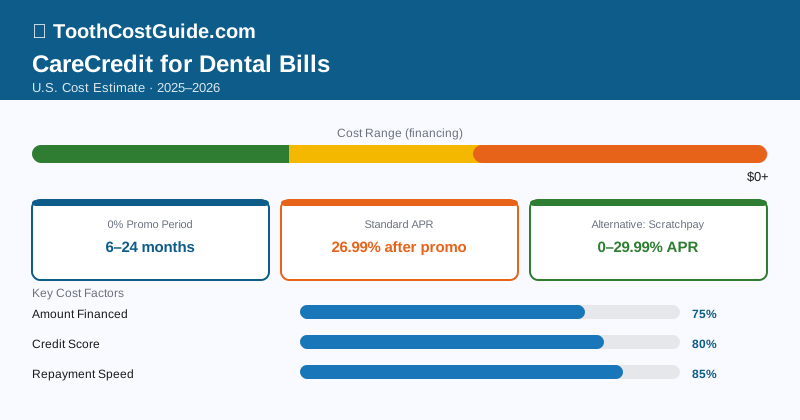
Your dentist just handed you a treatment plan for $2,400. The office manager smiles and says, “We accept CareCredit — it’s 0% interest for 18 months.” Sounds great. But here’s what that sentence leaves out: if you’ve got $1 left on your balance the day that promotional period ends, CareCredit charges you interest retroactively on the entire original amount — going back to the very first day you swiped the card. That’s not a hypothetical. According to Synchrony Bank’s own cardholder agreement, the deferred interest rate sits at approximately 26.99% APR, and it applies from date of purchase.
Used correctly, CareCredit is genuinely useful. Used carelessly, a $2,000 procedure can quietly become $2,500 before you realize what happened.
| CareCredit Promotional Period | Minimum Amount | APR If Not Paid Off | Monthly Payment to Pay Off in Time |
|---|---|---|---|
| 6 months | $200+ | 26.99% retroactive | $167/month (on $1,000) |
| 12 months | $200+ | 26.99% retroactive | $83/month (on $1,000) |
| 18 months | $1,000+ (varies by provider) | 26.99% retroactive | $56/month (on $1,000) |
| 24 months | $2,500+ (varies by provider) | 26.99% retroactive | $42/month (on $1,000) |
| 24+ months extended (reduced APR) | Varies | 17.99–29.99% stated APR | Fixed monthly payment |
The Mechanics Behind the Card
CareCredit is issued by Synchrony Bank and works like a revolving credit card restricted to healthcare purchases. You apply at the dental office front desk or online; most applicants get an instant decision. It’s accepted at more than 260,000 healthcare providers, so your dentist almost certainly takes it.
The promotional period structure breaks down like this:
- While you’re within the promotional window (6, 12, 18, or 24 months), minimum monthly payments are due and no interest appears on your statement — provided you clear the entire balance before time runs out
- Which promotional period you qualify for depends on both the amount you’re charging and which periods your specific provider has enrolled in — they don’t all offer all options
- If any balance remains when the promotional clock hits zero: interest is applied retroactively at roughly 26.99% APR dating back to the original transaction date
This is the mechanism people get burned by. It’s fundamentally different from a simple 0% installment loan, where interest just doesn’t accrue. With deferred interest, the interest is always accumulating — it’s just invisible until the deadline passes.
CareCredit’s 0% promotional period means interest is waived only if you pay the full balance by the deadline. If you’re one day late or $1 short, you’re charged the full 26.99% APR on the original purchase amount from day one. Set up auto-pay for the exact amount needed to zero the balance before the period ends.
A Concrete Example of the Deferred Interest Math
Scenario: $1,800 root canal and crown on a 12-month 0% promotion
Most people see “0% for 12 months” and make minimum payments, figuring they’ll deal with the rest later.
- You make minimum payments (~$50/month) for 12 months: $600 paid
- Remaining balance at month 12: $1,200
- Retroactive interest applied from purchase date at 26.99%: approximately $486
- New balance due immediately: $1,686
- Total out of pocket: $600 paid + $1,686 still owed = $2,286 on an $1,800 bill
What paying it off correctly looks like:
- You pay $150/month for 12 months
- Balance at month 12: $0
- Interest charged: $0
- Total paid: $1,800
The deferred interest model isn’t an accident — it’s a deliberate revenue strategy. CareCredit earns nothing from customers who pay on time and makes a significant amount from those who don’t. Knowing which side of that line you’ll be on is the whole question.
Is CareCredit Right for Your Situation?
It probably makes sense if:
- You’ve got a sizable dental bill ($500–$3,000) and the income to retire it within 6–18 months, but just don’t have liquid cash today
- You’re treating it as a short-term float — you get paid next month and plan to pay down immediately
- You’re willing to set up automatic payments calibrated to clear the balance before the deadline
- You understand deferred interest cold and won’t forget the deadline
It probably doesn’t make sense if:
- You’ll realistically only be able to afford minimum payments — the deferred interest hit is punishing
- Your credit score is below 620, which often means denial or unfavorable terms anyway
- You’d come out ahead taking a personal loan with a transparent, lower APR
Financing Alternatives Worth Comparing
Sunbit operates as a point-of-sale installment loan, not a deferred-interest credit card. You see your APR upfront, your monthly payment is fixed, and there’s no retroactive interest penalty lurking at the end. Better transparency for anyone who can’t guarantee they’ll zero the balance quickly.
LendingClub Patient Solutions (formerly Springstone) offers medical-specific personal loans with terms ranging from 24 to 84 months and stated APRs. No deferred interest. Better suited to large procedures ($3,000–$20,000) where the payoff window is necessarily long.
Proceed Finance is another installment loan product with true (non-deferred) interest, fixed payments, and 24–60 month terms.
Personal loans from a bank or credit union — if your FICO is 700 or above, you may find personal loan APRs in the 7–15% range, far below what CareCredit charges post-promotion. LightStream, SoFi, and local credit unions are worth a quick check.
FSA/HSA accounts — the cleanest dental financing available if you have access. Pre-tax healthcare dollars effectively discount the cost of dental care by 22–37% based on your marginal rate. No promotional clock, no interest, no risk.
If you’re offered CareCredit at the dental office, ask your dental provider specifically: “What is the minimum promotional period available for this amount?” and “Is there a longer promotional period option if I charge more?” Sometimes upgrading to a longer promo period (and paying off a slightly larger balance) over 18 months instead of 6 months is the right choice.
Applying for CareCredit
The application is straightforward:
- Apply online at carecredit.com or right at the front desk
- Enter basic personal and financial information
- Receive an instant credit decision in most cases
- If approved, the card can be used immediately at participating providers
- Before leaving the appointment, confirm in writing what promotional period was applied to your charge
On approval: Credit score matters here. Applicants above 620 are most commonly approved. Below that, you may be declined or offered a card without promotional periods. If that happens, Sunbit and LendingClub tend to have more flexible underwriting criteria.
Using CareCredit Without Getting Burned
Target the payoff number, not the minimum. Calculate exactly what you need to pay each month to hit zero before the deadline. The statement minimum is calibrated to keep a balance alive — ignore it.
Put the end date on your calendar. Literally. One day past that date and the retroactive interest charges. Set a reminder 30 days early so you can make a large extra payment if you’re running behind.
Keep it for healthcare only. CareCredit can technically be used across vision, veterinary, and other healthcare providers. Responsible, consistent use over time builds a positive history with Synchrony Bank.
The Bottom Line
CareCredit works exactly as advertised — but only when you pay in full before the promotional period closes. For a $2,000 procedure spread over 18 months at $111/month, it genuinely delivers 0% financing. For patients who’ll struggle to hit that monthly number, the 26.99% retroactive interest penalty makes it one of the most expensive financing products out there.
Run your own numbers first. If you can genuinely clear the balance in time, CareCredit is a legitimate tool. If you’re not sure, a personal loan with transparent APR is the safer bet.
Always get a written treatment plan before agreeing to any dental work. Before financing dental treatment with CareCredit or any financing product, confirm the total treatment cost in writing, understand exactly what promotional period you’re being offered, and calculate the minimum monthly payment needed to pay off the balance in full before the promotional period ends.
Frequently Asked Questions
Most dental treatments eligible for CareCredit financing range from $1,500 to $5,000, with common procedures like root canals ($800–$1,500), crowns ($1,000–$2,000), and implants ($3,000–$6,000) representing the upper end of typical out-of-pocket costs. The $2,400 treatment plan is a common mid-range example that makes the 0% promotional period attractive to patients.
Dental insurance coverage remains unchanged whether you use CareCredit or pay out-of-pocket—your insurance typically covers 50–80% of major procedures like crowns or root canals, leaving you responsible for the remaining 20–50% that CareCredit can help finance. CareCredit itself is a payment plan, not insurance, so it does not reduce your actual dental costs.
If any balance remains when the 0% promotional period (typically 6, 12, or 18 months) expires, CareCredit charges retroactive interest on the entire original amount at rates between 19.99% and 26.99% APR, going back to your first purchase date. For example, leaving $1 unpaid on an $2,400 balance means you owe interest on all $2,400, not just the remaining dollar, making alternatives like dental payment plans or personal loans worth comparing first.