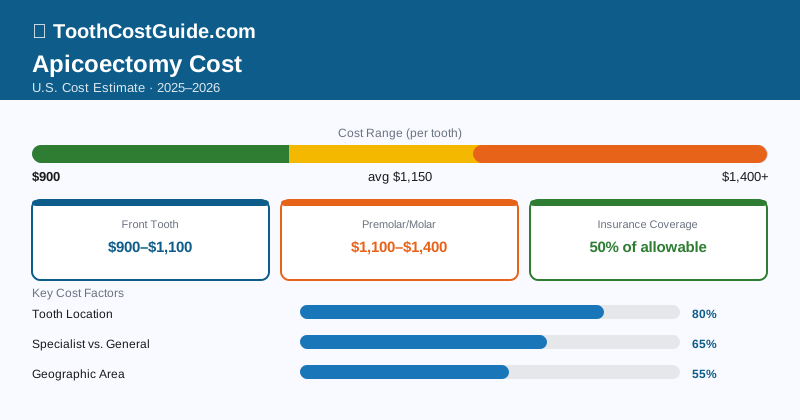
Your dentist is telling you the root canal didn’t work. There’s still infection at the root tip. A second attempt from inside the tooth isn’t an option. What’s left is an apicoectomy — minor oral surgery to remove the infected root tip and seal the canal from the bottom up. Without insurance, expect to pay $900–$1,400. With coverage, your share typically falls to $300–$700 after the plan pays its portion.
It’s not cheap, but it’s a fraction of what you’d spend extracting the tooth, replacing it with an implant, and dealing with the bone loss in between.
Apicoectomy Costs by Tooth and Complexity
| Procedure / Tooth Type | Cost (No Insurance) |
|---|---|
| Apicoectomy – front tooth (anterior) | $900–$1,200 |
| Apicoectomy – premolar | $1,000–$1,300 |
| Apicoectomy – molar | $1,100–$1,400 |
| Apicoectomy with bone graft | Add $200–$600 |
| Retrograde filling material (MTA) | Often included |
| Biopsy of periapical tissue | Add $100–$300 |
| Cone beam CT (CBCT) scan (pre-surgical) | $150–$400 |
Four Things That Move the Price
Which tooth. Front teeth cost the least — single straight roots sitting just beneath thin bone make them the most accessible targets. You can see clearly, work quickly, and the success rates are excellent (85–90%+). Premolars are moderate: upper premolars often have two roots, each needing its own apex removed. Molars are the most complex and expensive. Three or four roots, deeper bone, proximity to the sinus on top and the inferior alveolar nerve below — some endodontists won’t take molar cases at all and refer to extraction instead. Molar apicoectomies run $100–$200 more than front tooth cases.
Who does it. Endodontists and oral and maxillofacial surgeons both perform apicoectomies. Endodontists typically handle anterior and premolar cases; oral surgeons step in for complex posterior cases or when significant bone surgery is involved. Both specialists charge more than general dentists. Endodontist range: $900–$1,300. Oral surgeon range: $1,000–$1,500. Those aren’t the same number — compare quotes.
Whether the bone needs grafting. If the infection has eroded the bone around the root tip, the surgeon may pack graft material into the void after removing the diseased tissue. This supports healing and prevents collapse of the surrounding structure. Add $200–$600. Ask your provider upfront whether your case likely requires it — if there’s a large dark shadow on the X-ray at the root tip, grafting is probably on the table.
Pre-surgical imaging. A cone beam CT (CBCT) scan before the procedure gives a three-dimensional map of the root anatomy, showing exactly where the apex sits relative to nerves, sinus, and adjacent teeth. Cost: $150–$400. Some endodontists build this into their procedure fee; others bill it separately. Ask before assuming it’s included.
An apicoectomy is almost always a second-line treatment — it’s performed when a previous root canal has failed and retreatment inside the canal is not possible or has already been tried. Before agreeing to an apicoectomy, confirm with an endodontist that root canal retreatment cannot resolve the issue. Retreatment ($900–$1,500) has a similarly high success rate and may be covered more favorably by insurance.
Success Rates by Tooth Position
Anterior teeth (incisors, canines). Best candidates. Direct surgical access through the thin cortical bone of the front jaw, single root, clear visualization. Success rates exceed 85–90% when performed by an experienced endodontist. Cost: $900–$1,200. If you need an apicoectomy, this is the scenario you want.
Premolars. Solid track record. Upper premolars with two roots require careful identification and treatment of each apex — miss one and the infection persists. Success rates comparable to anterior teeth. Cost: $1,000–$1,300.
Molars. Complicated. Multiple roots, deeper anatomy, anatomical risk structures nearby. Not every endodontist offers this. Success rates are lower than for anterior teeth. Many surgeons honestly recommend extraction and implant rather than a molar apicoectomy with marginal prospects. If you’re quoted for a molar apicoectomy, ask explicitly about the success rate for that specific tooth.
Large periapical lesions. When infection has created a substantial cyst or granuloma at the apex, more tissue removal is required, bone grafting is more likely, and the removed tissue should be sent to a pathology lab for biopsy (an extra $100–$300). These complex cases sit at the top of the cost range.
Insurance Coverage: The Honest Version
Apicoectomies are billed as either endodontic or oral surgery procedures, and insurers treat those categories differently.
With dental insurance: If your plan covers root canals, it likely covers apicoectomies too — typically at 50–80% of the allowed fee after your annual deductible ($50–$100). On a $1,100 fee with 50% coverage: you pay $550 plus any deductible. The catch is your annual maximum. If you’ve already spent $1,200 of a $2,000 annual max earlier in the year, only $800 in benefits remain — which might cover just part of the apicoectomy.
Pre-authorization matters here. Because the fee is significant, many insurers require pre-authorization before they’ll commit. Your endodontist should submit X-rays, chart notes, and a written explanation of why retreatment inside the tooth isn’t viable. Without pre-auth, claims get denied or dramatically reduced.
New plans and waiting periods. Recently enrolled in new dental insurance? Check whether apicoectomy falls under “major services” — if so, there’s likely a 6–12 month waiting period before the benefit kicks in, even for urgent care.
HSA and FSA funds. An apicoectomy is a qualified medical expense. Paying your out-of-pocket share with pre-tax dollars reduces your effective cost by 22–37% depending on your tax bracket. This is the most efficient way to cover the copay.
Apicoectomies are expensive enough that going in without insurance pre-authorization is risky. Some insurers require that root canal retreatment be attempted before approving an apicoectomy. Have your endodontist document clinically why retreatment is not feasible and submit this with the pre-auth request.
Five Ways to Pay Less
Get a second opinion before committing. Another endodontist might tell you retreatment from inside the tooth is actually feasible — which is less invasive, better covered by insurance, and avoids surgery entirely. A second opinion for a $1,000+ procedure is worth the consult fee.
Ask retreatment vs. apicoectomy directly. Root canal retreatment costs $900–$1,500 and succeeds in many failed root canal cases without any surgery. Insurance covers it comparably to the original root canal. Don’t assume apicoectomy is the only option without hearing why retreatment was ruled out.
Endodontic residency programs. University dental school endodontic programs perform apicoectomies at 40–60% below private practice fees under attending faculty supervision. The residents doing the work are licensed dentists completing specialty training. Cost range: $400–$700. Best suited for patients with straightforward cases who have schedule flexibility.
Compare specialist quotes. Fees for the same procedure vary $200–$400 between endodontic practices in the same city. Call 2–3 offices for quotes before scheduling. Ask whether CBCT and any likely bone grafting are included or billed separately.
Negotiate as a self-pay patient. No insurance? Ask directly about a cash-pay discount. Many endodontic practices extend 10–15% off for self-pay patients who settle the bill at time of service.
Financing Options
CareCredit. Accepted at most endodontic practices. The 0% promotional period (typically 6–24 months) works well for $900–$1,400 expenses — manageable monthly payments with no interest if you pay it off in time. The deferred interest clause is the danger: if you don’t clear the balance before the promotional period ends, interest accrues retroactively at 26–29% APR from day one.
Alphaeon Credit and Sunbit. Alternative financing products available at some practices. Ask what financing options your provider works with — not everyone offers CareCredit.
In-office payment plans. Many endodontic practices offer 0% interest in-house plans for 3–6 months. Often simpler than third-party credit products and without the deferred interest risk. Ask before enrolling elsewhere.
HSA/FSA payment. The most cost-effective option hands down. Pre-tax dollars reduce the effective cost by 22–37% — better than any promotional financing deal on the market.
Bottom Line
At $900–$1,400, an apicoectomy is a meaningful expense. But compare it to the alternative: extracting the tooth starts a chain reaction — implant placement ($3,000–$5,000 all-in), bone grafting if needed, and permanent loss of the original tooth. For a tooth worth saving, an apicoectomy with 85–95% success rates for anterior teeth is a sound investment.
The process: confirm the diagnosis with a specialist, verify insurance will cover it with pre-authorization, ask whether retreatment is an option first, and look at endodontic residency programs if cost is a significant constraint. Recovery takes about a week. Most patients find it far less uncomfortable than they expected.
Dental cost estimates in this guide reflect U.S. national averages for 2024–2025 and may vary significantly by geographic region, provider type, and individual treatment needs. Always request a written treatment plan with itemized costs before agreeing to any dental work. Confirm coverage details directly with your insurance provider before treatment begins.
Frequently Asked Questions
An apicoectomy typically costs $900–$1,400 without insurance, depending on tooth location, complexity, and your geographic region. Procedures on front teeth are usually less expensive than those on molars due to easier access and shorter surgical time.
Most dental insurance plans cover apicoectomies at 50% after you meet your deductible, bringing your out-of-pocket cost to $300–$700. However, some plans classify it as a specialty endodontic procedure with lower coverage percentages, so check your plan details before scheduling.
Delaying treatment allows the infection to persist and potentially spread to surrounding bone and adjacent teeth, increasing pain and future treatment costs. Most dentists recommend scheduling an apicoectomy within 2–4 weeks of determining the root canal failed to prevent complications.