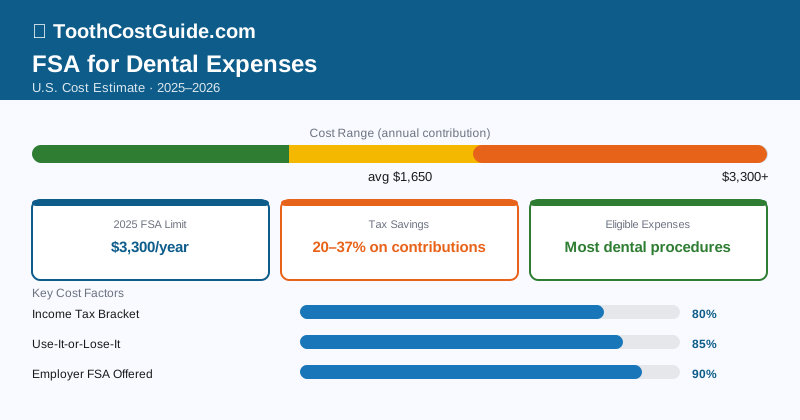
A Flexible Spending Account (FSA) lets you pay for dental expenses with pre-tax dollars, reducing your effective cost by 20–30% depending on your tax bracket — and unlike an HSA, an FSA is available even if your health insurance isn’t a high-deductible plan. The key is understanding the use-it-or-lose-it rules and planning your dental care and FSA elections together strategically.
| FSA Key Numbers (2025) | Amount |
|---|---|
| Annual FSA contribution limit (healthcare) | $3,300 |
| IRS grace period option (employer choice) | 2.5 months after year-end |
| IRS rollover option (employer choice) | Up to $660 |
| Effective discount at 22% tax bracket | ~22% |
| Effective discount at 24% tax bracket | ~24–30% (with state tax) |
| Full amount available January 1 | Yes (entire elected amount) |
How It Works
An FSA is an employer-sponsored benefit account that lets you set aside pre-tax money from your paycheck to pay for qualified medical and dental expenses. You elect your contribution amount during open enrollment (typically in November for the following calendar year). Your employer deducts that amount from your paychecks throughout the year before federal, state, and FICA taxes are applied.
Unique feature: Unlike an HSA, your full elected FSA balance is available on January 1, even though your contributions come in over the full year via payroll. This means if you elect $2,000 and have a $1,500 dental procedure in January, you can access all $2,000 even though you’ve only contributed $200 so far.
FSAs are available alongside any type of health insurance plan — you don’t need an HDHP. However, if you have both an HSA and a standard healthcare FSA, IRS rules prohibit “double-dipping” on the same expenses.
Costs & Savings Details
Tax savings on dental procedures (assuming 22% federal + 5% state = 27% effective rate):
| Procedure | Cost | FSA Tax Savings | Effective Cost |
|---|---|---|---|
| Annual cleanings (2) + exam + X-rays | $350 | $94 | $256 |
| Composite filling | $200 | $54 | $146 |
| Root canal + crown | $2,600 | $702 | $1,898 |
| Braces | $5,000 | Use $3,300 FSA = $891 savings | $4,109 |
| Dental implant | $4,500 | Use $3,300 FSA = $891 savings | $3,609 |
| Night guard | $400 | $108 | $292 |
Year-end planning: If you have remaining FSA funds in November–December, scheduling dental work before year-end eliminates waste. Common moves: prepaying for upcoming orthodontic treatment, scheduling an accelerated cleaning cycle, replacing a night guard or retainer.
Eligible Dental Expenses
Covered by FSA:
- Dental exams and X-rays
- Teeth cleanings (prophylaxis)
- Fillings (composite, amalgam, gold)
- Root canals
- Crowns and bridges
- Dental implants
- Extractions and oral surgery
- Dentures and partial dentures
- Orthodontic treatment (braces, Invisalign, retainers)
- Night guards and bite splints (for medically diagnosed bruxism)
- Gum disease treatment (scaling and root planing, surgery)
- Fluoride treatments (prescription)
- Dental sealants
- Anesthesia for covered procedures
Not covered (cosmetic):
- Teeth whitening (elective)
- Cosmetic veneers (no medical necessity)
- Toothbrushes, electric or manual
- Toothpaste, mouthwash, floss (OTC dental hygiene products)
Eligibility / Who Qualifies
To participate in an FSA:
- You must be employed by a company that offers a healthcare FSA benefit
- Self-employed individuals cannot contribute to a healthcare FSA
- You enroll during your employer’s open enrollment period
- New hires can usually enroll within 30 days of their start date
- Qualifying life events (marriage, divorce, birth of child) allow mid-year enrollment changes
Dependent Care FSA vs. Healthcare FSA: Only the Healthcare FSA covers dental. A Dependent Care FSA is for child/elder care — do not confuse the two.
Pros and Cons
Pros
- Available with any health insurance plan (not just HDHPs)
- Full annual balance available on day one of the plan year
- Pre-tax savings reduce federal, state, AND Social Security/Medicare taxes
- Covers a broad range of dental expenses
- Can cover dental costs for your spouse and qualifying dependents
Cons
- Use-it-or-lose-it rule — unused funds are forfeited (subject to employer’s grace period or rollover option)
- Limited to $3,300/year (2025) — less than HSA family limit
- Employer must offer the benefit — not universally available
- No investment growth (funds sit in cash)
- Cannot roll over into future years beyond the employer’s permitted maximum ($660 in 2025)
The use-it-or-lose-it rule is real: Americans collectively forfeit an estimated $400 million in FSA funds each year. Set a calendar reminder in October to check your FSA balance and schedule any needed dental work before December 31 (or your plan’s grace period ends).
Step-by-Step Guide
Estimate your annual dental expenses: Before open enrollment, list upcoming dental needs — routine cleanings, any known restorative work, orthodontic payments. Add a buffer for unexpected needs. This is your FSA election target.
Check your employer’s grace period or rollover policy: Does your employer offer a 2.5-month grace period, a rollover up to $660, or neither? This affects how aggressively you should fund your FSA.
Elect your FSA amount during open enrollment: Log into your benefits portal in November and elect your contribution. You can change this only during open enrollment or after a qualifying life event.
Use the front-loaded feature strategically: If you have a dental crown or implant scheduled for January or February, elect enough to cover it. The full amount is available immediately, even before all contributions are collected.
Pay for dental expenses with your FSA card: Use the FSA debit card (or app) directly at your dental office. Most dental offices accept FSA cards. If your card is declined, pay out of pocket and submit a reimbursement claim with a receipt.
Track your balance throughout the year: Monitor your FSA balance via your plan administrator’s portal or app. Avoid the December scramble by tracking quarterly.
Use year-end funds on qualifying items: If you have a surplus in Q4, schedule an extra cleaning, replace a retainer, buy a prescription night guard, or prepay for upcoming orthodontic installments.
Many orthodontists allow FSA prepayment. If you or your child will start braces, ask if you can prepay a portion of treatment in December using your expiring FSA funds, then continue payments from next year’s FSA. This effectively lets you funnel two years of FSA contributions toward orthodontic treatment.
Bottom Line
An FSA is an underused tool for reducing dental costs, especially for workers who don’t have an HSA-eligible plan. The pre-tax savings of 22–30%+ are real money — a family spending $2,000/year on dental care saves $440–$600 annually just by running the same expense through an FSA. The critical discipline is electing the right amount and using the funds before they expire. Plan your dental calendar in October, elect accordingly in November, and spend strategically throughout the year.