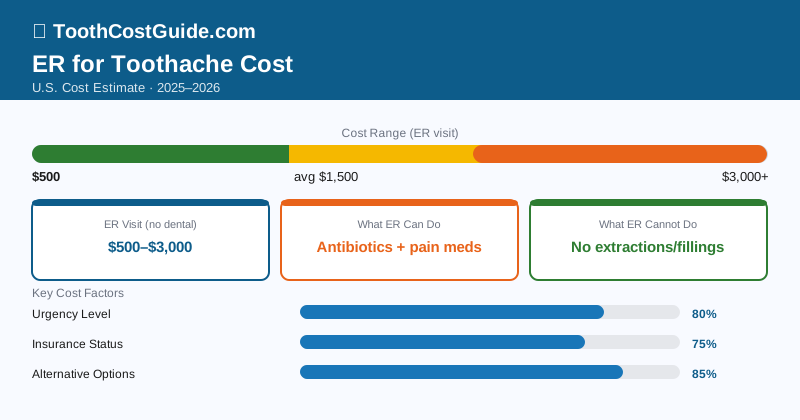
Going to the emergency room for a toothache costs $500–$3,000+ — and the ER cannot perform root canals, extractions, or any definitive dental treatment. For most dental pain, the ER provides antibiotics and pain medication, then sends you home with a referral to a dentist. You’ll pay the full ER bill plus still need dental treatment. Despite this, nearly 2 million Americans visit the ER annually for dental pain — often because they have no dental insurance and no dental home.
| ER Scenario | Estimated Cost (No Insurance) |
|---|---|
| ER visit — facility fee (base) | $500–$1,500 |
| Physician/provider fee | $100–$400 |
| X-ray (panoramic or facial CT) | $300–$2,000 |
| IV antibiotics (severe infection) | $500–$1,500 |
| Prescription medications (discharge) | $10–$100 |
| ER visit — total uncomplicated case | $600–$2,500 |
| ER visit — severe infection, hospital admission | $15,000–$50,000+ |
| Patient share with insurance (ER copay + deductible) | $150–$1,500 |
What Affects the Cost
Hospital type. Urban academic medical centers and Level 1 trauma centers charge more than community hospitals. The facility fee alone at a major hospital can be $1,000–$2,000 before any services are added. The physician fee is billed separately by the provider group.
Level of care required. An ER visit for tooth pain that results in X-rays, medication, and discharge is a lower-acuity encounter — typically billed at Level 2–3, costing $600–$1,500. If a CT scan is ordered, IV antibiotics administered, or observation is required, the bill climbs to $2,000–$5,000+.
Hospital admission. If the ER physician determines the infection is serious enough for admission — for IV antibiotics, surgical drainage, or airway monitoring — the bill escalates rapidly. A 2–3 night stay for a dental infection runs $10,000–$30,000. Ludwig’s angina (floor of mouth infection threatening the airway) can generate $50,000–$100,000+ in hospital charges.
Insurance. With insurance, ER visits are subject to the ER copay ($150–$500), deductible ($1,000–$6,000), and coinsurance (20%). A $2,000 ER bill with a $500 copay and $1,000 deductible still costs the patient $1,500 out of pocket in the worst case.
After-hours and weekend. ER costs don’t vary by time of day the way dental offices do — you pay ER rates around the clock.
Treatment Options & Costs at the ER
What the ER CAN do:
- Diagnose whether an infection is localized or spreading (physical exam, imaging)
- Administer IV antibiotics for severe spreading infections
- Provide IV or IM pain medication for severe pain
- Write prescriptions for oral antibiotics and pain medication
- Drain surface abscesses in some cases
- Manage airway if infection threatens breathing
- Refer you to an on-call oral surgeon for emergencies requiring extraction
What the ER CANNOT do:
- Fill cavities
- Perform root canals
- Extract teeth (in most cases; some hospital ERs have oral surgery on call)
- Place or replace crowns, fillings, or other restorations
- Address the underlying dental cause of the pain
Typical ER treatment for dental pain: Exam, facial/jaw X-ray or CT, prescription for amoxicillin or clindamycin, prescription for pain medication, referral to a dentist or oral surgeon. Total time: 2–5 hours. Total cost: $600–$2,500 without insurance.
When the ER Is Appropriate
Go to the ER for dental pain when:
- Swelling extends to the neck, floor of the mouth, or around the eye
- You have difficulty breathing or swallowing
- You have a fever above 103°F with facial swelling
- Swelling is spreading visibly over hours
- You cannot open your mouth more than 1–2 fingers wide (trismus)
- You are immunocompromised (diabetic, on chemotherapy, organ transplant)
- Pain is truly uncontrollable even with maximum OTC doses
Don’t go to the ER for:
- Tooth pain without swelling or fever
- A lost filling or crown
- A broken tooth that’s not bleeding severely
- Pain that’s managed by ibuprofen + acetaminophen
- Situations where an urgent care clinic or after-hours dentist is available
With vs. Without Insurance
With medical insurance: ER copays range from $150–$500 per visit. You’re also subject to your annual deductible and coinsurance (typically 20%). If you haven’t met your deductible, you may owe the first $1,000–$6,000 of charges. In-network ERs cost less than out-of-network.
With dental insurance: Dental insurance does not cover ER visits — those bill to medical insurance.
Without insurance: ER bills are the highest face-value cost. However, most hospitals have financial assistance programs (charity care) for patients below 200–400% of the federal poverty level. Applying for charity care can reduce or eliminate the bill. Always ask about financial assistance before paying a large ER bill.
Surprise billing: The No Surprises Act (effective 2022) protects patients from out-of-network bills for emergency care at in-network hospitals. Emergency physician groups at in-network hospitals cannot bill you at out-of-network rates for emergencies.
What To Do
- Try urgent care first if your situation is not life-threatening. Urgent care provides essentially the same medications for $100–$300 vs. the ER’s $600–$2,500.
- If you go to the ER, ask for financial assistance. Hospitals are legally required to screen uninsured patients for charity care programs. Ask the billing department about “financial assistance,” “charity care,” or “sliding scale.”
- Negotiate the bill. Hospital bills are negotiable. Ask for an itemized bill, dispute any errors, and ask about prompt-pay discounts (often 20–40% for lump-sum payment).
- See a dentist within 48 hours of an ER visit. ER antibiotics buy time — they do not fix the problem. A dentist must address the source.
- Ask the ER doctor directly: “Do you think this requires the ER, or could I be seen at an urgent care facility?” Honest providers often acknowledge that dental pain without spreading infection can be managed at a lower-acuity setting.
How to Save Money
Use urgent care instead of the ER for non-life-threatening cases. Urgent care costs $100–$300 and provides the same medications. Reserve the ER for true emergencies.
Apply for charity care. Nonprofit hospitals (which includes most major hospitals) are required to have charity care programs. Income limits typically cover patients up to 200–400% of the federal poverty level. A family of four earning under $100,000 may qualify.
Use GoodRx for discharge prescriptions. Amoxicillin costs $4–$10 at most pharmacies with GoodRx — take the prescription there rather than filling it at the hospital pharmacy.
Set up a payment plan. If you receive a large ER bill, call the billing department and ask for an interest-free payment plan. Hospitals routinely set up plans of $50–$200/month.
Dental infections can spread to the airway and become life-threatening within hours. Signs requiring immediate ER care: neck swelling, difficulty breathing or swallowing, high fever with rapidly spreading facial swelling, or inability to open your mouth. Do not delay for these symptoms. The ER cost is irrelevant compared to your life.
Bottom Line
An ER visit for tooth pain costs $600–$2,500+ without treatment of the underlying dental problem — and you’ll still need to see a dentist afterward. ERs are appropriate for spreading infections with systemic symptoms; they’re a very expensive option for pain without those warning signs. Use urgent care for less severe dental emergencies, and always follow up with a dentist within 48 hours of any ER dental visit.