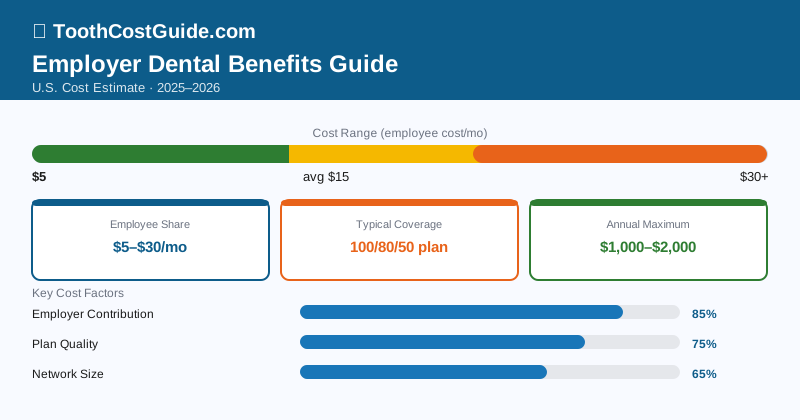
The average employee pays just $5–$15/month for single dental coverage through an employer plan — with the employer contributing the remaining $20–$50/month — making employer dental benefits one of the most underutilized financial perks in the American workplace. Yet studies show that nearly 40% of employees with employer dental benefits don’t use their full preventive coverage each year, leaving hundreds of dollars in value on the table. Here’s a complete guide to understanding and maximizing your employer dental benefits.
| Coverage Category | Typical Employee Cost | What Employer Plan Covers |
|---|---|---|
| Preventive (cleanings, exams, X-rays) | $0 | 100% (no deductible) |
| Basic restorative (fillings, extractions) | $25–$60 per procedure | 70–80% after deductible |
| Major restorative (crowns, bridges) | $400–$800 per crown | 50% after deductible |
| Root canals | $350–$700 per tooth | 50–80% after deductible |
| Dentures | $500–$1,500 per arch | 50% after deductible |
| Orthodontics (if included) | $1,500–$4,000 total (after coverage) | $1,000–$2,000 lifetime max |
| Employee monthly premium | $5–$15 (single) | Employer covers $20–$50 |
| Employee monthly premium (family) | $30–$70 | Employer covers $30–$100 |
How Employer Dental Benefits Work
Employer dental benefits are a form of group dental insurance that your employer negotiates on behalf of all employees. Because the risk pool includes potentially hundreds or thousands of employees, employers can typically negotiate lower group rates than employees could obtain individually. The employer pays a portion of the premium (called the employer contribution), and the employee pays the remainder through payroll deduction.
The typical employer dental plan structure (PPO):
- Preventive services (cleanings, exams, X-rays): 100% covered, no deductible, no waiting period
- Basic services (fillings, simple extractions, periodontal treatment): 70–80% covered after a $50–$100 annual deductible
- Major services (crowns, bridges, dentures, complex oral surgery): 50% covered after deductible, often with a 6–12 month waiting period (waived for employees enrolling at initial hire date)
- Orthodontics (if included): $1,000–$2,000 lifetime maximum per covered dependent, typically with a 12–24 month waiting period
Annual maximum: Most employer dental plans have an annual maximum of $1,000–$2,000 per covered person. Preventive and diagnostic care counts toward this maximum at most plans (the insurer’s payment for cleanings reduces the remaining maximum for major work).
In-network vs. out-of-network: Most employer dental plans are PPOs, which allow both in-network and out-of-network use. In-network dentists have contracted rates that reduce your cost-sharing significantly. Out-of-network dentists can charge their standard fees — you pay the difference between those fees and the plan’s “allowable amount” plus your coinsurance.
Premium cost-sharing by employer type (2025 data):
- Large employers (1,000+ employees): Employee pays ~$5–$10/month for single coverage; employer covers $40–$60/month
- Mid-size employers (100–999 employees): Employee pays ~$10–$20/month for single; employer covers $25–$45/month
- Small employers (under 100 employees): Employee pays ~$15–$30/month for single; employer covers $15–$35/month
- Family coverage: Employee share averages $30–$70/month; employer contribution varies significantly
The employer’s contribution to your dental premium is a form of additional compensation that’s invisible on your paycheck. An employer paying $40/month toward your dental premium is providing $480/year in non-wage compensation. Factor this in when comparing total compensation packages between jobs.
Costs & Coverage Details
What employer dental plans typically include:
Preventive dental (covered 100%):
- 2 routine cleanings per year
- 1–2 routine exams per year (some plans limit to 1)
- Bitewing X-rays annually; full-mouth series every 3–5 years
- Panoramic X-ray as needed
- Oral cancer screening (often included)
- Fluoride treatment (for children on family plans)
- Sealants (for children on family plans)
Basic restorative (covered 70–80% after deductible):
- Composite (tooth-colored) fillings: Most plans cover at basic rate; some use “least expensive alternative treatment” and pay only amalgam rate for back teeth
- Amalgam (silver) fillings: Covered at 80% typically
- Simple tooth extractions
- Periodontal scaling and root planing (deep cleaning): Often classified as basic; 4 quadrants typically covered per year
Major restorative (covered 50% after deductible):
- Porcelain/ceramic crowns
- Metal/porcelain-fused-to-metal crowns
- Inlays and onlays
- Bridges (per abutment tooth)
- Complete and partial dentures
- Implants: Covered on some employer plans, excluded on many; check your specific plan
Root canals (typically covered at 50–80%):
- Classified as either basic or major depending on the plan
- Molar root canals (3 canals) cost more than anterior root canals; coverage percentage is the same
What employer dental plans typically EXCLUDE:
- Cosmetic procedures: teeth whitening, veneers (unless placed for restorative reasons)
- Implants: Many employer plans exclude or have a missing tooth clause; check yours specifically
- Experimental procedures
- Services covered by another insurance plan (unless coordinating benefits)
- War/combat injuries
The “least expensive alternative treatment” (LEAT) provision: Many employer dental plans include this clause, which says the plan will only pay the cost of the least expensive clinically appropriate treatment. Example: your dentist recommends a tooth-colored composite filling on a back molar. The plan pays the amalgam (silver) rate rather than the composite rate, leaving you to pay the difference. This provision is legal and common — be aware of it.
Coordination of benefits (COB): If you and your spouse both have employer dental coverage, you can potentially use both plans. One plan acts as primary, paying its normal benefits. The secondary plan may then cover some or all of the remaining cost-sharing. COB rules vary by insurer — contact your insurer to understand exactly how secondary coverage would work before planning major dental expenses.
Pros and Cons
Employer dental — Pros:
- Very low employee premium (often $5–$15/month)
- Employer contribution adds $20–$60/month in value not visible on paystub
- Group plan network is typically broad with strong carrier partnerships
- No underwriting — all employees covered regardless of dental history
- Waiting periods often waived for initial enrollment during new hire period
- FSA enrollment usually available alongside dental, enabling pre-tax dental spending
Employer dental — Cons:
- Annual maximum ($1,000–$2,000) is a limiting factor for major dental needs
- Plan choices are limited to what employer selected — may not be the ideal plan for individual needs
- Changing plans requires waiting for open enrollment
- Coverage ends with employment — triggering the COBRA decision
- Employer can change the plan at annual renewal, potentially reducing benefits
Who Benefits Most from Employer Dental
All employees should enroll — even the cheapest employer dental plan at $10/month for employee-only coverage is virtually always worth it when the employer is contributing $30–$60/month in premium value. The minimum use case (two free cleanings) alone provides $150–$200 in value for a $120/year employee cost.
Employees with families need to evaluate whether adding dependents to the employer plan is cost-effective versus CHIP for children (possibly free) and an individual plan for a spouse.
Employees with upcoming dental needs who enroll at initial hire should note that most employer plans waive waiting periods for new employees — sign up during the initial enrollment window to avoid the standard 12-month major work wait.
Dual-income couples should compare both employers’ dental plans and potentially cover dependents under the plan with the lower employee share for family coverage and better benefits.
How to Maximize Employer Dental Benefits
Enroll immediately at new hire. Most employers allow new employees to waive waiting periods during their initial enrollment window (typically 30–60 days after hire). If you wait and enroll during the next open enrollment, you’ll face the standard waiting period. Enroll from day one even if you think you won’t need dental care.
Use both cleanings every year. It sounds obvious, but nearly 40% of employees with dental benefits miss one or both cleanings annually. Two cleanings at $0 copay represent $150–$250 in insurance value. Set calendar reminders for May and November.
Understand your plan’s LEAT provision. Before getting a composite filling on a back tooth, ask your dentist to check whether your plan will pay the composite rate or only the amalgam rate. Knowing this in advance prevents surprise bills.
Coordinate benefits with spouse’s coverage. If both spouses have employer dental, use COB to minimize out-of-pocket costs on major procedures. The primary plan covers its standard share; the secondary plan covers some or all remaining cost-sharing. This can reduce a $700 out-of-pocket crown to near-zero.
Maximize pre-tax contributions. If your employer offers an FSA (Flexible Spending Account) or HSA alongside dental, use it. Contributing $500–$1,000 to a Healthcare FSA saves 20–37% in taxes on dental out-of-pocket costs. FSA elections are made during open enrollment — don’t miss this opportunity.
Use benefits before year-end. Employer dental benefits don’t roll over. If you have $800 remaining in your annual maximum in November, schedule any deferred dental work (needed filling, fluoride treatment, etc.) before December 31.
Ask HR about plan details. Many employees never read their Summary of Benefits and Coverage. Request the full plan document from HR and specifically look for: annual maximum, major work waiting period, whether implants are covered, and the LEAT provision.
If you decline your employer’s dental plan at initial enrollment (thinking you don’t need it), you may not be able to enroll until the next annual open enrollment period — typically 12 months away. Only waive employer dental if you have a specific, better alternative already in place.
Employer dental benefits are one of the best deals in the American benefits system — low employee cost, employer-subsidized premium, and comprehensive preventive + restorative coverage. At $5–$15/month employee cost, virtually every employee should enroll. Maximize the benefit by using both annual cleanings, coordinating with a spouse’s coverage, contributing to an FSA, and timing major work to maximize annual benefit within the $1,000–$2,000 cap.
Bottom Line
Employer dental benefits provide significant value at minimal employee cost — typically $5–$15/month for individual coverage while the employer contributes $20–$60/month in premium. Standard employer plans cover preventive care at 100%, basic work at 70–80%, and major work at 50%, with annual maximums of $1,000–$2,000. To maximize your employer dental benefits: enroll at initial hire to avoid waiting periods, use both annual cleanings, coordinate benefits with your spouse’s plan, fund an FSA for pre-tax dental expenses, and schedule any remaining needed work before year-end. The employer dental benefit is a valuable component of your total compensation — use every dollar of it.