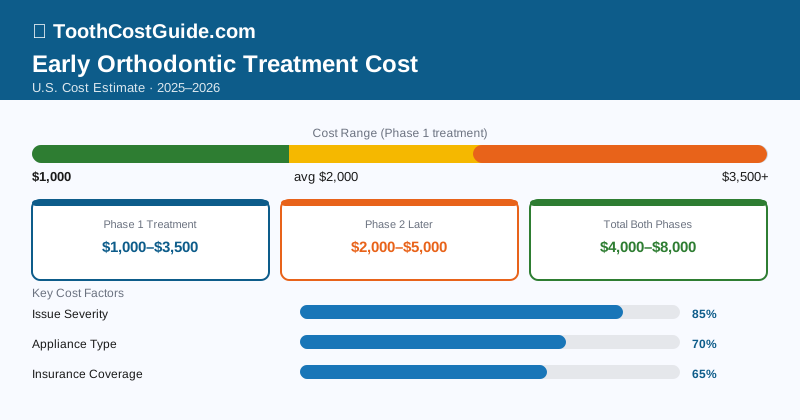
Early orthodontic treatment (Phase 1) costs $1,000–$3,500 for children ages 7–10, with the most common Phase 1 interventions running $1,500–$3,000. This is the first phase of a two-phase treatment approach — addressing specific jaw development or bite issues while the child’s jaw is still growing and most responsive to intervention. Not every child needs Phase 1 treatment; the American Association of Orthodontists recommends a first evaluation at age 7 to identify the cases that genuinely benefit from early intervention.
| Phase 1 Treatment Type | Cost Range |
|---|---|
| Palate expander (fixed/removable) | $1,000–$2,500 |
| Reverse-pull headgear (facemask for underbite) | $1,500–$3,000 |
| Functional appliance (Herbst, Twin Block, etc.) | $1,500–$3,500 |
| Partial braces (limited to specific teeth) | $1,500–$3,500 |
| Space maintainer (holding arch length) | $250–$600 |
| Phase 1 comprehensive (includes appliance) | $1,500–$3,500 |
| Phase 2 comprehensive braces (follows Phase 1) | $2,500–$5,500 |
| Total two-phase treatment | $4,000–$8,000 |
What Is Phase 1 Orthodontic Treatment?
Phase 1 (also called early interceptive orthodontic treatment) refers to orthodontic treatment completed in children with a mix of primary (baby) and permanent teeth — typically between ages 7 and 10. The goal is not to fully straighten the teeth (that comes later in Phase 2) but to intercept specific jaw development problems that are best addressed while bone is still growing and responsive.
Phase 1 is designed for specific conditions — not for all children. Most children do not need Phase 1 treatment. A watchful waiting approach until all permanent teeth have erupted (ages 11–14) is appropriate for the majority of cases. Phase 1 is genuinely valuable for a narrower set of conditions where early intervention prevents more difficult, invasive, or expensive treatment later.
When Phase 1 Treatment Is Genuinely Indicated
Posterior crossbite with a narrow upper arch: The upper arch is too narrow, causing the lower jaw to shift to one side to find a comfortable bite position. If left untreated, this jaw shift can create asymmetric jaw growth. Palate expansion at ages 7–10 corrects the narrow arch and eliminates the functional shift — and is far simpler at this age than treating it later.
Severe underbite (Class III) with potential for growth modification: Early facemask/reverse-pull headgear treatment (ages 7–10) can stimulate upper jaw growth and redirect lower jaw growth, potentially preventing the need for jaw surgery at adulthood. The window for effective growth modification is ages 7–10 — after this, skeletal modification becomes progressively less effective.
Severe overbite with lower jaw retrognathia in a growing patient: Functional appliances (Herbst, Twin Block, Bionator) can advance a retruded lower jaw during the growth spurt. Timed correctly, this corrects the jaw relationship without surgery. Timing is critical — too early or too late reduces effectiveness.
Impacted upper canines detectable on X-ray: Early palate expansion or selective extraction of primary canines can guide permanent canines into proper eruption paths, preventing impaction that would later require surgery.
Space maintenance after early loss of primary teeth: Space maintainers ($250–$600) preserve arch length after early loss of a baby molar, preventing the permanent teeth from drifting and worsening crowding.
Severe Class II with significant overjet (protruding upper front teeth): Early functional appliance treatment can reduce trauma risk (protruding front teeth are more vulnerable to being broken in falls), though the long-term orthodontic benefit of early vs. late Class II treatment is debated.
Phase 1 treatment is genuinely indicated for a minority of children — those with specific, well-defined problems (narrow arch with crossbite, underbite with growth modification potential, severe overjet, impacted canines). It is NOT indicated for mild crowding, which is best treated in comprehensive Phase 2 braces when all permanent teeth are in. Always get a second opinion before starting Phase 1 to confirm genuine necessity.
Is Phase 1 Worth the Cost?
When Phase 1 IS worth it:
- Posterior crossbite with jaw shift: Correcting at age 8 with a $2,000 expander prevents more complex treatment and potentially jaw surgery later
- Underbite with growth modification potential: A $2,000–$3,000 facemask at age 8 may prevent $25,000–$40,000 in jaw surgery at age 21
- Space maintainers after early tooth loss: A $400 space maintainer prevents $3,000–$5,000 in additional orthodontic treatment for severe crowding
When Phase 1 may NOT be worth it:
- Mild crowding: Research consistently shows that comprehensive Phase 2 braces alone (waiting until all permanent teeth are in) achieves equivalent results to two-phase treatment for mild crowding — at lower total cost
- Mild overbite: In most cases, a growing child with mild overbite achieves excellent results with comprehensive braces at age 12 without Phase 1 intervention
- Cosmetic concerns only: Phase 1 treatment is for functional and developmental issues, not cosmetic alignment of baby teeth
The critical question to ask: “What specifically will Phase 1 treatment do for my child that waiting for Phase 2 cannot achieve?” If the orthodontist cannot give a specific answer about functional or developmental benefit, seek a second opinion.
Phase 1 and Phase 2 Costs Together
Two-phase treatment typically costs more in total than single-phase comprehensive treatment, but may be justified by the developmental benefits described above.
Total cost comparison:
- Two-phase treatment (Phase 1 + Phase 2): $4,000–$8,000
- Single-phase comprehensive treatment (ages 11–14): $3,000–$6,500
- Cost difference: $500–$2,500 more for two-phase
What Phase 1 practices usually offer: Most orthodontists who do Phase 1 treatment offer a reduced Phase 2 fee for patients of their practice — $500–$1,500 less than the standard Phase 2 fee. This discount partially offsets the additional Phase 1 cost.
The Resting Period Between Phase 1 and Phase 2
Between Phase 1 completion and Phase 2 start (often 1–3 years), the child enters a “resting” or “observation” period. A retainer is worn at night to maintain Phase 1 results. The orthodontist monitors jaw growth and tooth eruption at periodic appointments (typically every 6 months).
Some orthodontists charge for observation period appointments ($50–$150/visit); others include monitoring in the Phase 1 fee. Clarify this cost upfront.
Insurance Coverage
Phase 1 orthodontic treatment is covered by dental insurance under the same orthodontic benefit terms as comprehensive treatment:
- Lifetime maximum: $1,000–$3,000 per patient
- Coverage: 50% up to the lifetime maximum
- Age limits: Under 18–19
Critical issue: The lifetime orthodontic maximum is shared between Phase 1 and Phase 2. A $1,500 insurance maximum used $750 in Phase 1 leaves only $750 for Phase 2. If Phase 1 uses the majority of the benefit, Phase 2 is largely out-of-pocket.
Best strategy: Ask your insurance company about the lifetime maximum and whether it can be applied to Phase 1 and Phase 2 separately or only to the total treatment. Some plans do allow benefits to apply to each phase of a clearly defined two-phase plan.
If your plan has a $1,500 lifetime orthodontic maximum and Phase 1 costs $2,500, the insurance pays $750 for Phase 1 (50% of the first $1,500) and has no remaining benefit for Phase 2. Get a predetermination of benefits from your insurer before starting Phase 1 to understand exactly how the benefit splits between phases.
Financing Options
In-office payment plans: Phase 1 fees spread over the treatment period (typically 6–12 months active + observation). A $2,500 Phase 1 plan over 10 months = $250/month.
Bundled Phase 1 + Phase 2 financing: Some orthodontists allow patients to bundle the total two-phase treatment cost into a single long-term payment plan, spreading $5,000–$7,000 over 3–5 years.
FSA: Phase 1 appliances and orthodontic services are FSA eligible. Contributing the planned Phase 1 cost to the FSA during open enrollment saves 22–37% on that amount.
How to Save on Early Orthodontic Treatment
Get a second opinion on Phase 1 necessity. This is the single most important savings strategy. If the second orthodontist says watchful waiting is appropriate, you save the entire Phase 1 cost ($1,500–$3,500) with no developmental disadvantage.
Ask about space maintainers as a lower-cost alternative. For cases where the primary concern is space maintenance after early tooth loss, a $400 space maintainer is a much simpler and less expensive intervention than full Phase 1 braces.
Dental school orthodontic programs. Phase 1 cases are commonly accepted at orthodontic residency programs at discounts of 30–50%.
Schedule the age-7 evaluation proactively. Catching genuinely indicated Phase 1 conditions at the optimal window (ages 7–9) when treatment is most effective and minimally invasive prevents more expensive intervention at later ages.
Bottom Line
Phase 1 early orthodontic treatment costs $1,000–$3,500 and is genuinely valuable for a specific minority of children — those with narrow arches causing crossbite, underbites amenable to growth modification, or severe protruding front teeth. For mild crowding or minor cosmetic concerns, waiting for comprehensive Phase 2 treatment achieves equivalent results at lower total cost. Always get a second orthodontic opinion before proceeding with Phase 1 treatment to confirm genuine clinical necessity.
Phase 1 early treatment prevents the need for more expensive and invasive procedures in specific developmental conditions — particularly underbite and posterior crossbite. For most children, watchful waiting until age 11–14 for comprehensive braces achieves equal results at lower total cost. The age-7 evaluation is free and valuable; the Phase 1 treatment itself requires careful justification before commitment.