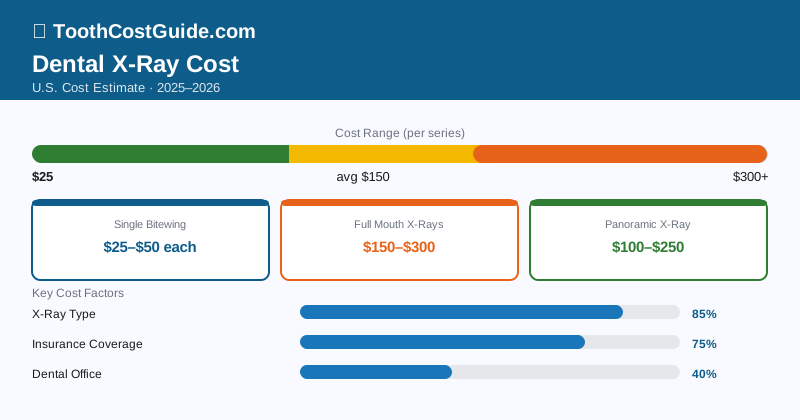
Dental X-rays cost $25–$50 per individual film and $150–$300 for a complete full-mouth series without insurance. A panoramic X-ray — the single image that captures all your teeth and jaw — runs $100–$250 on its own. Most dental insurance plans cover X-rays at 100% as preventive care, subject to frequency limits.
| X-Ray Type | Cost Without Insurance |
|---|---|
| Single bitewing film | $25–$50 |
| 4-film bitewing series | $75–$150 |
| Full-mouth series (14–18 films) | $150–$300 |
| Panoramic X-ray (OPG) | $100–$250 |
| Periapical film (single tooth) | $25–$50 |
| Cone beam CT scan (CBCT) | $300–$600 |
| Cephalometric X-ray (orthodontics) | $100–$175 |
What Affects the Cost of Dental X-Rays
Type of X-ray. The imaging technology and amount of information captured drives the fee. Simple bitewing films (two or four images showing cavity-prone surfaces between teeth) are cheap. A full-mouth series (FMX) of 18 periapical and bitewing films shows every tooth from crown to root. A panoramic captures the full jaw in one image and is essential for evaluating wisdom teeth, jawbone, and sinuses. CBCT is three-dimensional imaging used for implant planning and complex cases.
Digital vs. film-based. Nearly all modern dental offices use digital radiography, which reduces radiation exposure by 80% versus traditional film and allows instant viewing on a monitor. Most fees quoted today are for digital X-rays; film-based offices (rare) may charge slightly less.
How many films your dentist takes. A new patient at most offices receives a full-mouth series (14–18 films) to establish a baseline. Recall patients usually get bitewing X-rays every 12–24 months to check for new cavities. Some offices add periapical films for specific concerns at each visit. Frequent add-ons inflate the total imaging bill significantly.
Geographic location. As with other dental fees, X-ray prices run 20–40% higher in major metro areas than in smaller markets.
Dental X-rays are diagnostic tools, not automatic add-ons. Ask your dentist what specific clinical question each X-ray is meant to answer. You have the right to request that existing X-rays from a previous dentist be transferred before agreeing to new imaging — this can save $75–$250 and avoid repeat radiation exposure.
Cost by X-Ray Type
Bitewing X-rays: The most commonly taken dental X-rays. Show the crowns and upper portions of roots of upper and lower back teeth, revealing cavities between teeth, decay under fillings, and bone levels. Standard recall X-rays for most adults are 4 bitewing films taken annually or biannually. Cost: $75–$150 for a 4-film set.
Periapical X-rays: Show the entire tooth from crown to root tip, plus surrounding bone. Taken when there’s a specific concern: infection, fracture, root anatomy before a root canal, or a painful tooth. Usually taken individually or in small groups. Cost: $25–$50 per film.
Full-mouth series (FMX): A complete set of 14–18 periapical and bitewing films covering every tooth. Standard for new patients, then typically repeated every 3–5 years as a comprehensive baseline. Cost: $150–$300.
Panoramic X-ray (OPG): One wide-angle image capturing all teeth, both jaws, TMJ joints, sinuses, and jaw structure. Essential for wisdom tooth evaluation, orthodontic treatment planning, dental implant assessment, and identifying jaw pathology. Many dentists take a panoramic on all new patients as a screening tool. Cost: $100–$250.
Cone beam CT (CBCT): Three-dimensional imaging that provides detailed views of bone volume and anatomy. Used for implant planning, evaluating complex root canal anatomy, and assessing jaw pathology. Not routine — ordered for specific clinical needs. Cost: $300–$600.
With vs. Without Dental Insurance
Dental insurance nearly universally classifies X-rays as preventive or diagnostic care, covered at 80–100%.
Typical coverage with insurance:
- Bitewing X-rays: 100% covered, usually once per year
- Full-mouth series: 100% covered, usually once every 3–5 years
- Panoramic: Usually 100% covered for new patients or periodically
- Periapical films at problem visits: 100% covered in most plans
- CBCT: Varies significantly by plan — some cover it, many don’t
Important frequency limitation: Insurance plans set specific frequency limits. If you get a FMX and then change dentists within 2 years, your new insurance may not cover a new FMX because the plan’s frequency limit hasn’t expired. Request your X-rays from your previous dentist before transferring.
Without insurance: Bitewing series ($75–$150) and a periodic panoramic are reasonable costs to absorb. A full-mouth series every 3–5 years ($150–$300) is the most significant imaging expense outside of CBCT.
How to Save Money on Dental X-Rays
Transfer X-rays from your previous dentist. Request your digital radiographs before switching. Most states require dentists to provide copies. Bring them to your new dentist and ask whether new X-rays are clinically necessary — often they’re not if the previous X-rays are recent.
Question the frequency. Some dental offices automatically add X-rays at every appointment “because it’s been a year.” In reality, healthy adults with no active disease may need bitewings only every 18–24 months per the ADA’s evidence-based guidelines. Ask your dentist to justify the frequency based on your specific risk factors.
Dental school clinics. X-rays at dental school clinics cost $20–$60 for bitewing series and $60–$120 for a FMX — roughly half the cost of private practices.
Dental discount plans. Discount plan members typically save 20–30% on X-ray fees at participating dentists.
All dental X-rays are your property. When switching dentists, ask for a copy of your radiographs sent electronically. Most offices can email a JPEG or DICOM file at no charge. This is especially important if you’ve recently had a panoramic or CBCT scan — never pay to have imaging redone unnecessarily.
Financing Options
Individual X-ray costs are low enough that financing is rarely needed. The exception is CBCT scanning for implant workup, which can run $300–$600.
FSA/HSA funds: Dental X-rays are eligible FSA/HSA expenses. Use pre-tax funds to pay for imaging and reduce the real cost by 22–37%.
In-house membership plans: Many dental practices with in-house membership plans include X-rays in the annual fee. A $200/year membership that covers two cleanings, bitewing X-rays, and a periodic exam represents excellent value for uninsured patients.
Bundled new patient exams: Many practices bundle the new patient exam, full-mouth X-rays, and cleaning together for a flat fee ($150–$350). This is often cheaper than paying each service a la carte.
Bottom Line
Dental X-rays are essential diagnostic tools that help dentists detect cavities, bone loss, and pathology invisible to the naked eye. A 4-film bitewing series costs $75–$150 without insurance and is typically free with coverage. A full-mouth series runs $150–$300 and should be needed only every 3–5 years in healthy adults.
The best way to minimize X-ray costs is to transfer records between dentists, question unnecessary frequency, and take advantage of dental insurance coverage for this almost universally covered diagnostic category.
Always get a written treatment plan before agreeing to any dental work. For X-rays, ask your dentist what specific clinical information each image will provide and whether your existing X-rays from a previous provider are sufficient. You are entitled to copies of all your dental radiographs.