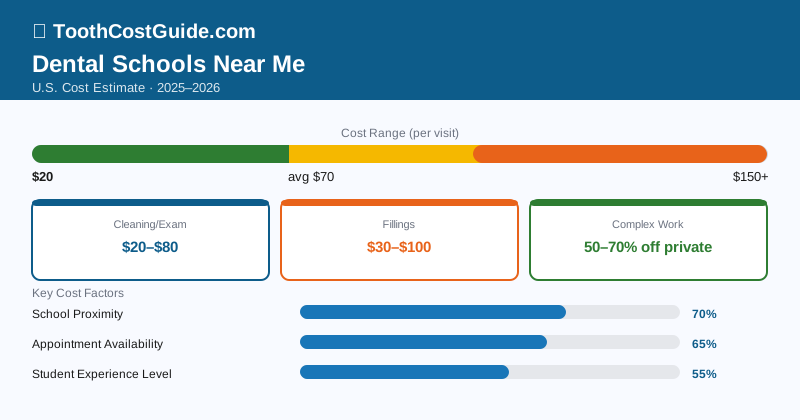
Accredited dental school clinics offer the same quality dental care as private practices at 40–65% lower cost — a $1,400 crown that costs $1,400 at a private office may cost $500–$800 at a dental school, and treatments are supervised by licensed faculty dentists. With 67 accredited dental schools across the US, most Americans are within a reasonable distance of this valuable resource.
| Procedure | Private Practice | Dental School | Typical Savings |
|---|---|---|---|
| Dental exam + X-rays | $150–$250 | $50–$100 | 50–60% |
| Adult cleaning (prophylaxis) | $100–$200 | $25–$60 | 55–70% |
| Composite filling (1 surface) | $150–$300 | $60–$120 | 55–65% |
| Root canal (molar) | $1,000–$1,600 | $400–$700 | 50–60% |
| Porcelain crown | $1,200–$1,800 | $500–$800 | 50–60% |
| Dental implant (full) | $3,500–$5,500 | $1,500–$2,800 | 50–60% |
| Full dentures (one arch) | $1,500–$3,500 | $600–$1,200 | 55–65% |
| Teeth extraction (simple) | $150–$350 | $75–$150 | 50–55% |
| Orthodontic treatment (braces) | $3,500–$7,000 | $1,500–$3,500 | 50–60% |
How It Works
CODA accreditation: All 67 dental schools in the US must be accredited by the Commission on Dental Accreditation (CODA) to award degrees. Accreditation ensures that clinical training meets national standards for patient safety and care quality. This means every accredited dental school clinic is held to documented quality standards.
Who treats you: At predoctoral clinics (for dental students completing their DDS/DMD degree), you are treated by dental students in their 3rd or 4th year under the direct supervision of licensed faculty dentists. At postdoctoral or residency clinics, you may be treated by dentists who have already completed their degree and are completing specialty training.
Why it takes longer: Each step of a procedure must be reviewed and approved by a faculty supervisor before the student proceeds. This “check-in” model is what makes appointments take 2–3x longer than a private office — but it also means every step is verified by an experienced dentist.
Key assurance: If a student makes a mistake or cannot complete a procedure satisfactorily, the faculty dentist steps in. Your care does not depend solely on a student’s skill.
Costs & Savings Details
Major savings examples at specific schools (2025 approximate fees):
NYU College of Dentistry (New York City):
- Crown: ~$600–$750
- Root canal: ~$500–$650
- Implant: ~$1,800–$2,500
UCLA School of Dentistry (Los Angeles):
- Crown: ~$500–$700
- Cleaning: ~$30–$50
- Implant: ~$1,800–$2,400
University of Michigan School of Dentistry (Ann Arbor):
- Crown: ~$500–$750
- Root canal: ~$450–$600
- Dentures: ~$700–$1,000/arch
Meharry Medical College School of Dentistry (Nashville):
- Crown: ~$450–$650
- Cleaning: ~$25–$45
Annual dental school patient clinic care example (1 patient, full year):
- 2 cleanings + exams + X-rays: $80–$200 vs. $450–$600 privately
- 2 fillings: $120–$240 vs. $300–$600 privately
- 1 crown: $500–$800 vs. $1,200–$1,800 privately
- Total at dental school: $700–$1,240 vs. $1,950–$3,000 privately
- Annual savings: $1,250–$1,760
Eligibility / Who Qualifies
Patient eligibility at dental school clinics:
- Adults and children of all ages are seen
- No income requirement — dental schools accept patients at all income levels
- Patients with complex or interesting cases are sometimes preferred (educational value)
- Patients who may be higher-risk (medical conditions, complex anatomy) may be referred after evaluation
- Most schools accept Medicaid and some accept private insurance
- Uninsured patients pay the reduced student clinic rates directly
Clinical eligibility (whether your specific case is accepted):
- Most routine cases are accepted
- Complex cases (severe bone loss, multi-tooth implants) may require faculty approval
- Specialty cases (orthodontics, oral surgery, periodontics) are handled by the corresponding specialty clinic
- Emergency cases are generally accepted if appointments are available
Pros and Cons
Pros
- 40–65% lower cost than private dentists
- Same quality materials as private practices (dental schools use standard-of-care materials)
- Faculty supervision ensures quality control at every step
- Comprehensive range of services at most schools
- Dental schools often have the latest technology (CBCT scanners, digital impressions, CAD/CAM)
Cons
- Appointments take significantly longer (2–3x) than a private office
- Scheduling can be less convenient — limited evening/weekend availability
- May not accept emergency same-day appointments
- Student cases must be within their training level — complex cases may be referred to other providers
- Patient volume can be high; multiple waiting periods within a single appointment
Not all dental school procedures can be completed quickly. A crown that takes 2 hours at a private dentist may require 2 separate appointments of 3–4 hours each at a dental school. Before scheduling major work, ask about typical appointment duration and how many visits the procedure typically requires.
Step-by-Step Guide
Find CODA-accredited dental schools near you: Visit the American Dental Association’s school listing at ada.org/education/dental-schools, or the American Dental Education Association at adea.org. Search by state. There are 67 accredited DDS/DMD programs.
Also check dental hygiene schools: Dental hygiene schools offer free or very low-cost cleanings ($0–$35) performed by dental hygiene students under supervision. These are separate from dental schools and are often located at community colleges. Search “[City] dental hygiene student clinic.”
Call the school’s patient clinic: Not the main university number — call the dental school’s patient care clinic directly. Ask: (1) Are you accepting new patients? (2) What is the current wait time for new patient appointments? (3) What services are offered? (4) Do you accept Medicaid or insurance? (5) What are your fees for [specific procedure]?
Schedule a new patient exam: The first appointment is typically a comprehensive examination where a student (with faculty) evaluates your full oral health needs and creates a treatment plan. This determines which procedures will be performed and in what sequence.
Budget for time: Plan for appointments that run 2–3 hours. Bring a book, headphones, or work you can do on a phone. Don’t schedule dental school appointments on days with tight schedules.
Complete treatment in priority order: Faculty will typically want to address the most urgent needs first (infections, severe decay) before cosmetic or elective work. Follow their recommended sequence.
Maintain continuity with the same student: Whenever possible, continue with the same dental student throughout your treatment. They know your case, have your records, and have established a treatment relationship with you. Ask to stay with the same student when scheduling follow-up appointments.
Dental school postdoctoral clinics — where dentists who have already earned their degree are completing specialty training (orthodontic residency, periodontics residency, prosthodontics residency) — offer specialty-level care at reduced rates and typically faster appointments than predoctoral clinics. These are excellent for complex orthodontic cases, implants, and full-mouth reconstruction. Ask specifically about postdoctoral or graduate clinic availability when you call.
Bottom Line
Dental schools are one of the most reliable, year-round sources of high-quality, affordable dental care in the US. For patients near a major city, there is almost certainly an accredited dental school within 1–2 hours. The 40–65% savings are substantial and consistent, and the supervison model ensures quality. The only real cost is time — appointments take longer, but for most patients, saving $500–$2,000 on a major procedure makes the extra hours well worth it.