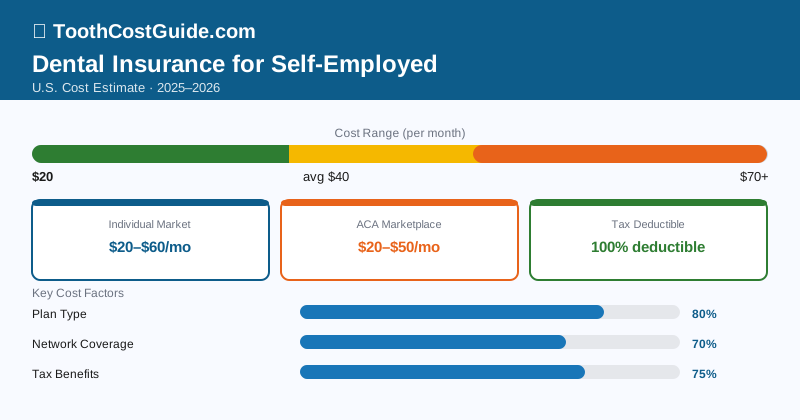
Self-employed Americans pay $20–$60 per month for individual dental insurance — and the IRS lets you deduct 100% of those premiums if you’re self-employed and not eligible for a subsidized employer plan. Without an HR department selecting your plan, you have to shop yourself, but this also means you can choose coverage that actually fits your needs rather than whatever your employer negotiated. Here’s how to navigate the individual dental insurance market as a freelancer, sole proprietor, or small business owner.
| Plan Type | Monthly Cost | Annual Max | Who It’s For |
|---|---|---|---|
| ACA marketplace standalone dental | $20–$50 | $1,000–$2,000 | ACA medical plan enrollees |
| Individual PPO (off-exchange) | $30–$60 | $1,000–$2,500 | Flexibility seekers |
| Individual HMO | $15–$30 | None | Budget-focused, metro areas |
| Dental discount plan | $8–$20 | N/A (discounts) | Very tight budget, immediate savings |
| Association plan (freelancer group) | $25–$55 | $1,000–$2,000 | Those with association membership |
| S-corp owner (payroll deduction) | $30–$60 | $1,000–$2,000 | S-corp business owners |
How Dental Insurance for the Self-Employed Works
Unlike employees who receive subsidized dental coverage through work, self-employed individuals must purchase coverage in the individual market and pay the full premium. The good news: as a self-employed person, you can deduct 100% of health and dental insurance premiums from your federal taxable income as an above-the-line deduction (Form 1040, Schedule 1) — as long as you are not eligible for coverage through a spouse’s employer plan.
ACA marketplace dental: The Affordable Care Act created a marketplace (healthcare.gov) where you can purchase health and dental insurance. Dental plans on the ACA marketplace come in two forms:
- Standalone dental plans (SADPs): Purchased separately from health insurance, available to anyone on the marketplace.
- Embedded dental: Dental coverage included within a health plan (common for children’s dental, which is an essential health benefit for plans covering kids).
Marketplace dental plans are categorized as “high” or “low” coverage tiers, similar to metal levels for health insurance. Premiums: $20–$50/month for adults.
Off-exchange individual dental plans: You can also buy dental insurance directly from carriers like Delta Dental, Cigna, Aetna, Humana, or Guardian — completely independent of the ACA marketplace. These plans often offer more options, broader networks, and sometimes lower premiums than marketplace plans.
Self-employed individuals have a 100% federal income tax deduction for dental insurance premiums — meaning a $50/month plan effectively costs you only $35–$40/month after tax savings, depending on your marginal tax rate. Factor this in when comparing plan costs.
Costs & Coverage Details
ACA marketplace dental plans:
- Low-coverage plan: ~$20–$35/month; covers preventive at 100%, basic at ~50%, major at 0–50%
- High-coverage plan: ~$35–$50/month; covers preventive at 100%, basic at 70–80%, major at 50%
- Deductibles: $50–$200/year
- Annual maximum: $1,000–$2,000
- Pediatric dental (essential health benefit): If you have children, your health plan may already include pediatric dental; check before buying a separate dental plan
Off-exchange PPO plans:
- Delta Dental PPO: ~$35–$55/month, 155,000+ dentist network, $1,500–$2,000 annual max
- Cigna Dental 1500: ~$35–$50/month, $1,500 annual max
- Ameritas: ~$25–$45/month, offers no-waiting-period options
- Guardian Direct: ~$30–$50/month, flexible plan options
Individual HMO plans:
- Monthly cost: $15–$30
- No deductible, no annual maximum
- Fixed copays per procedure (exam $0–$10, filling $20–$50, crown $150–$300)
- Network restriction: must use assigned dentist
- Best for metro areas where HMO networks are robust
Dental discount plans:
- Not insurance — a membership that gives you access to discounted dental fees
- Monthly cost: $8–$20 (Careington, DentalPlans.com network)
- Save 20–60% on most dental procedures
- No waiting periods, no annual maximums, no deductibles
- Works at any participating dentist (large networks)
- Good option for self-employed people who just need cleanings and occasional fillings at a discount
Association dental plans: Freelancers Union, NASE (National Association for the Self-Employed), and other associations offer group dental rates. These can be competitive with individual market plans. NASE members can access group dental plans for $25–$55/month with solid benefits.
Pros and Cons
Individual dental insurance — Pros:
- 100% premium tax deduction for self-employed
- Flexible plan choice — more options than employer-selected plans
- PPO plans let you keep your current dentist
- No dependency on employer offering coverage
Individual dental insurance — Cons:
- Full premium cost falls on you (no employer contribution)
- Waiting periods apply for major work
- Annual maximums limit payout in high-need years
- Requires active shopping and comparison
Dental discount plans — Pros:
- Very low monthly cost ($8–$20)
- No waiting periods, immediate savings
- No annual caps
- Easy to use — just show membership card at participating dentist
Dental discount plans — Cons:
- Not insurance — does not “cover” procedures, only discounts them
- Savings depend on dentist participation and fee schedules
- Less useful for very expensive procedures where percentage savings aren’t huge in absolute dollars
Who Each Option Is Best For
Healthy self-employed individuals who mainly need cleanings and occasional fillings can often do well with a low-cost individual PPO ($30–$40/month) or even a dental discount plan plus a savings fund.
Self-employed people who know they need major work (crowns, implants, bridges) should choose a plan with a high annual maximum ($2,000+), minimal waiting periods, and 50% major coverage. The out-of-pocket savings on a single crown can repay an entire year’s premium.
S-corporation owners can pay dental premiums through the corporation and include them in W-2 compensation, potentially getting both a corporate deduction and personal premium deduction — consult your CPA for the most tax-efficient structure.
Self-employed people with families should compare individual + family plans. Adding a spouse and children to an individual plan is often cheaper than two separate individual plans.
How to Save Money as a Self-Employed Dental Insurance Buyer
Take the self-employment health insurance deduction. Deduct 100% of dental premiums on your 1040 (Schedule 1, Line 17). This reduces your adjusted gross income — not just your taxable income — which also reduces your ACA subsidy calculation and self-employment tax indirectly. A $600/year dental premium in the 24% tax bracket saves $144 in federal taxes alone.
Compare off-exchange and marketplace plans. Marketplace plans aren’t always the best deal. Compare marketplace options at healthcare.gov with direct carrier plans and aggregator sites like eHealth, GoHealth, or DentalPlans.com.
Shop annually. Individual dental insurance is not set-it-and-forget-it. Premiums and benefits change yearly, and new carriers enter the market. Set a reminder to re-shop each fall.
Use your HSA or FSA for dental expenses. If you have a Health Savings Account (HSA) through a High-Deductible Health Plan, dental expenses (fillings, crowns, cleanings) are HSA-eligible. Pay dental expenses with pre-tax HSA dollars to reduce your net out-of-pocket cost.
Consider pairing a discount plan with insurance. Some self-employed people use a basic preventive insurance plan for cleanings/X-rays plus a discount plan for procedures that exceed their annual maximum. This combination can reduce costs more than either alone.
If you have a spouse with employer-sponsored dental coverage, you typically cannot deduct your individual dental premiums if you were eligible (but declined) to be covered by the spouse’s employer plan. Check IRS rules before claiming the deduction.
Self-employed individuals pay $20–$60/month for individual dental insurance but get a 100% federal income tax deduction that reduces the real cost to $14–$45/month in most brackets. Off-exchange PPO plans from Delta Dental, Cigna, or Ameritas offer the best combination of network breadth and coverage depth. If you just need basics, a $10/month dental discount plan plus an HSA is the most cost-efficient option.
Bottom Line
Self-employed Americans have strong dental insurance options in the individual market — and the 100% premium tax deduction makes coverage more affordable than it appears at first glance. Compare ACA marketplace standalone dental plans against off-exchange PPO options from major carriers. For those on a tight budget, dental discount plans ($8–$20/month) provide immediate, no-waiting-period savings on cleanings and procedures without insurance complexity. The key advantage of being self-employed: you choose the plan that fits your actual dental needs, not the one your employer happened to select.