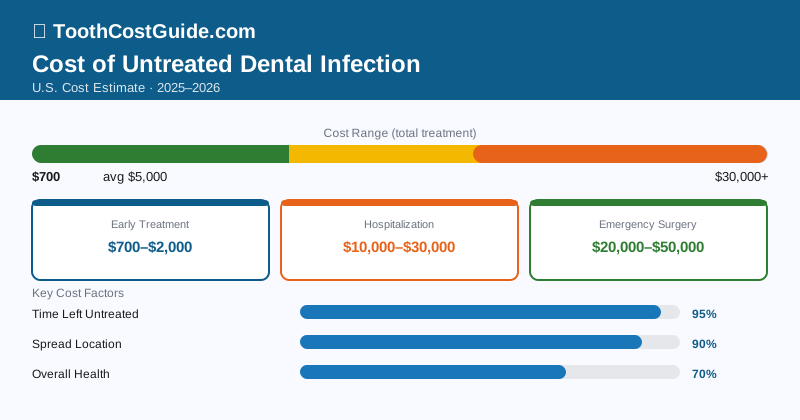
An untreated dental infection treated early costs $700–$2,500. The same infection allowed to spread to deep jaw spaces, the neck, or the airway can cost $15,000–$100,000+ in hospitalization — and can be fatal. Approximately 600 Americans die from dental infections each year, and virtually all of these deaths are preventable. This guide explains what happens when dental infections spread and the escalating costs at each stage.
| Stage of Spread | Treatment Required | Cost (No Insurance) |
|---|---|---|
| Stage 1: Localized abscess | Root canal or extraction | $700–$2,500 |
| Stage 2: Spreading to adjacent tissue | Root canal + antibiotics + I&D | $1,000–$3,500 |
| Stage 3: Cellulitis (soft tissue spread) | Hospital admission + IV antibiotics | $5,000–$20,000 |
| Stage 4: Deep space infection | Surgical drainage + ICU + IV antibiotics | $15,000–$50,000 |
| Stage 5: Ludwig’s angina / airway threat | ICU, tracheotomy, mechanical ventilation | $50,000–$200,000+ |
| Death / permanent injury | — | Incalculable |
How Dental Infections Spread
A dental infection begins at a single point — typically an infected tooth pulp (periapical abscess) or a deep periodontal pocket (periodontal abscess). If not treated, bacteria spread through several mechanisms:
Step 1 — Periapical abscess: Infection at the root tip of a dead or dying tooth. Bacteria multiply within the bone, creating an abscess. Symptoms: throbbing pain, temperature sensitivity.
Step 2 — Cortical bone perforation: The infection erodes through the cortical (outer) bone plate and enters soft tissue. Once bacteria exit bone, they can spread rapidly through fascial planes.
Step 3 — Fascial space spread: Soft tissue spaces in the face and neck communicate through connective tissue planes. Bacteria spread preferentially based on the tooth source: upper teeth infections can spread toward the eye or sinuses; lower teeth infections spread into the submandibular, sublingual, and parapharyngeal spaces.
Step 4 — Ludwig’s angina: When infection spreads to fill the floor of the mouth bilaterally (both submandibular spaces and the sublingual space simultaneously), the tongue is pushed upward and backward. This is a rapidly progressing, potentially fatal condition that can obstruct the airway within hours.
Step 5 — Systemic spread: Bacteria can enter the bloodstream (bacteremia) from a dental infection. In susceptible individuals, this can cause bacterial endocarditis (heart valve infection), brain abscess, or sepsis.
Stages of Treatment and Their Costs
Stage 1 — Early treatment ($700–$2,500): The ideal scenario. The dentist diagnoses the infection at the periapical abscess stage. Root canal therapy removes infected pulp and seals the canal ($700–$1,500), or extraction removes the infected tooth ($150–$600). Antibiotics ($10–$60) manage any spreading component. Recovery in days. Total cost: $700–$2,500 at a dental office.
Stage 2 — Spreading soft tissue involvement ($1,000–$3,500): The infection has moved beyond the tooth socket into adjacent soft tissue. Treatment still primarily dental but may require incision and drainage (I&D) of a fluctuant abscess ($150–$400) in addition to definitive dental care and antibiotics. May warrant ER evaluation to confirm the infection has not spread to fascial spaces. Total treatment: $1,000–$3,500.
Stage 3 — Cellulitis ($5,000–$20,000): Diffuse soft tissue infection without a defined abscess. The skin over the jaw or cheek is red, warm, tender, and indurated (firm). Patient typically has fever and elevated white blood cell count. Requires hospital admission for IV antibiotics (penicillin G, clindamycin, or ampicillin-sulbactam). If no defined abscess to drain, treatment is primarily IV antibiotics + close monitoring + definitive dental care. Hospital admission 2–5 days: $5,000–$15,000.
Stage 4 — Deep space infection ($15,000–$50,000): Infection in the submandibular, parapharyngeal, or retropharyngeal spaces. Requires surgical exploration and drainage under general anesthesia — the surgeon creates incisions in the neck to evacuate pus, places drains, and irrigates the spaces with antibiotic solution. ICU monitoring required. IV antibiotics for 7–14 days. Hospital stay 5–14 days. Total: $15,000–$50,000.
Stage 5 — Ludwig’s angina / airway emergency ($50,000–$200,000+): The most severe and feared complication. Bilateral floor-of-mouth infection causes tongue displacement, drooling, and progressive airway compromise. Emergency airway management (intubation or surgical airway/tracheotomy) is required. ICU admission with mechanical ventilation, surgical drainage under general anesthesia, IV antibiotics for weeks. Total care: $50,000–$200,000+.
Warning Signs of Spreading Infection
Seek immediate emergency room care if you have:
- Swelling extending below the chin or into the neck
- Difficulty opening your mouth (trismus — less than 2 fingers wide)
- Difficulty or pain when swallowing
- Muffled or “hot potato” voice quality
- Fever above 103°F
- Rapid heart rate (above 100 beats per minute) with fever
- Swelling around or below the eye
- Feeling of throat tightness or difficulty breathing
- Visible swelling that is rapidly increasing in size over hours
Symptoms that are concerning but allow a dentist visit today (not ER):
- Fever 100–102°F with localized jaw swelling
- Pain that is worsening despite antibiotics after 48 hours
- Swelling that is enlarging slowly over 24–48 hours without neck involvement
With vs. Without Insurance
Early treatment (Stage 1–2) costs by insurance status:
- With dental insurance (50–80% coverage): $150–$1,000 out of pocket
- With Medicaid (dental): $0–$200
- Without insurance: $700–$3,500; dental schools reduce to $400–$1,500
Advanced treatment (Stage 3–5) costs by insurance status:
- With comprehensive medical insurance (after deductible + OOP max): $3,000–$8,700 (typical OOP max)
- With Medicaid (medical): $0–minimal
- Without insurance: $15,000–$200,000; hospital charity care can reduce significantly
- Without insurance and ineligible for charity care: Payment plans, medical debt, or bankruptcy as outcomes
What To Do
- Don’t rationalize symptoms. Swelling that gets “a little bigger” each day is spreading. This requires escalating action, not hoping it resolves.
- Never rely on antibiotics as a permanent solution. Antibiotics manage spreading infection but cannot eliminate the source. The tooth must be treated.
- Monitor improvement on antibiotics. Within 48 hours of starting antibiotics, you should notice improvement in fever, swelling, and pain. If not improving or worsening — call your dentist or go to the ER.
- Know the ER warning signs above and act on them immediately.
- Schedule and keep your follow-up dental appointment. After emergency treatment, the underlying tooth requires definitive care within weeks.
How to Save Money (By Acting Early)
Early treatment is always cheaper than late treatment. A root canal + crown completed at Stage 1 for $2,000 is 25× less expensive than a Stage 4 hospitalization at $50,000. This is the most dramatic cost-differential in all of dental care.
If you can’t afford early dental treatment — use FQHCs, dental schools, and Medicaid (if eligible) to access treatment quickly. A $300 extraction at a community health center prevents a $30,000 hospital stay.
GoodRx for antibiotics during the bridge period. If you’re waiting a day or two for a dental appointment and have been prescribed antibiotics, use GoodRx to fill them for $4–$20.
Dental infection deaths are preventable but real. An estimated 600 Americans die annually from dental infections — almost all from delay in seeking care. If you have spreading swelling, fever, and difficulty swallowing or breathing, call 911 or go to the nearest emergency room immediately. The cost of care is irrelevant compared to the consequence of delay.
Bottom Line
An untreated dental infection that stays localized costs $700–$2,500. The same infection spreading to deep jaw spaces can cost $15,000–$200,000 or result in death. The cost difference between early and late treatment is staggering — and the difference is simply acting within days instead of weeks. Use dental schools and FQHCs if cost is a barrier, but never delay treatment until infection spreads.