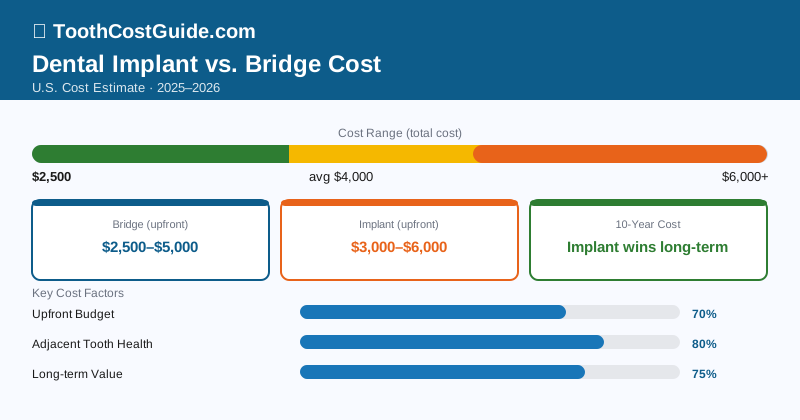
A dental implant costs $3,000–$6,000 all-in per tooth. A 3-unit dental bridge costs $2,500–$6,000 for all three units. Upfront, the bridge often appears cheaper. Over a 10-year horizon — accounting for bridge replacement, abutment tooth complications, and bone loss — the implant typically has comparable or lower total cost while delivering superior clinical outcomes.
This is one of the most consequential financial and clinical decisions in dentistry. Here’s the complete honest comparison.
| Factor | Dental Implant | 3-Unit Bridge |
|---|---|---|
| Upfront cost | $3,000–$6,000 | $2,500–$6,000 |
| Lifespan (typical) | 15–25+ years | 10–15 years |
| 10-year cost (no complications) | $3,000–$6,000 | $2,500–$6,000 |
| 10-year cost (with replacement) | $3,000–$6,000 | $5,000–$12,000 |
| Effect on adjacent teeth | None (independent) | Permanent crown prep required |
| Bone preservation | Yes — prevents resorption | No — bone loss continues |
| Flossing difficulty | Standard | Requires floss threader |
| Insurance coverage (major) | Often minimal | 50% (up to annual max) |
| Risk of complications | Low if placed correctly | Moderate over 15+ years |
The Upfront Cost Comparison
Single-tooth implant (all-in): $3,000–$6,000 covers the titanium implant post ($1,000–$2,000), the abutment connector ($300–$600), and the porcelain crown ($1,000–$1,800). Additional costs for bone grafting ($300–$3,000) and extraction ($150–$550) if needed.
3-unit bridge: $2,500–$6,000 covers three crowns fabricated as a connected unit — two anchor crowns placed over the adjacent teeth, and a pontic (fake tooth) suspended between them. Price varies by material (PFM vs. zirconia), lab quality, and geographic market.
At face value: The bridge typically costs $500–$2,000 less upfront for similar quality. This is the primary reason many patients historically chose bridges over implants. The complete picture requires looking beyond year one.
The biggest hidden cost of a bridge is what it does to the two adjacent teeth. To place a bridge, a dentist permanently grinds down two healthy or minimally restored neighboring teeth to accept crown caps. Those teeth are now permanently altered — they will always need crowns, will never return to natural enamel, and are statistically at higher risk for future root canals.
The 10-Year Total Cost Analysis
Bridge 10-Year Costs
Initial bridge placement (Year 1): $2,500–$6,000
Expected bridge lifespan: 10–15 years, with a study average around 12 years before failure or replacement.
Bridge failure modes and their costs:
- Decay under anchor crown (abutment tooth): Requires crown replacement + possible root canal ($700–$1,800 RCT + $800–$1,800 new crown) = $1,500–$3,600 per affected abutment tooth
- Porcelain fracture: $500–$1,000 repair or full bridge replacement at $2,500–$6,000
- Full bridge replacement at year 12: $2,500–$6,000
Bone loss under the pontic: Where the bridge spans the gap, the jawbone underneath has no tooth root to stimulate it. Bone resorbs at a rate of approximately 0.5–1mm per year. Over 10–15 years, significant bone loss occurs beneath the bridge pontic — which may complicate future implant placement if the bridge eventually fails.
Realistic 10-year total (bridge, moderate complications): $4,000–$10,000
Implant 10-Year Costs
Initial implant placement (Year 1): $3,000–$6,000
Expected implant lifespan: 15–25+ years for the implant post itself. The crown on top may need replacement at 15–20 years ($1,000–$1,800) — but the implant post remains in function.
Bone preservation: The titanium post stimulates the jawbone just like a natural tooth root, preventing the resorption that occurs under a bridge pontic. This has long-term value for facial structure and future implant stability.
Implant complications:
- Peri-implantitis (gum disease around implant): 5–20% of implants develop some peri-implantitis. Treatment: periodontal therapy around the implant ($300–$800)
- Crown replacement at 15–20 years: $1,000–$1,800 (just the crown, implant post stays)
- Implant failure rate: 5–10% over lifetime (requires removal and possibly re-implantation)
Realistic 10-year total (implant, typical): $3,000–$6,000 (same as initial cost — most implants need no additional treatment in first 10 years)
Clinical Outcomes Beyond Cost
Tooth structure: An implant is an independent replacement — no neighboring teeth are involved. A bridge requires permanently preparing and crowning the adjacent teeth, even if they were healthy. This is an irreversible alteration that statistically increases the risk of future root canals in those teeth.
Bone health: Implants prevent alveolar bone resorption because the titanium post functions as a tooth root, transmitting chewing forces into the bone. Bridges do not prevent bone loss under the pontic area. Over decades, this creates visible facial changes (sunken appearance) and complicates future implant placement if needed.
Hygiene: Brushing is identical for both. Flossing differs significantly: implants are flossed normally. Bridge pontics require a floss threader or water flosser to clean under the bridge — a more cumbersome process that many patients skip, leading to decay accumulation on the abutment teeth.
Function: Both implants and bridges restore chewing function effectively when well-placed. Patient satisfaction ratings are high for both.
When deciding between an implant and bridge, ask your dentist this specific question: “How are the adjacent teeth (abutment teeth)? Do they have any existing restorations, decay risk, or root canal history?” If those teeth are completely healthy and unrestored, permanently crowning them for a bridge represents a significant sacrifice of tooth structure. If they already have large fillings or crowns, the tradeoff is less.
Insurance Coverage: How Each Is Covered
Bridge: Covered under major restorative benefits at 50% after deductible, up to the annual maximum ($1,000–$2,000). Most patients receive $1,000–$2,500 in insurance contribution for a bridge.
Implant: Coverage is improving but inconsistent. Many traditional plans cover the crown portion at 50% (saving $500–$900). Some plans now cover implants under major restorative at 50%. Check your specific plan — call and ask about code D6010 (implant body) coverage specifically.
In practice: A bridge may generate more insurance benefit than an implant in a single year, but the bridge’s lower durability means those insurance benefits will be needed again in 10–15 years.
Who Should Choose an Implant vs. a Bridge?
Implant is usually the better choice when:
- The adjacent teeth are healthy and unrestored
- The patient is under 60 and has decades of use ahead
- Adequate bone is present (or can be grafted)
- The patient can invest the upfront cost difference
- Long-term thinking favors the lower lifetime cost
Bridge may be the better choice when:
- The adjacent teeth already need crowns (bridge utilizes those crowns)
- The patient has inadequate bone for implant placement and bone grafting isn’t feasible
- Health conditions (uncontrolled diabetes, active cancer treatment, radiation to jaw) contraindicate implant surgery
- The patient cannot afford the upfront implant cost and the bridge’s lower initial cost is necessary
- The patient needs the gap filled quickly (bridges can be placed in 2–3 weeks; implants take 3–6 months)
Financing Comparison
Implant financing: CareCredit 18–24 month promotional financing is widely available for the $3,000–$6,000 implant cost. HSA/FSA funds apply to both implants and bridges.
Bridge financing: Same options apply. Because bridge costs may be lower upfront, financing balances tend to be smaller.
Dental school option: Both procedures are available at dental schools at 40–60% savings. An implant at a dental school prosthodontics/oral surgery program: $1,500–$3,000. A bridge: $800–$2,000.
Bottom Line
Over 10 years, dental implants and bridges have comparable total costs — but implants deliver superior clinical outcomes: no damage to adjacent teeth, preserved jawbone, easier hygiene, and longer functional lifespan. The bridge’s lower upfront cost can be offset by replacement costs and complications in the second decade.
If your adjacent teeth are healthy and you can afford the upfront investment, an implant is clinically the better choice in the vast majority of cases. If adjacent teeth already need crowning, or cost is the decisive factor, a bridge is a legitimate and proven solution with a 10–15 year track record.
Always get a written treatment plan before agreeing to any dental work. For the implant vs. bridge decision, ask your dentist to evaluate the adjacent teeth, assess your bone volume with a CBCT scan if implant is being considered, and give you an honest 10-year prognosis for both options based on your specific clinical situation.