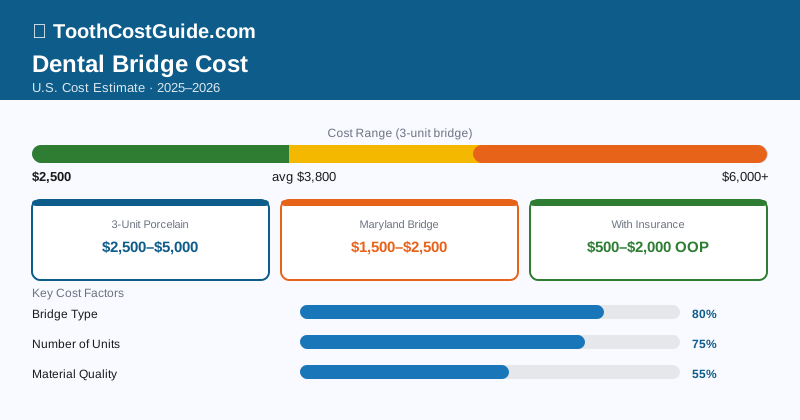
A 3-unit dental bridge costs $2,500–$6,000 without insurance. That price covers two anchor crowns placed on the teeth on either side of the gap, plus the artificial tooth (pontic) suspended between them — three units total. With dental insurance that covers major restorative care, patients typically pay $1,250–$3,000 out of pocket.
A dental bridge is one of the most common ways to replace a single missing tooth and has a proven track record. Understanding the full cost picture — including long-term maintenance — helps you compare it accurately to dental implants.
| Bridge Type | Cost Without Insurance |
|---|---|
| 3-unit porcelain-fused-to-metal (PFM) bridge | $2,500–$4,500 |
| 3-unit all-ceramic / zirconia bridge | $3,000–$6,000 |
| 4-unit bridge (2 pontics) | $4,000–$8,000 |
| Maryland (resin-bonded) bridge | $1,500–$2,500 |
| Implant-supported bridge (2 implants, 3 units) | $5,000–$10,000 |
| Each additional pontic unit | $800–$1,500 |
What Affects the Cost of a Dental Bridge
Number of units. The most direct cost factor. A 3-unit bridge (two crowns + one pontic) is standard for replacing a single missing tooth. A 4-unit bridge replaces two adjacent missing teeth. Each additional pontic adds $800–$1,500 to the lab fee.
Material choice. Porcelain-fused-to-metal (PFM) bridges are the most common and affordable. All-ceramic and zirconia bridges cost more but offer superior esthetics — important for visible front teeth. Zirconia is also more durable for back teeth under heavy chewing forces.
Location of the missing tooth. Front teeth require more aesthetic precision — carefully matched shading, shape, and translucency — which increases lab costs. Back teeth endure heavier bite forces, requiring stronger materials.
Condition of the abutment teeth. The teeth on either side of the gap must be crowned to anchor the bridge. If these teeth already have large fillings or are structurally compromised, a core buildup ($150–$300 per tooth) may be needed before crown preparation. If either abutment tooth also needs a root canal, that adds another $700–$1,800.
A dental bridge requires permanently crowning two healthy adjacent teeth — grinding them down to accept crown caps — even if those teeth are cavity-free. This is an irreversible alteration. Factor the long-term consequences to those abutment teeth when comparing a bridge to an implant.
Cost by Bridge Type
Traditional 3-unit PFM bridge ($2,500–$4,500): The most commonly placed bridge type in the U.S. A metal substructure provides strength; porcelain fused over it provides appearance. The metal alloy margin can show as a dark line at the gumline over decades. Durable and well-studied. Average lifespan: 10–15 years.
All-ceramic / zirconia 3-unit bridge ($3,000–$6,000): No metal. Better esthetics, no gray margin at the gumline. Zirconia bridges are now strong enough for most positions, including back teeth. Increasingly the preferred material. Average lifespan: 10–20 years with proper care.
Maryland (resin-bonded) bridge ($1,500–$2,500): A conservative option for replacing a front tooth. Instead of crowning the adjacent teeth, the pontic is bonded to wings attached to the backs of the neighbor teeth. No tooth reduction required. Drawback: less durable and more prone to debonding over time. Best for front teeth, good candidates who want a conservative approach.
Implant-supported bridge ($5,000–$10,000): Two implants placed on either side of a gap support a 3-unit bridge — without crowning natural teeth. More expensive upfront, but preserves adjacent tooth structure. Potentially the best long-term investment for a two-tooth gap.
With vs. Without Dental Insurance
Dental insurance categorizes bridges as “major restorative” — typically covered at 50% after deductible.
Example for a $3,500 zirconia 3-unit bridge:
- Annual deductible: $100 (assumed unmet)
- Insurance pays 50% of $3,400 = $1,700
- Patient out-of-pocket: $1,900
Annual maximum limitation: A bridge at $3,000–$4,500 can consume your entire annual dental benefit of $1,000–$2,000 instantly. Patients whose plan maximum is $1,500 will find that insurance pays $1,500 and they pay $2,000+ regardless of the 50% coverage rate.
Waiting periods: Most dental plans with major coverage have a 12-month waiting period. If you lost a tooth recently and just signed up for insurance, you likely can’t use major benefits for a bridge for 12 months. Plan accordingly.
Replacement frequency: Insurance typically won’t cover a replacement bridge until 5–10 years after the original placement (frequency limitations vary by plan). If your bridge fails at 7 years and your plan’s limit is 10, you’ll pay out of pocket for the new one.
How to Save Money on a Dental Bridge
Dental schools with prosthodontics programs. Dental bridges placed by supervised students or prosthodontic residents at dental school clinics cost $800–$2,000 for a 3-unit bridge — 50–65% less than private practice. The timeline is longer (multiple appointments spread over several weeks), but faculty supervise every step of crown preparation, impression, and placement.
Consider a Maryland bridge for front teeth. If you’re replacing a front tooth and the adjacent teeth are healthy and unrestored, a Maryland bridge at $1,500–$2,500 avoids permanently altering those teeth and costs significantly less than a traditional bridge.
Time treatment across insurance years. If your annual maximum is $1,500 and the bridge costs $3,500, the work must be split — crown preparation in November, bridge delivery in January — to claim benefits across two plan years. Many dentists accommodate this timeline.
Compare lab fees. Some dental offices use offshore dental labs to reduce crown costs. Ask whether your bridge will be fabricated domestically (typically better quality control) or internationally. Domestic all-ceramic labs often produce better shade matching and fit.
Before committing to a bridge, get the genuine long-term cost picture from your dentist: What is the expected lifespan? What happens if the bridge fails at 12 years — can it be recemented or does it require full replacement? What happens to the abutment teeth at end of bridge life? This honest accounting sometimes shifts the math in favor of an implant.
Financing Options
At $2,500–$6,000, dental bridges represent a major expense for most patients. Financing options are widely available.
CareCredit: Most dental offices accept CareCredit for major restorative work. For amounts over $2,500, 18–24 month 0% promotional periods are commonly available. Pay the full balance before the promotional period or retroactive interest applies at 26–29% APR.
Sunbit / Proceed Finance: True installment loan alternatives to CareCredit. Fixed monthly payments, transparent interest rates. Better structure for patients who are unlikely to pay off the full balance within a short promo period.
HSA/FSA: Dental bridges are fully eligible. Using pre-tax funds provides a genuine 22–37% reduction in real cost depending on tax bracket.
Dental schools: The most significant real cost reduction. No interest, no terms — just a dramatically lower starting price.
Bottom Line
A 3-unit dental bridge costs $2,500–$6,000 without insurance, with insurance reducing patient share to roughly $1,250–$3,000 depending on plan maximums. Bridges are a proven, effective way to replace a missing tooth and typically last 10–15 years.
The most important decision: compare a bridge to a dental implant honestly. An implant costs more upfront ($3,000–$6,000 all-in) but preserves adjacent teeth, lasts decades longer, and maintains jawbone. Over a 20-year horizon, a bridge (which will need replacement) and an implant have comparable total costs — but the implant preserves more tooth structure.
Always get a written treatment plan before agreeing to any dental work. For a bridge, ask for the full breakdown — crown preparation fees, lab fabrication, temporary bridge, and cementation — plus whether any buildup or root canal work on the abutment teeth might be needed.