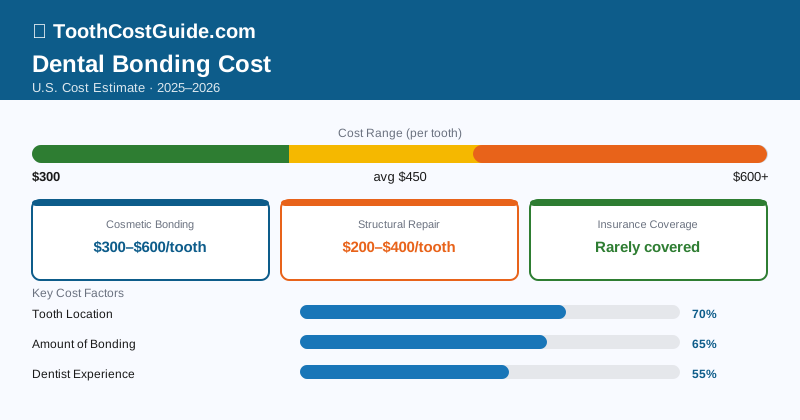
Dental bonding costs $300–$600 per tooth without insurance. It’s the most budget-friendly cosmetic dental option, requiring no lab work and typically completed in a single 30–60 minute appointment. For chips, gaps, minor discoloration, and small shape corrections, bonding delivers impressive results without the commitment or cost of porcelain veneers.
| Bonding Application | Cost Per Tooth |
|---|---|
| Cosmetic bonding (chips, gaps, shape) | $300–$600 |
| Bonding over tooth-colored filling | $100–$300 |
| Composite resin veneer (extensive bonding) | $250–$600 |
| Tooth reshaping + bonding | $300–$600 |
| Diastema (gap) closure – 2 front teeth | $600–$1,200 total |
| Emergency chip repair (same day) | $100–$400 |
What Affects the Cost of Dental Bonding
Extent of work on each tooth. Repairing a small chip on the corner of an incisor might take 20 minutes; reshaping and lengthening a tooth with worn edges to match adjacent teeth takes 45–60 minutes. Dentists may charge by procedure code or by the hour — the more extensive the bonding, the higher the cost.
Purpose: cosmetic vs. restorative. Bonding done for purely cosmetic reasons (closing a gap between front teeth, changing the shape of healthy teeth) is considered elective and typically not covered by insurance. Bonding used to restore a fractured or decayed tooth is a restorative filling — treated differently by insurance and often covered at 70–80%.
Number of teeth treated. Most bonding cases treat 1–4 teeth. A single chipped tooth might cost $300–$400. Closing a noticeable gap between the two front teeth requires bonding both teeth simultaneously for a balanced result — approximately $600–$1,200 total.
Dentist’s experience with cosmetic bonding. Composite resin bonding is highly technique-dependent. A skilled cosmetic dentist who does bonding daily can achieve remarkably natural results in 30 minutes. A general dentist without a cosmetic focus may produce competent but less refined results. Fee differences between a cosmetic-focused practice and a basic general dentist may be $100–$200 per tooth.
Dental bonding is the only cosmetic dental procedure that can be completely reversed — no tooth enamel is removed in most cases. This makes it an ideal “try it first” option before committing to permanent porcelain veneers at 5x the cost.
What Dental Bonding Can and Can’t Fix
Bonding works well for:
- Chipped or fractured front teeth
- Closing small gaps (diastema) between front teeth
- Covering minor stains or discoloration on individual teeth
- Making teeth appear slightly longer or more even
- Covering exposed root surfaces from gum recession
- Minor tooth reshaping
Bonding is less ideal for:
- Severe discoloration or staining across all teeth (professional whitening or veneers work better)
- Large structural damage or decay (crown or onlay needed)
- Teeth that bear heavy biting forces (molars) — composite chips more easily under load
- Patients who clench or grind (bruxism) — bonding deteriorates quickly
- Very dark teeth requiring significant color masking — porcelain veneers block underlying color more effectively
Lifespan: Composite bonding lasts 3–10 years depending on location, bite habits, and care. Front teeth used for biting or patients who drink coffee, tea, and wine heavily will see staining and wear faster. Bonding on teeth not in direct bite contact can last much longer. Touch-ups and polishing can extend the life.
With vs. Without Dental Insurance
Whether bonding is covered depends entirely on why it’s being done.
Restorative bonding (composite filling): When bonding is used to repair decay or a fractured tooth, it’s billed as a composite filling and typically covered at 70–80% by dental insurance under basic restorative benefits. Your cost: $20–$60 per tooth after insurance.
Cosmetic bonding: Pure cosmetic procedures (gap closure, shape enhancement, elective color change) are explicitly excluded from most dental insurance plans. These are 100% out-of-pocket.
The gray zone: Some procedures sit between cosmetic and restorative — such as bonding over worn edges from acid erosion or bruxism. Documentation of functional concern sometimes supports an insurance claim. Ask your dentist whether the clinical reason qualifies for any coverage.
FSA/HSA: Cosmetic bonding is not eligible for FSA or HSA reimbursement. Restorative bonding (filling) is eligible.
How to Save Money on Dental Bonding
Choose bonding over veneers for minor issues. For a small chip or slight gap, composite bonding at $300–$600 provides a result that’s nearly indistinguishable from a porcelain veneer to most observers, at one-quarter the cost.
Get multiple teeth done in the same appointment. Dentists often give a modest discount for treating multiple teeth in a single session since the setup time (shade matching, isolation, polishing) is shared. If you want 3–4 front teeth bonded, having them done at once may save $50–$100 per tooth versus separate appointments.
Dental schools with cosmetic programs. Dental schools that teach cosmetic dentistry offer bonding procedures at dramatically reduced rates. Advanced aesthetics students (supervised by faculty) may perform bonding for $75–$200 per tooth. Quality varies but is closely supervised.
Maintain bonding carefully. Avoid biting fingernails, chewing ice, or using your bonded teeth to open packages. Reduce coffee and tea intake or rinse afterward to slow staining. These habits extend bonding life by years — delaying the need for replacement.
If you’re considering both teeth whitening and bonding, always whiten first and let the shade stabilize for 2 weeks before bonding. Composite resin cannot be lightened after placement, but it can be shade-matched to freshly whitened enamel. Bonding done before whitening will no longer match your teeth after bleaching.
Financing Options
At $300–$600 per tooth, dental bonding is one of the few cosmetic dental procedures accessible without financing for most patients. However, multi-tooth cases or unexpected same-day chip repairs may warrant these options:
CareCredit: Available at most dental offices for charges over $200. Useful for spreading a $600–$1,500 multi-tooth bonding case over 6–12 months at 0% interest. Make sure to pay off the full balance before the promotional period ends.
Same-day payment arrangements: For emergency chip repairs, some offices allow payment the following month if you’re an established patient. Simply ask — there’s no harm in requesting.
Dental discount plans: For uninsured patients planning elective bonding, a $99/year dental discount plan reduces bonding fees by 15–25% at participating dentists. On a $1,200 multi-tooth bonding case, that’s $180–$300 in savings.
Bottom Line
Dental bonding costs $300–$600 per tooth — making it the most accessible cosmetic dental procedure available. A single chipped tooth can be repaired in one appointment for under $400. Closing a gap between two front teeth runs $600–$1,200 for both teeth combined. With no anesthesia needed for most cases, no lab delays, and no permanent tooth reduction in most applications, bonding is an ideal starting point for anyone considering cosmetic dental treatment.
The main limitation is longevity (3–10 years vs. 10–20 for porcelain) and staining tendency. For lasting cosmetic transformation, porcelain veneers remain superior — but bonding delivers impressive results at a fraction of the cost.
Always get a written treatment plan before agreeing to any dental work. For dental bonding, ask whether the procedure is classified as cosmetic or restorative (affecting insurance coverage), how long the result is expected to last for your specific situation, and what signs indicate the bonding needs replacement.