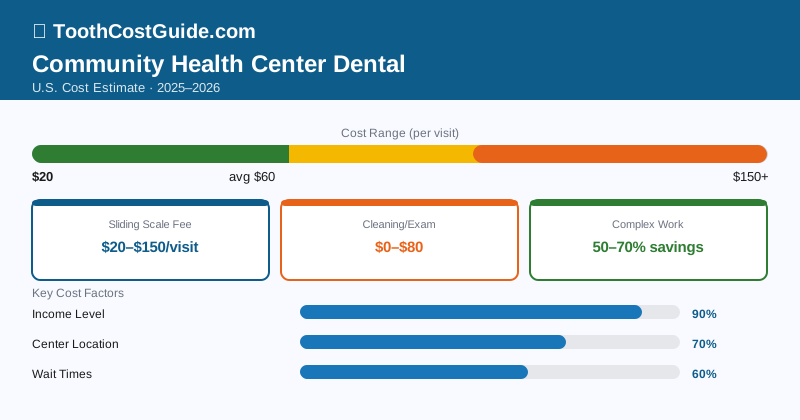
Federally Qualified Health Centers (FQHCs) are the best-kept secret in affordable dental care — over 1,400 organizations with 14,000+ service sites provide dental care on a sliding-fee scale, and patients at or below the federal poverty level often pay $0–$20 for procedures that cost $200–$1,500 elsewhere. With 30 million patients served annually, FQHCs are the nation’s largest safety-net dental care system.
| Procedure | Private Office Cost | FQHC (at 100% FPL) | FQHC (at 200% FPL) | Savings |
|---|---|---|---|---|
| Dental exam + X-rays | $150–$250 | $0–$10 | $15–$50 | 80–100% |
| Adult teeth cleaning | $100–$200 | $0–$10 | $15–$45 | 80–100% |
| Composite filling | $150–$300 | $0–$20 | $25–$75 | 75–100% |
| Tooth extraction (simple) | $150–$350 | $0–$25 | $30–$80 | 75–100% |
| Root canal (molar) | $800–$1,500 | $0–$75 | $80–$200 | 85–100% |
| Full dentures | $1,500–$3,500 | $50–$200 | $200–$600 | 80–95% |
| Pediatric cleaning + exam | $100–$200 | $0–$5 | $10–$30 | 85–100% |
How It Works
FQHCs are health centers that receive federal grants under Section 330 of the Public Health Service Act. In exchange for this funding, they must:
- Be located in a medically underserved area or serve a medically underserved population
- Offer care to all patients regardless of ability to pay
- Use a sliding-fee discount program based on income and family size
- Offer comprehensive primary care services (and most offer dental)
- Operate under the governance of a patient-majority board
Sliding-fee discount program: FQHCs use the federal poverty level (FPL) as their benchmark. Patients are assigned to a fee tier based on income and family size:
- At or below 100% FPL: Nominal fee ($0–$20 per visit maximum)
- 101–200% FPL: Sliding scale, typically 10–40% of full charge
- Above 200% FPL: Full fee (but still accepted, and still often lower than private dentist)
Dental services offered: Not all FQHCs offer dental, but most do. Services typically include preventive care, restorative care (fillings), extractions, dentures, and sometimes root canals and crowns. Specialty care (orthodontics, implants) is less common but some larger FQHCs offer it.
Costs & Savings Details
Real-world FQHC fee examples (2025):
For a family of four at 138% FPL (income ~$43,000/year — Medicaid expansion limit):
- Two adult cleanings per year: $0–$40 total
- Two child cleanings per year: $0–$20 total
- A crown: $30–$150 vs. $1,200–$1,800 at a private dentist
- Annual dental care for the family: $30–$200 vs. $600–$1,200+ private
For a single adult at 175% FPL (income ~$27,400/year):
- Exam, X-rays, and cleaning: $15–$60 vs. $250–$450
- Root canal: $80–$200 vs. $800–$1,500
These are not estimates — they are based on HHS guidelines for sliding-fee scale minimums that FQHCs receiving federal grants must honor.
Accepting insurance: FQHCs also accept Medicaid, CHIP, Medicare, and private insurance. If you have Medicaid, your copays at an FQHC are typically $0–$3. FQHCs serve both insured and uninsured patients.
Eligibility / Who Qualifies
FQHCs serve everyone — there is no income cutoff for access. However, the sliding-fee discount applies only to uninsured patients (or in some cases, underinsured patients with documented hardship).
For sliding-fee discounts, bring:
- Proof of income: last 2 pay stubs, most recent tax return, unemployment letter, or self-attestation form (for those with no income)
- Proof of household size: statement of who lives with you
- ID: photo ID preferred but not required at all centers
Patients with insurance pay their normal copays/deductibles. FQHCs accept Medicaid in all states.
Patients without income or documentation: Many FQHCs allow self-attestation of income. If you have no documentation, say so — most centers will still enroll you in the lowest fee tier on your word.
Pros and Cons
Pros
- Available in every state and DC (14,000+ sites)
- Accepts everyone — no insurance required
- Sliding-fee scale makes care genuinely affordable for low-income patients
- Accepts Medicaid, CHIP, Medicare
- Year-round access — not dependent on sporadic clinic events
- Stable, ongoing patient-provider relationships
Cons
- Not all FQHCs offer dental services — call ahead to confirm
- Appointments can be difficult to get quickly; some have waiting periods of 2–6 weeks
- Specialty services (implants, orthodontics) are usually not available
- Quality varies by center — some have newer equipment and experienced dentists, others are more basic
- May require multiple visits to complete complex treatment
Not every community health center listed online offers dental services. Always call ahead and specifically ask: “Do you offer dental care? Are you currently accepting new dental patients? Do you have a sliding-fee program for uninsured patients?” Getting a clear answer before driving to the center saves wasted trips.
Step-by-Step Guide
Find FQHCs near you: Visit findahealthcenter.hrsa.gov. Enter your address and select “Dental Care” under services. A map shows qualifying centers within your chosen radius.
Call ahead to confirm dental services: Phone the health center and ask: (1) Do you have dental services? (2) Are you accepting new dental patients? (3) Do you have a sliding-fee discount program? (4) What documents do I need to bring for the sliding-fee application?
Gather income documentation: Prepare your last 2 pay stubs (or a recent tax return, or benefit letter). If you have no income, write a simple self-attestation letter or ask the center if they have a self-attestation form.
Schedule your appointment: Some FQHCs have same-week availability; others have 2–4 week waits. Ask to be put on a cancellation list if you need care sooner.
Bring required documents: Photo ID, income documentation, proof of household size (if requested), and any insurance cards (Medicaid, CHIP, Medicare, private). If you’re uninsured, bring income documents for the sliding-fee application.
Complete the sliding-fee enrollment: When you arrive, you’ll typically complete a short application. A staff member reviews your income documentation and assigns you to a fee tier. This process takes 10–15 minutes.
Establish care and schedule follow-ups: FQHCs work best as your ongoing dental home. Establish yourself as a patient and schedule regular cleanings — the sliding-scale fees make preventive care essentially free for low-income patients, preventing expensive emergency treatment later.
Look beyond the nearest FQHC. Some centers are better-staffed and have more dental services than others. If the closest FQHC has a long dental waitlist, check the next few on the list. The HRSA locator shows all qualifying centers — sometimes one 10 miles further has much shorter waits and broader dental services.
Bottom Line
FQHCs are the most accessible, reliable source of affordable dental care in the United States. With 14,000+ sites in all 50 states and a legally required sliding-fee program that can bring costs to zero for the lowest-income patients, they represent a genuine solution to the dental affordability crisis for millions of Americans. The key steps are simple: find the nearest FQHC with dental services at findahealthcenter.hrsa.gov, call to confirm availability, and bring income documentation for the sliding-fee application.