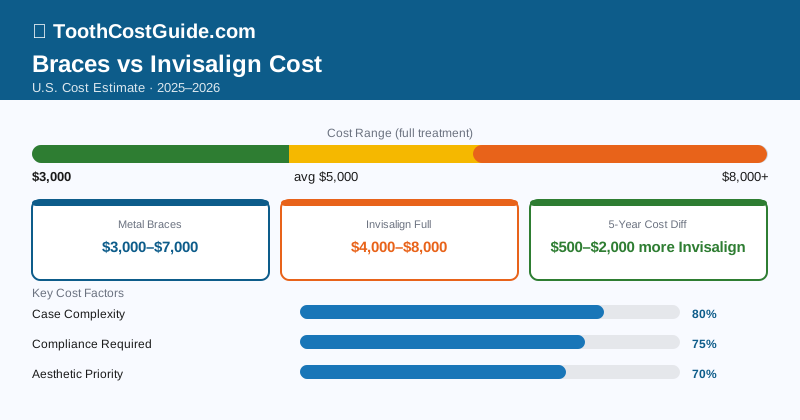
Traditional braces cost $3,000–$7,500 and Invisalign costs $3,000–$8,000 — making them largely comparable in price for most cases. The real difference isn’t cost; it’s effectiveness for specific case types, lifestyle fit, and compliance requirements. Braces are fixed and can’t be removed; Invisalign aligners are removable but require 20–22 hours of wear per day. For complex bite correction, braces remain the gold standard. For mild-to-moderate cosmetic crowding in motivated adults, Invisalign produces comparable results.
| Treatment Option | Cost Without Insurance |
|---|---|
| Traditional metal braces | $3,000–$7,500 |
| Ceramic braces | $4,000–$8,000 |
| Self-ligating braces (Damon) | $3,500–$8,000 |
| Invisalign Comprehensive | $3,000–$8,000 |
| Invisalign Lite (mild cases, 14 trays) | $2,500–$4,500 |
| Invisalign Express (7 trays) | $1,800–$3,500 |
| Lingual braces | $8,000–$13,000 |
What Affects the Cost of Each Option
Braces cost factors:
- Metal braces are the least expensive fixed option
- Ceramic adds $500–$1,500 for aesthetics
- Lingual adds $4,000–$6,000 for complete concealment
- Orthodontist fees include all adjustments, which occur every 6–8 weeks
- Treatment duration: 12–36 months depending on complexity
Invisalign cost factors:
- Number of aligners in the treatment plan (correlated with complexity)
- Invisalign Comprehensive vs. Lite vs. Express programs
- Provider tier — Diamond and Platinum providers may offer slight discounts due to higher volume
- Refinements: Some providers include unlimited refinements; others charge $500–$1,500 per set
- Retainers: Often not included in the Invisalign fee ($100–$600 extra)
Effectiveness: What Each Treats Best
This is the most important factor in the decision — and cost is secondary to getting the right treatment for your specific case.
Braces are superior for:
- Severe crowding (more than 6mm per arch)
- Significant bite correction (severe overbite, underbite, open bite)
- Tooth rotation greater than 20°
- Large vertical tooth movements
- Cases requiring precise molar control
- Complex multi-tooth movements
- Patients who can’t comply with 22 hours/day of aligner wear
Invisalign is equivalent or superior for:
- Mild-to-moderate crowding (1–6mm per arch)
- Mild spacing
- Mild-to-moderate overbite
- Mild crossbite
- Adults and teens who prioritize aesthetics
- Patients who play wind instruments or contact sports
- Patients with excellent compliance
The braces vs. Invisalign decision should be driven by case complexity first, lifestyle second, and cost third. Many mild-to-moderate cases are equally well treated by either option. Your orthodontist’s recommendation based on your specific case — not cost or aesthetics — should be the primary driver.
Side-by-Side Comparison
| Category | Metal Braces | Ceramic Braces | Invisalign |
|---|---|---|---|
| Average cost | $3,000–$7,500 | $4,000–$8,000 | $3,000–$8,000 |
| Visibility | High | Low | Very low |
| Removable | No | No | Yes |
| Complex case capability | Excellent | Excellent | Good (mild-moderate) |
| Compliance requirement | Built-in | Built-in | 20–22 hrs/day |
| Dietary restrictions | Yes | Yes | None |
| Oral hygiene difficulty | Moderate | Moderate | Easy |
| Staining risk | No | Moderate | Low (trays replaced) |
| Emergency repairs | Broken brackets/wires | Broken brackets | Lost/chewed aligner |
| Insurance coverage | Yes | Yes | Yes (same terms) |
| Average treatment time | 18–24 months | 18–24 months | 12–20 months (moderate) |
Insurance Coverage: Equal for Both
Most dental insurance plans with orthodontic benefits cover braces and Invisalign under identical terms:
- Lifetime maximum: $1,000–$3,000
- Coverage: 50% up to the lifetime maximum
- Age limits: Usually under 18–19 for children’s coverage; adult coverage varies by plan
The insurance benefit does not discriminate between appliance types. A $1,500 lifetime maximum applies the same whether you choose metal braces or Invisalign.
A common misconception is that Invisalign is not covered by dental insurance. Most plans that cover braces also cover Invisalign, since the clinical outcome (properly aligned teeth) is equivalent. Always verify with your specific plan — but don’t assume Invisalign is excluded simply because it’s “newer” technology.
Total Cost of Ownership
The listed treatment fee doesn’t capture the full financial picture.
Hidden costs of braces:
- Broken bracket/wire repair: $25–$100 per incident (may or may not be included)
- Orthodontic wax, emergency appointments for soreness: Typically included
- Retainers after treatment: Often included, sometimes $250–$600 extra
- Dietary restrictions may require cooking adjustments
- Longer oral hygiene routines (flossing with braces: 15–20 minutes per session vs. 3–5 minutes)
Hidden costs of Invisalign:
- Lost or damaged aligners: $50–$150 each if not covered by a guarantee
- Retainers after treatment: $100–$600 (rarely included)
- Refinements beyond the initial plan: $500–$1,500 (varies by provider)
- Teeth whitening foam may be included (small value add)
- Compliance failure: If worn fewer than 22 hours/day, treatment fails — potentially requiring restart
Financing Options
Both braces and Invisalign are financed through the same channels:
In-office payment plans: 0% interest spread over treatment period. Most orthodontic offices offer identical terms for both appliance types.
CareCredit: Available for both at participating providers. Promotional 0% APR for 12–24 months.
FSA/HSA: Both are fully eligible expenses. Use pre-tax dollars for installment payments.
Dental school programs: Both braces and Invisalign are available at orthodontic residency programs at 30–50% below private practice fees.
How to Decide: Questions to Ask Your Orthodontist
- Is my case complexity suitable for Invisalign or does it require fixed braces?
- Would the treatment timeline differ between the two for my specific case?
- What’s the total fee for each option including retainers and any potential refinements?
- Does my insurance cover both equally?
- What happens to my treatment timeline if I miss a week of aligner wear?
- Are refinements included in your Invisalign fee?
Bottom Line
Braces and Invisalign cost roughly the same for comparable case complexity. The decision should hinge on your specific orthodontic needs, not price. For complex cases, braces remain the gold standard and the effective choice. For mild-to-moderate cases in motivated adults and teens, Invisalign offers comparable results with significantly better aesthetics and convenience. Get at least two consultations — and ask both providers which option they honestly recommend for your specific case, not which one they prefer to place.
At equivalent prices, the right choice between braces and Invisalign depends on case complexity and compliance. Complex cases need braces. Mild-to-moderate cases in motivated patients work equally well with either. If your orthodontist gives you a genuine choice, lifestyle factors — aesthetics, dietary preferences, sports, instrument playing — should guide your decision.