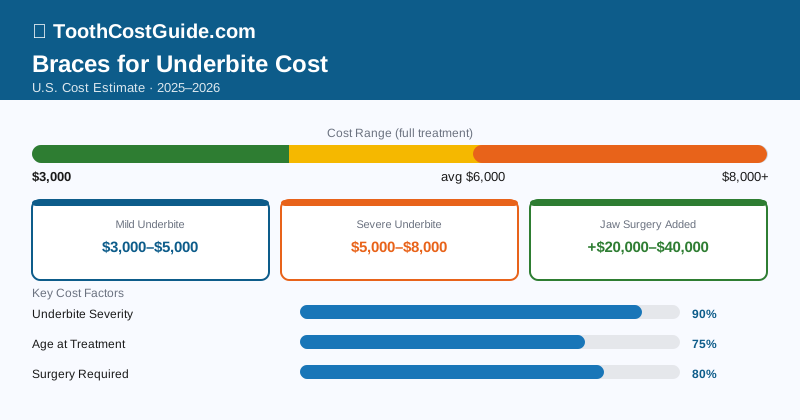
Correcting an underbite with braces costs $3,000–$8,000+ depending on the severity of the jaw discrepancy and the patient’s age. Underbites — where the lower jaw protrudes beyond the upper jaw — are among the more challenging orthodontic conditions because they frequently have a skeletal component that tooth movement alone cannot fully correct. For children still growing, appliances like facemasks and chin cups can modify jaw development. Adults with significant skeletal underbites typically require jaw surgery costing $20,000–$40,000 in addition to orthodontic treatment.
| Underbite Treatment Option | Cost Without Insurance |
|---|---|
| Braces for mild dental underbite | $3,000–$7,500 |
| Reverse-pull headgear (facemask) | $1,500–$3,500 (Phase 1) |
| Braces + Class III elastics | $3,500–$7,500 |
| Invisalign for mild underbite | $3,000–$8,000 |
| Combined braces + jaw surgery | $25,000–$50,000 total |
| Orthognathic surgery alone | $20,000–$40,000 |
What Makes Underbite Treatment Expensive
Skeletal vs. dental underbite. A dental underbite means the lower front teeth sit in front of the upper front teeth due to tooth angulation, not jaw position. This can often be corrected with braces alone. A skeletal underbite means the lower jaw (mandible) is genuinely too long or the upper jaw (maxilla) is underdeveloped — and braces can only partially compensate, not fully correct, this discrepancy. The majority of significant underbites have a skeletal component.
Adult vs. child treatment. This distinction is more dramatic for underbites than for almost any other orthodontic condition. Growing children can have upper jaw growth stimulated or lower jaw growth redirected through appliances like reverse-pull facemasks and chin cups. Adults with completed growth cannot be redirected — they must either accept compromised tooth compensation or proceed with jaw surgery.
Genetic predisposition. Underbites (Class III malocclusion) have a strong hereditary component, particularly in patients of East Asian descent. Monitoring children with family history of underbite from an early age is important.
Treatment Options by Age Group
Children ages 7–10 (early interceptive treatment — $1,500–$3,500): Reverse-pull facemask (protraction headgear): A headgear device worn at home 12–14 hours per day. Hooks attach to a facemask frame in front of the face and pull the upper jaw forward while restraining the lower jaw. Most effective between ages 7–10 when facial bones are most responsive. Can normalize the jaw relationship so that comprehensive braces achieve full correction later.
Chin cup: Worn over the chin to restrain lower jaw growth. Less commonly used in the US; more prevalent in Asian orthodontic practice. Limited evidence of long-term skeletal change.
Teenagers ages 11–16 (comprehensive braces — $3,000–$7,500): After Phase 1 treatment (if any), comprehensive braces correct tooth positions. Class III rubber bands (elastics) run in a triangular pattern to pull the lower teeth back and the upper teeth forward. Effective for dental compensation but limited for skeletal correction. For teens with growth remaining, some additional skeletal modification may still be possible.
Adults with moderate skeletal underbite (comprehensive braces — $3,500–$7,500): Braces can camouflage a moderate underbite through tooth movement — retroclining lower teeth and procliing upper teeth — creating acceptable functional occlusion even when the jaw relationship isn’t perfectly corrected. Results are functional but may not fully satisfy aesthetic expectations in severe cases.
Adults with severe skeletal underbite (combined orthodontic-surgical — $25,000–$50,000): For significant jaw discrepancy that tooth movement can’t adequately camouflage, orthognathic surgery is the definitive treatment:
- Pre-surgical orthodontics (12–18 months): Braces align teeth to their final position within each arch, removing the dental compensation that masked the skeletal problem
- Surgery: Jaw repositioning (mandibular setback, maxillary advancement, or both)
- Post-surgical orthodontics (6–12 months): Fine-tuning after the jaw is in its new position
Underbites treated early in growing children can often avoid the need for jaw surgery. The window for effective facemask/interceptive treatment is ages 7–10. After this window closes and jaw growth is complete, significant skeletal underbites require surgery for full correction. Early intervention can save $15,000–$30,000 in surgical costs.
Insurance Coverage for Underbite Treatment
Braces and appliances: Covered under dental insurance orthodontic benefits on standard terms — 50% up to the lifetime maximum ($1,000–$3,000), typically for patients under 18–19. Phase 1 interceptive treatment (reverse-pull facemask) is covered under orthodontic benefits at most plans.
Jaw surgery: Covered by medical insurance when documented as medically necessary. Requires prior authorization. The surgical component typically involves:
- Medical insurance covers surgery at 50–80% after deductible and out-of-pocket max
- Anesthesia billed separately to medical insurance
- Hospital facility fees covered under medical inpatient or outpatient benefits
- The orthodontic component (braces) is billed separately to dental insurance
Documentation for surgery approval: Medical insurance requires documentation of functional impairment — difficulty chewing, speech problems, sleep apnea, jaw pain, or skeletal deformity. “Cosmetic improvement” alone is insufficient for coverage. Your oral surgeon and orthodontist will need to write thorough clinical letters supporting medical necessity.
Get prior authorization in writing from both medical AND dental insurance before starting combined surgical orthodontic treatment. Once you begin pre-surgical orthodontics, you’re committed to a 2–3 year process. Discovering mid-treatment that the surgery is not covered by medical insurance creates a devastating financial surprise. Pre-authorization letters from both insurers should be in hand before the first bracket goes on.
Financing Options
In-office orthodontic plans: Standard 0% installment plans for the braces component. For combined surgical cases, the braces and surgery are typically financed separately through different providers.
Medical financing for surgery: The surgical component can be financed through CareCredit, medical loans, or hospital financing programs. Amounts $10,000–$40,000 may require longer repayment terms.
FSA/HSA: Both the dental and medical components of combined underbite treatment are FSA/HSA eligible. Maximizing contributions from both the dental and medical FSA (if both are available) helps manage the total out-of-pocket cost.
Patient assistance at academic medical centers: Combined underbite treatment at an academic medical center with both orthodontic and oral surgery residency programs is substantially less expensive. Cases are more complex to schedule but are managed by supervised specialists.
How to Save on Underbite Treatment
Start treatment in childhood. The single biggest cost-saving strategy for families with a child showing underbite tendencies. The age-7 orthodontic evaluation exists precisely to catch this. A $2,500 facemask Phase 1 treatment at age 8 may prevent a $30,000 surgical procedure at age 21.
Choose in-network surgical providers. For adults requiring jaw surgery, choosing an in-network oral and maxillofacial surgeon with your medical insurance can save $5,000–$15,000 versus out-of-network care.
Academic medical centers. Combined orthodontic-surgical cases at university hospitals or dental school academic medical centers can reduce total costs by 30–50%.
Consider camouflage for moderate cases. For adults with moderate (not severe) skeletal underbites, comprehensive braces at $3,500–$7,500 may achieve acceptable functional and aesthetic results through dental compensation, avoiding surgery entirely. Discuss this option honestly with your orthodontist and get a second opinion.
Bottom Line
Underbite correction ranges from $1,500–$3,500 for early childhood intervention to $25,000–$50,000 for adult cases requiring jaw surgery. The enormous cost difference between early and late treatment makes childhood evaluation critical. Insurance covers braces under standard dental orthodontic benefits and covers jaw surgery under medical benefits when medically documented. For the highest-cost cases, academic medical centers provide the most affordable access to qualified combined orthodontic and surgical care.
Underbite correction has the steepest cost penalty for delayed treatment of any orthodontic condition. Children with apparent underbites should see an orthodontist by age 7. Early interceptive treatment with a reverse-pull facemask costs $1,500–$3,500 and can potentially eliminate the need for jaw surgery, saving $20,000 or more.